Java Full Stack Developer Course Syllabus: Everything You Need to Know
You Google "best Java full stack course" and suddenly there are forty results, all with different syllabuses, different prices, and zero agreement on what actually matters. This post skips the noise. Here is what a solid Java Full Stack Developer Course actually teaches you, broken down in plain language.
What Comes Before Module One
Good courses do not throw you into Spring Boot on day one. They check if you can handle basic programming first.
Variables, loops, conditionals - if these words mean nothing to you right now, that is fine. But you need to get comfortable with them before the actual Java Full Stack Developer Course content makes any sense. Most courses either test you at enrollment or run a short pre-module to cover this ground.
Skip this part and the harder modules later will feel like a different language.
Core Java - The Part Nobody Wants to Rush But Should Not
This is where the Java Full Stack Developer Course begins for real.
Java is the language the entire backend runs on. Spring Boot, Hibernate, APIs - none of it works if Core Java is shaky underneath.
What this covers:
- OOP concepts - classes, objects, inheritance, polymorphism
- Abstract classes and interfaces
- Exception handling - checked, unchecked, custom
- Collections framework - ArrayList, HashMap, HashSet, LinkedList
- Java 8 additions - lambda functions, stream API, optional class
- Threads and basic file operations
Most students want to speed through this section. That is a mistake that shows up three modules later when nothing makes sense. Give Core Java the time it needs.
Frontend - HTML, CSS, JavaScript, React
The Java Full Stack Developer Course covers both sides of the web. Frontend is not a small add-on - it is half the job.
This section teaches you how to build the interface that users actually touch:
- HTML - headings, forms, tables, semantic structure
- CSS - styling, flexbox, grid, making things work on mobile
- JavaScript - events, DOM updates, async calls, ES6 features
- React - components, state, props, useEffect, React Router
React takes the biggest slice of time here. Most new projects in the industry use React, and the syllabus of any updated Java Full Stack Developer Course reflects that. Angular still appears in older enterprise syllabuses but React is what most job postings ask for now.
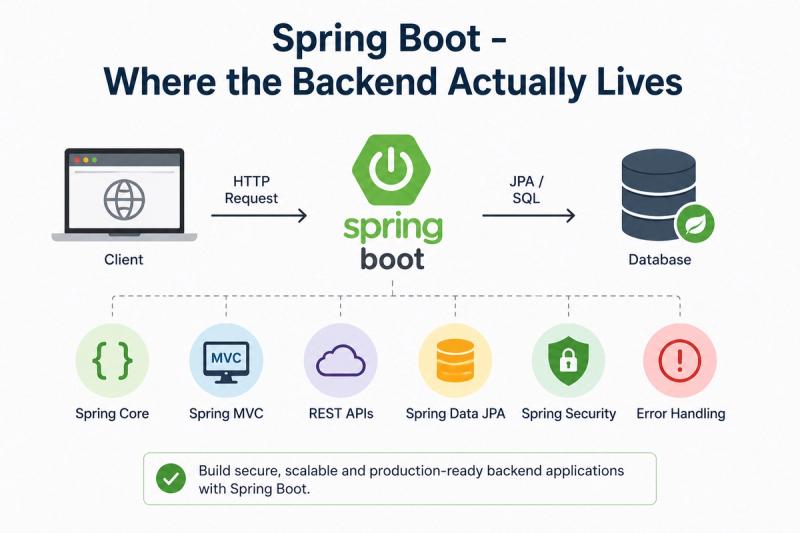
Spring Boot - Where the Backend Actually Lives
If Core Java is the foundation, Spring Boot is the building on top of it.
This module is the technical centrepiece of any Java Full Stack Developer Course. It takes the longest, covers the most ground, and produces the skills that get you hired.
Topics inside this module:
- Spring Core - how dependency injection works and why it matters
- Spring MVC - routing, request handling, controllers
- Spring Boot - setting up REST APIs without heavy configuration
- Spring Data JPA - database operations through Java objects instead of raw SQL
- Spring Security - user login, token-based auth using JWT, role permissions
- Proper error handling and structured API responses
When this module is done, you can build a backend that accepts requests, checks user permissions, talks to a database, and sends clean responses back. That is a production-level skill set.
Databases - Storing and Fetching the Right Data
Every application stores something. This module in the Java Full Stack Developer Course teaches you how to handle that storage properly.
What gets covered:
- MySQL - queries, joins, indexes, stored procedures
- Hibernate - mapping Java classes directly to database tables
- JPA - the standard Java approach to database interaction
- MongoDB - for data that does not fit neatly into rows and columns
- Schema design - how to structure data, set up relationships, avoid common mistakes
Hibernate is the one that trips most people up. The idea of treating a database row like a Java object takes a while to feel natural. Push through it - once it clicks, database work gets noticeably easier.
REST APIs - Connecting Frontend to Backend
Frontend and backend are separate applications. APIs are what make them talk.
This module covers:
- What REST means and the rules that make an API RESTful
- Writing endpoints - GET, POST, PUT, DELETE - in Spring Boot
- Handling bad input and returning useful error messages
- Using Postman to test everything before the frontend touches it
- Wiring React up to call the Spring Boot API and display real data
This is the module where the Java Full Stack Developer Course stops feeling like individual skills and starts feeling like one working system. You write an endpoint, call it from React, and see live data on screen. That moment changes how you think about web development.
Skills without tools do not get you far in a real workplace.
A complete Java Full Stack Developer Course covers:
- Git and GitHub - commits, branches, merging, pull requests
- Maven or Gradle - handling dependencies and building the project
- Docker - containerising the app so it runs the same on every machine
- Linux basics - command line navigation, running apps on a server
- Cloud deployment - pushing the app live on AWS or a similar platform
- CI/CD basics - automating how code gets tested and deployed
Git will save you from losing work. Docker will save you from "works on my machine" arguments. Both are non-negotiable in any development job.
Projects - The Section That Actually Gets You Hired
The final part of a Java Full Stack Developer Course is building something real.
Common project options:
- E-commerce site - products, cart, checkout, order tracking
- Employee management portal - departments, roles, leave requests
- Online banking system - accounts, transfers, transaction history
- Hospital booking app - doctors, appointments, patient records
One properly built project beats five half-finished ones every time. Clean code, a working deployment, and the ability to explain every decision in an interview - that combination gets attention from recruiters.
How Long and How Much Daily Practice
Most people finish a Java Full Stack Developer Course in 4 to 6 months starting from scratch. With some Java background already in place, 3 months is doable.
Two hours of actual coding daily is enough. Not video watching - coding. The people who fall behind are almost always the ones who watch without building.
Looking to build a career in software development? Explore our Java Full Stack Developer Course in Thane and gain industry-ready skills with hands-on training.
Salary Numbers
India:
- Fresher: Rs. 4 LPA to Rs. 8 LPA
- Mid-level: Rs. 10 LPA to Rs. 20 LPA
- Senior: Rs. 25 LPA and above
USA:
- Entry level: $75,000 to $95,000 per year
- Senior level: $140,000 and above
FAQ
Q1. Is this course hard for someone with no coding background?
The first month is the toughest. Core Java takes adjustment. After that it gets easier as long as you keep building things alongside the videos.
Q2. Java or Python - which full stack path pays better?
Java edges ahead in banking, insurance, and enterprise software. Python is stronger in startups and AI products. Choose based on where you want to work, not just the salary numbers.
Q3. Do I need Java knowledge before enrolling?
Not if the course starts with Core Java, which most do. Basic programming logic helps but is not required.
Q4. Will I learn React or Angular in this course?
React mostly. Angular still shows up in some syllabuses but the industry has shifted and so have most updated courses.
Q5. Does finishing the course mean I get a job?
The course builds your skills. The job comes from your projects, how you perform in interviews, and how well you can explain what you built and why.
Final Thoughts
The Java Full Stack Developer Course covers a lot of ground - Core Java, Spring Boot, React, databases, APIs, and deployment. Each module feeds into the next. Take it in order, treat the projects seriously, and you come out the other side with skills that the job market actually wants.
For more insights and updates, follow us on Instagram and Facebook now.

 Chat to Support