Discover eligible degrees for data science careers. Read more.
Mrityunjay Pandey
· 26 June 2026 ·10 min read
Share:
Contents
Data Science After Graduation: Which Degrees Actually Qualify?
Okay, so you graduated. Maybe it was last year, maybe just a few months back. And now everyone around you is talking about data science. Your college buddy is doing a course. Someone on Instagram just posted about their data analyst job. And you are sitting there wondering - wait, does my degree even get me in?
This is honestly one of the most common things people search for. And nobody gives a straight answer because most blogs are written to confuse you into buying a course.
This one is not like that. Read it fully, and you will know exactly where you stand.
What Is Data Science After Graduation, Actually?
Think of it this way. Every company - from a small startup to a giant like Amazon - has data. Loads of it. Sales numbers, customer behavior, delivery times, feedback, clicks. All of it is sitting somewhere.
Data scientists are the people who make sense of all that. They clean the data, study it, find what is going wrong or going right, and help the company decide what to do next.
Data science after graduation simply means you pick up this skill set after finishing your bachelor's. Most programs have one main requirement - a graduation degree. That is it. The stream often does not matter as much as people think.
Join our Data Science course and gain the practical skills, tools, and industry knowledge needed to become a successful data professional.
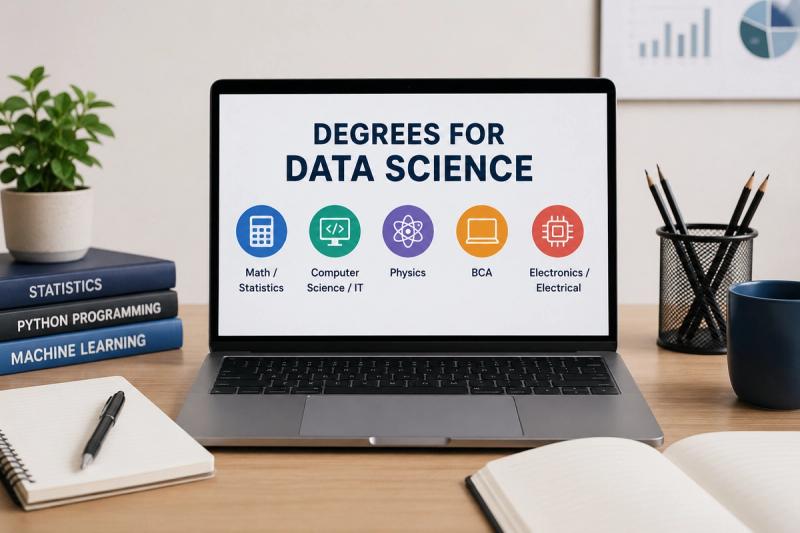
Degrees Where You Walk In Easily
Some graduates have it easier when it comes to data science after graduation. Their coursework already covers a big chunk of what data science needs.
B.Sc. Mathematics or Statistics - Probability, algebra, distributions - you studied this for three years. Data science is built on exactly these things.
B.Tech / B.E. Computer Science or IT - You already know how to write code. That is honestly half the battle. The rest comes with practice.
B.Sc. Physics - Physics trains you to think analytically. Numbers and patterns are second nature to you. Adjusting to data science is not hard at all.
BCA - Programming background, logical thinking - this is a very natural fit for data science after graduation.
B.Tech Electronics or Electrical - Signals, systems, data processing - you have been working with these concepts already.
For these folks, most programs will not throw any extra hurdles. Your application goes through without much trouble.
Degrees for Data Science
Degrees That Qualify Too - Most People Do Not Know This
Now here is where a lot of people have wrong assumptions. They think data science after graduation is only for people from science or tech. That is not true at all.
B.Com or BBA - You know how a business runs. That background is actually very useful when you are reading business data and explaining what the numbers mean. Add some Python skills and you are a strong hire.
BA Economics - Economics students already work with graphs, data sets, and statistical models. The switch to data science is not as big as it looks.
BA Psychology - You ran experiments. You collected survey data. You interpreted results. That process is very similar to what data analysts do every day.
B.Sc. Chemistry or Biology - Recording lab data, running controlled experiments, analyzing outcomes - your mindset is already wired for data work.
B.Pharm or B.Sc. Nursing - Healthcare data is growing really fast. Hospitals, insurance companies, pharma firms - all of them need people who understand both medical context and data. Your background is actually rare and valuable here.
Data science after graduation does not care as much about which stream you came from. It cares more about what you are willing to learn next.
What If Your Degree Is Completely Unrelated?
Say you did BA in History. Or Literature. Or even Fine Arts. Does data science after graduation become impossible for you?
Nope.
Most programs just need three things from you:
A bachelor's degree - any stream, any university
Basic comfort with the English language
Readiness to start learning Python and math from the beginning
Many programs start from absolute zero. They do not assume you know anything. So even if your graduation had zero numbers or coding in it, you can still get started.
One honest thing though - the starting months will be tougher for you compared to someone from a math or CS background. There is more to pick up. But it is manageable. Plenty of people from arts and humanities have done it and landed solid data jobs. The degree did not stop them. Giving up early did.
The Skills That Actually Get You Hired
When companies hire for data roles, they are checking for certain skills. Data science after graduation is less about what your marksheet says and more about what you can actually do.
Basic Math - You need to be comfortable with numbers. Percentages, averages, basic algebra. Not advanced calculus, just the foundation stuff.
Statistics - Mean, median, standard deviation, probability - these come up constantly. Most courses teach them clearly.
Python - This is the main tool. Almost every data science role uses Python in some way. R is also used but Python is more common.
Thinking in questions - Good data scientists do not just run code. They ask - why is this number dropping? What changed last month? What does this pattern mean? That questioning habit matters a lot.
Sticking with it - Messy data, errors in code, results that make no sense - this happens regularly. The people who push through it are the ones who grow fast.
All of these are learnable. None of them need a specific degree. That is the whole point.
Which Program Should You Actually Join?
There are a few routes for data science after graduation and each suits a different type of person.
PG Diploma in Data Science - Usually 6 to 12 months long. Very focused on practical skills and job readiness. Good if you want to enter the field without spending two more years.
M.Sc. in Data Science - A full two-year university degree. Better for people who want to go into research or need a formal academic credential.
Online Certification Courses - Platforms like Coursera, upGrad, and Great Learning offer these. More affordable, self-paced, and you can keep working while studying.
MBA with Data Analytics - For those who want both management skills and data knowledge. Useful for roles that sit between business strategy and data teams.
There is no single best option. Pick based on how much time you have, your budget, and whether you want a formal degree or just the skills.
If you're looking to strengthen your analytical skills before diving deeper into data science, our Data Analytics Course can help you build a solid foundation with industry-relevant tools and hands-on projects.
Do Not Skip This Before Paying Any Fees
A lot of data science programs have very good marketing. Before you pay anything, check these things:
Do students actually build projects during the course, or is it all theory and videos?
Is there genuine placement support, or do they just say the word "placement" without delivering anything?
Are the instructors people who work in data science currently, or are they just reading slides?
When was the course last updated? A 2021 curriculum is already outdated.
Data science after graduation is both a time and money investment. A bad program wastes both. Spend a week talking to past students before you decide. It is worth it.
FAQs
Q1. Can a commerce graduate do data science after graduation?
Yes, without any issue. B.Com and BBA degrees are accepted. The course itself teaches Python and stats from scratch.
Q2. Do I need maths in my graduation for data science?
Not compulsory. Helpful, yes. But most programs start from basics and teach whatever math you need during the course.
Q3. How long does it take to complete a data science course after graduation?
Anywhere between 6 months for a short certification to 2 years for a full M.Sc. Depends entirely on what you choose.
Q4. Can I study data science after graduation while doing a job?
Yes. Online programs exist specifically for this. You can go through the material on evenings and weekends.
Q5. What kind of salary can a fresher expect after data science after graduation?
In India, freshers usually land between ₹4 to 7 LPA. After 2 to 3 years of solid experience, ₹12 to 15 LPA is pretty normal.
Final Thoughts
Your degree already handled the basic eligibility part. Now the real question is what you build on top of it.
Data science after graduation works for a surprisingly wide range of backgrounds. The people who make it are not always the ones with the most related degree. They are the ones who stayed consistent with learning and did not overthink the starting point.
Pick a good program. Start small. Keep going.
For more insights and updates, follow us on Instagram and Facebook now.
#Data Science After Graduation: Which Degrees Qualify Guide

 Chat to Support