Data Science vs Data Analytics: The Honest Difference for 2026
Data Analytics asks what happened. Data Science asks what will happen next. Here's the honest, complete guide to finally deciding which path is right for you.
ITDaksh Team
· 23 May 2026 ·19 min read
Share:
Contents
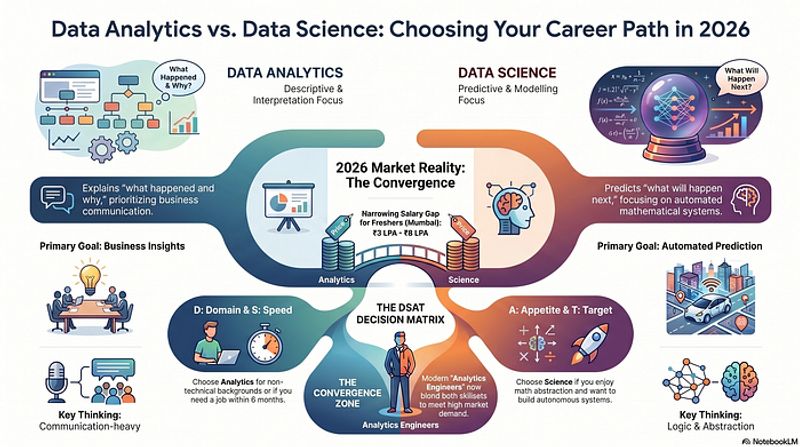
A split-concept hero graphic visually representing the core distinction between Data Science and Data Analytics. The left side shows Data Analytics with the label "What happened and why?" alongside icons for SQL, Excel, Power BI, and Tableau. The right side shows Data Science with the label "What will happen next?" alongside Python, ML model, and statistical graph icons. A central dividing element — arrow, line, or bridge — connects the two, with the overall headline "Data Science vs Data Analytics" and Itdaksh Education branding.
Direct Answer
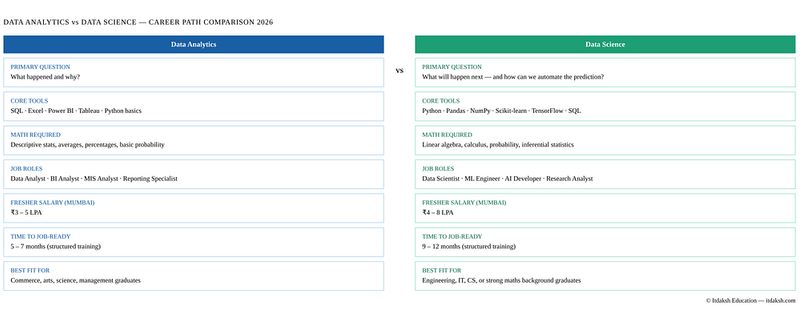
Data Analytics answers the question “what happened and why?” using SQL, Excel, Power BI, and Tableau to examine past data, identify patterns, and present business insights. Data Science answers “What will happen next, and how do we automate that prediction?” using Python, machine learning, and statistical modelling to build systems that learn from data and make decisions.
That is the core distinction. Everything else the tool lists, the salary comparisons, the career paths flows from this single difference in the fundamental question each discipline is trying to answer. If you understand this deeply, the decision between the two becomes significantly clearer. If you only look at comparison tables, you will remain confused, because the tables look similar at first glance.
Introduction: Why This Question Confuses So Many People
There is a reason “Data Science vs Data Analytics” is one of the most searched comparison queries in India, and it is not because the topic is genuinely complex. It is because most articles explain the difference in terms of tools “Data Analysts use Excel and Tableau, Data Scientists use Python and TensorFlow” which tells you nothing about whether you should pursue one over the other.
The tool overlap makes it worse. Both fields use Python. Both use SQL. Both require an understanding of data and statistics. Both produce insights from datasets. From the outside, they look almost identical. The confusion is entirely understandable and it is reinforced every time someone reads another article that leads with “Data Scientists have PhDs” or “Data Analytics is easier” without explaining what those statements actually mean for a fresher in Mumbai deciding where to invest the next 6 to 12 months of their life.
The One-Question Test to Clarify the Difference Immediately
Before going any further, here is the fastest possible way to feel the difference between the two disciplines in practice.
A Data Analyst at a retail company receives a request: “Sales dropped 18% in Mumbai stores last quarter. Can you tell us what happened?” They pull sales data by store, product, time period, and region. They clean and sort it in SQL. They build a Power BI dashboard. They identify that two high-margin product categories had stockout issues in weeks 7 through 11, correlating directly with the revenue dip. They present this finding to the business team, who use it to fix the supply chain.
A Data Scientist at the same company receives a different request: “We keep running out of stock during demand spikes. Can you build something that predicts when that is going to happen so we can reorder automatically?” They collect two years of historical sales data. They engineer features seasonality, promotional calendars, regional events. They train a forecasting model using Python and Scikit-learn. They evaluate it against a test set. They deploy it to production, where it automatically flags reorder requirements three weeks in advance.
Both are essential. Both require skill, rigor, and data literacy. But the Analyst interpreted what already happened. The Scientist built a system that predicts what has not happened yet. That difference descriptive versus predictive is the most honest way to understand the two disciplines.
The Real Skill Difference Not the Tools, But the Thinking
The tools matter, but they are not the deepest difference. The deepest difference is in the type of thinking each discipline requires on a daily basis.
Data Analytics is fundamentally about communication and interpretation. A great Data Analyst reads data the way a good journalist reads evidence finding the meaningful signal in a noisy dataset, questioning whether the pattern is real or coincidental, and then translating that finding into language a non-technical business stakeholder can act on. The skill that separates a ₹3 LPA analyst from a ₹9 LPA one is not SQL complexity it is the ability to frame a business problem precisely, find the right data to answer it, and present the answer in a way that changes how someone in the room thinks. This is a communication-heavy, business-adjacent discipline.
Data Science is fundamentally about modelling and prediction. A Data Scientist is, at their core, building systems that generalise from historical data to future situations. This requires a working understanding of probability theory how likely is this outcome? linear algebra how do features combine to influence a prediction?and optimisation how does the model adjust itself to minimise prediction error? You do not need a PhD in mathematics to do this practically, but you do need to be comfortable with these concepts at an applied level. A Data Scientist who is uncomfortable with the mathematical foundations of the models they deploy is flying blind they cannot diagnose why a model is performing poorly, and they cannot explain its behaviour to a business team.
This is why the “Data Analytics is easier” framing is both true and misleading. It is more accessible in the early weeks for someone with no technical background. It does not require the statistical and mathematical depth that Data Science does. But “easier to enter” is not the same as “less intellectually demanding at the expert level.” A senior Data Analyst who can navigate complex multi-table databases, run cohort analyses, design A/B tests, and present findings to a CFO is a highly skilled professional just skilled in different ways than a Data Scientist.
The Salary Reality: Honest Numbers, Not Marketing Claims
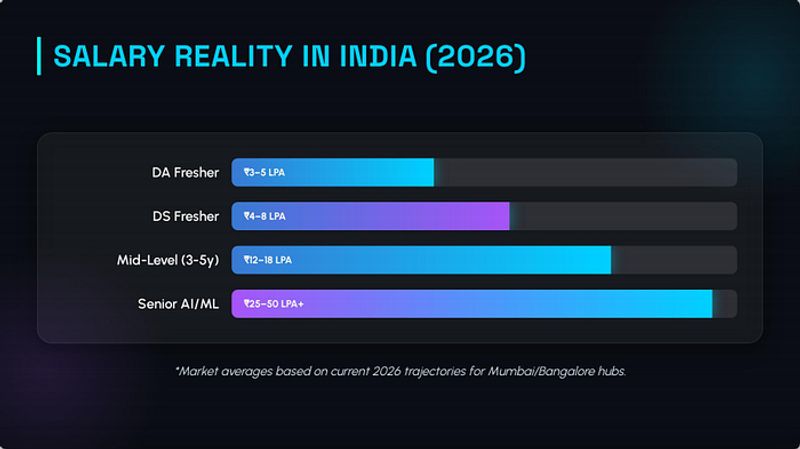
A salary comparison chart or tiered bar graphic showing salary ranges for Data Analytics and Data Science roles in Mumbai across three experience levels — fresher (₹3–5 LPA vs ₹4–8 LPA), mid-level (₹7–12 LPA vs ₹10–18 LPA), and senior/lead level (₹12+ LPA vs ₹20–40 LPA) — with clear labels, colour differentiation between the two paths, and a note showing the overlap zone at the fresher level.
This is the question most people have but are embarrassed to ask directly: which one pays more?
At the fresher level in Mumbai and Thane, the difference is smaller than most people expect. A skilled Data Analytics fresher someone with intermediate SQL, Power BI proficiency, Python basics, and a project to show can realistically enter the market at ₹3 to ₹5 LPA. A skilled Data Science fresher with Python, machine learning fundamentals, and a model-based project enters at ₹4 to ₹8 LPA. The overlap is real. The Data Science ceiling is higher at entry, but only for genuinely skilled candidates. A mediocre Data Science fresher earns the same as or less than a strong Data Analytics fresher because companies would rather hire someone who can build a reliable dashboard than someone who has trained a model they cannot explain.
The salary divergence becomes meaningful at the mid-level, three to five years into either career. According to salary data from AmbitionBox and LinkedIn Salary Insights for Mumbai, mid-level Data Scientists at product companies and BFSI firms earn ₹10 to ₹18 LPA. Mid-level Data Analysts in equivalent sectors earn ₹7 to ₹12 LPA. The gap widens, but it is not the dramatic difference that most articles imply. The reason is that strong Data Analysts in business-critical roles those who own dashboards that drive revenue decisions are valued highly by the companies that depend on their output.
The highest-ceiling roles ML Engineering leads, AI Research roles, Head of Data Science positions are in the Data Science path, with senior professionals at product companies earning ₹20 to ₹40 LPA. But these roles require 6 to 10 years of progressive, high-quality experience, not just a certification.
Data Analytics is the right starting point if your background is non-technical. Commerce graduates, arts graduates, science graduates without a programming foundation, and working professionals from sales, operations, finance, or HR who want to enter data roles all of these profiles are well-matched to the Data Analytics path.
The reason is structural, not about capability. Data Analytics begins with Excel and SQL tools that feel familiar to anyone who has worked with data in any professional context. The progression from Excel to SQL to Power BI to Python builds gradually, with each new tool building on practical skills already established. For someone who has never written a line of code, this gradual ramp is the difference between completion and dropout. Starting directly with machine learning and statistical modelling, on the other hand, overwhelms non-technical students in ways that have nothing to do with their intelligence and everything to do with the learning architecture.
The job market argument for Data Analytics is also compelling in terms of volume and accessibility. According to job postings on Naukri and LinkedIn for Mumbai and Thane in 2026, Data Analyst roles significantly outnumber Data Scientist roles at the fresher level. The BFSI sector, e-commerce industry, healthcare, FMCG, and IT services collectively generate a large and consistent demand for analysts who can extract, clean, and present business insights. This demand is spread across hundreds of companies, not concentrated in a handful of elite product firms.
At Itdaksh Education, a significant proportion of our most successful Data Analytics alumni have come from exactly these non-technical backgrounds. Students from BCom, BA, and BSc non-IT programmes who completed the Data Science & Analytics course and built a project portfolio have been placed at companies including EPCPROMAN Pvt. Ltd and MCM Pvt. Ltd in analytical and reporting roles. The entry point was accessible. The outcome was professional and employed.
Data Science is the right path if your background gives you a head start on the quantitative foundations. Engineering graduates, BSc Mathematics or Statistics students, BCA and MCA graduates, and IT professionals who already have Python or programming familiarity will find Data Science’s progression logical rather than overwhelming.
The case for Data Science in 2026 is also strengthened by the direction of the industry. The integration of machine learning into virtually every significant software product recommendation systems, fraud detection, demand forecasting, personalisation engines, natural language processing in customer-facing applications means the demand for professionals who can build, evaluate, and maintain predictive models is structural and growing. Unlike some technology trends that peak and contract, the embedding of ML into business systems is deepening, not reversing.
The Data Science path also opens directly into the Agentic AI and Generative AI space, which is the highest-growth segment of IT hiring in India in 2026. A Data Scientist who adds LLM integration skills, RAG pipeline development, and AI agent orchestration to their existing ML foundation is positioned at the intersection of two high-demand fields simultaneously a career advantage that will compound over the next five years.
At Itdaksh Education, the Data Science with AI programme is specifically structured to take students from Python fundamentals through machine learning, deep learning, NLP, and into Generative AI and Agentic AI building the complete stack in 9 months of structured, 80% hands-on training. Students who complete this track and build a model-based capstone project consistently receive stronger interview responses from product companies and AI-first organisations than those who have only theoretical exposure.
The Contrarian Truth: The Gap Between Them Is Closing Fast
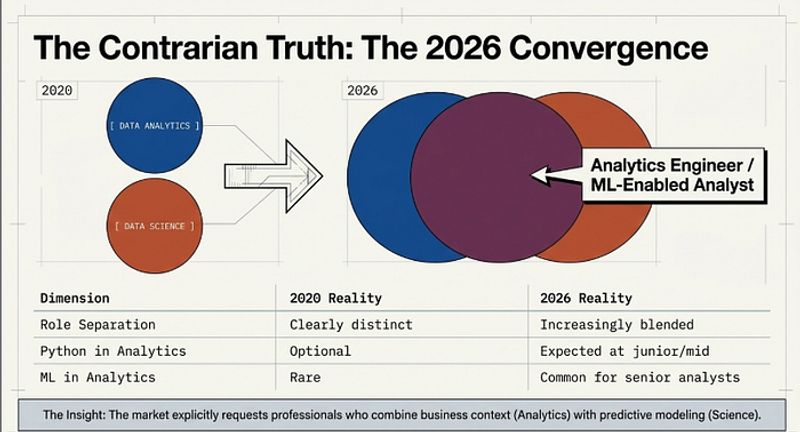
A spectrum or convergence diagram showing Data Analytics on the left, Data Science on the right, and an emerging middle zone labelled "Analytics Engineer" or "ML-enabled Analyst" — representing the convergence of both disciplines in 2026. The diagram likely shows arrows from both sides pointing toward the centre, with salary premium indicators and labels for tools relevant to each zone (SQL/BI on the left, Python/ML on the right, and a combination of both in the middle).
Here is what most comparison articles written in 2024 or earlier miss entirely: the boundary between Data Analytics and Data Science is actively dissolving in 2026, and the professionals who understand this will make better career decisions than those who treat it as a fixed binary.
The common assumption is that Data Analysts work with dashboards and reports while Data Scientists work with models and predictions and never the twain shall meet. But the reality in 2026’s job market is different. Automated ML platforms like Google AutoML, AWS SageMaker, and Azure ML have made basic model training accessible to analysts without deep statistical knowledge. At the same time, Data Scientists are increasingly expected to communicate business insights, not just technical findings which requires the visualisation and stakeholder communication skills historically associated with analysts.
The result is a convergence zone in the middle of the spectrum sometimes called the “Analytics Engineer” or “ML-enabled Analyst” where the most in-demand professionals combine SQL and BI tool proficiency with the ability to build and interpret predictive models. The salary premium in this zone exceeds both traditional analyst and entry-level Data Scientist roles, because it is genuinely rare.
This is why Itdaksh Education offers the Data Science & Analytics programme as a combined track not to confuse students, but because the market is demanding professionals who can do both. Understanding business context through analytics and building predictive models through data science is the combination that product companies, BFSI firms, and AI-first organisations are explicitly requesting on their job postings. The “either/or” framing is a simplification of a market that is increasingly asking for “and.”
Tactical Section: The 5-Minute Decision Apply the DSAT Matrix Right Now
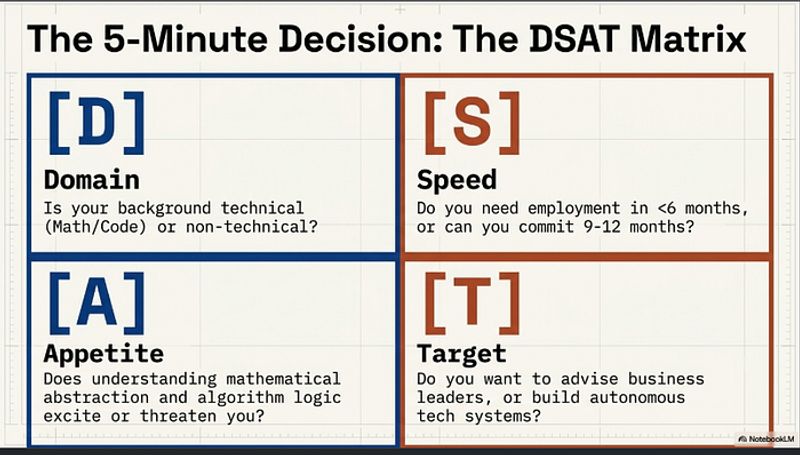
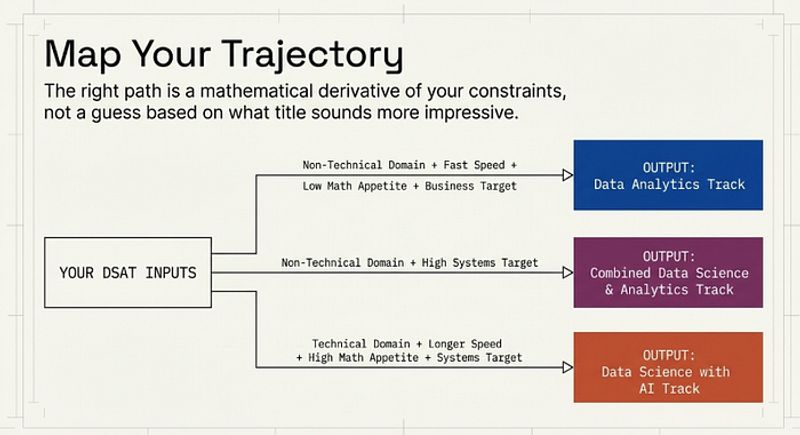
Stop reading after this section if you want. Apply the DSAT Matrix the decision framework visualised above to your own situation. Answer these four questions honestly. They will tell you which path is right for you more accurately than any comparison article.
The DSAT Matrix decision framework — a four-quadrant or four-question visual showing: D (Domain background: technical vs non-technical), S (Speed needed to employment: 6 months vs 9–12 months), A (Appetite for mathematical abstraction: low vs high), and T (Target role: business-facing vs system-building). Each quadrant points toward either Data Analytics, Data Science, or the combined track, making the decision path visually clear for a fresher to self-assess in under five minutes.
DWhat is your Domain background? If your degree or work history is non-technical any field without programming, mathematics, or IT as a core component Data Analytics is your entry point. The progression is designed for you. If you have engineering, IT, CS, mathematics, or statistics in your background, both paths are accessible and Data Science is a viable direct entry.
SHow much Speed do you need? If you need employment within 6 months for financial reasons, family circumstances, or career urgency Data Analytics is the more reliable path. The job volume is higher, the entry bar is more accessible, and a 5 to 7 month structured programme can realistically get you placed. If you can commit 9 to 12 months to training before applying, Data Science’s longer runway pays off in terms of ceiling and breadth of opportunity.
AWhat is your Appetite for mathematical abstraction? Be honest about this. Not whether you are “good at maths” but whether you genuinely enjoy the process of working with abstract numerical concepts, probability distributions, and optimisation logic. Data Science requires this daily. If the thought of understanding why a gradient descent algorithm converges feels interesting rather than threatening, Data Science fits you. If it feels threatening, Data Analytics is not a compromise it is a genuinely better match.
TWhat is your Target role and company type? If you want to work in a business-facing role helping a company understand its customers, sales, operations, or financials through data Data Analytics is directly aligned. If you want to build systems that make predictions, recommendations, or autonomous decisions at scale Data Science is the path.
If you answered A (Analytics) to all four, choose Data Analytics with confidence. If you answered S (Science) to all four, choose Data Science. If your answers are mixed particularly if D is non-technical but T is technical consider the combined Data Science & Analytics track, which builds both foundations progressively.
A structured comparison table showing how the Data Science and Data Analytics career landscape has shifted between 2020 and 2026 — covering factors including role separation, Python requirements in Analytics, ML in Analytics roles, Data Science entry requirements, business communication expectations, AI integration in both fields, combined DS and DA roles, non-IT entry accessibility, and the salary gap at fresher level — with a clear two-column 2020 vs 2026 layout.
FAQs
Q1: What is the main difference between Data Science and Data Analytics in simple terms?
Data Analytics looks backward it analyses what already happened and explains why, using tools like SQL, Excel, Power BI, and Tableau to surface business insights. Data Science looks forward it builds models that predict what is likely to happen next, using Python, machine learning algorithms, and statistical methods. Both use data, but they answer fundamentally different questions.
Q2: Which is better for a fresher Data Science or Data Analytics?
Neither is universally better the right choice depends on your background. For freshers from non-IT, commerce, or arts backgrounds, Data Analytics is the more accessible and faster path to employment. For freshers from engineering, IT, or science backgrounds who enjoy programming and mathematics, Data Science offers a higher long-term ceiling. Use the DSAT Matrix in this article to identify which fits your specific profile.
Q3: Does Data Science pay more than Data Analytics in India in 2026?
At the fresher level, the salary overlap is significant both paths produce ₹3 to ₹8 LPA depending on skill depth and company type. The divergence grows at the mid-level, where Data Scientists at product companies earn ₹10 to ₹18 LPA versus ₹7 to ₹12 LPA for analysts in equivalent sectors. However, a strong Data Analyst consistently earns more than a mediocre Data Scientist. Skill depth and evidence of outcomes matter more than the job title at every level.
Q4: Can I start with Data Analytics and move into Data Science later?
Yes this is one of the most natural career progressions in the data field. A Data Analyst who adds Python proficiency, builds machine learning project experience, and demonstrates an understanding of predictive modelling can transition into Data Science roles within 2 to 3 years. The analytics foundation SQL mastery, business problem framing, data cleaning expertise, and stakeholder communication is genuinely valuable in Data Science roles and gives career-switchers an advantage over pure technical candidates.
Q5: Is a Data Science degree required to become a Data Scientist in India?
No. According to hiring trends across Naukri and LinkedIn, the majority of Data Scientist job postings in India do not require a specific degree in Data Science they require demonstrated skill: Python proficiency, machine learning project experience, statistical understanding, and the ability to present model results clearly. Structured training programmes that deliver this skill stack, combined with a portfolio of real projects, are accepted as evidence of competence by most hiring companies at the fresher and junior level.
Q6: Which course does Itdaksh Education recommend Data Science or Data Analytics?
Itdaksh Education recommends based on the individual student’s background and goal which is why every prospective student goes through a free career counselling session before enrolling. For non-IT backgrounds, the Data Science & Analytics combined programme builds both disciplines progressively. For students who want the full machine learning and AI stack, the Data Science with AI programme covers Python, ML, deep learning, NLP, Generative AI, and Agentic AI across 9 months of 80% practical training. The right programme is the one that matches your D, S, A, and T not the one that sounds most impressive.
A visual summary or pull-quote card reinforcing the article's core contrarian insight — that the boundary between Data Science and Data Analytics is actively converging in 2026, and the highest-demand professionals combine both skill sets — possibly showing the "And" framing versus the "Either/Or" framing, with the combined Data Science & Analytics profile highlighted as the market's preferred outcome.
Data Analytics asks “what happened and why?” Data Science asks “what will happen next and how do we predict it?” This single distinction explains every other difference between the two fields.
The tool overlap is real both use Python and SQL. The thinking difference is what matters: Analytics is communication and interpretation, Data Science is modelling and prediction.
At the fresher level in Mumbai, salary ranges overlap significantly. The divergence grows at mid-level. Skill depth matters more than title at every stage.
Use the DSAT Matrix Domain, Speed, Appetite for abstraction, Target role to make a confident, personalised decision rather than relying on generic comparisons.
Data Analytics is the faster path to employment for non-technical backgrounds. Data Science offers a higher long-term ceiling for technical backgrounds and opens directly into the AI and Agentic AI career space.
The boundary between the two is converging in 2026. The highest-demand professionals combine analytical communication skills with predictive modelling capability the combined Data Science & Analytics profile is what the market is increasingly requesting.
Neither path is a compromise. Each is the right choice for a specific profile. Choosing based on what sounds more impressive is the only wrong answer.
Free Sources
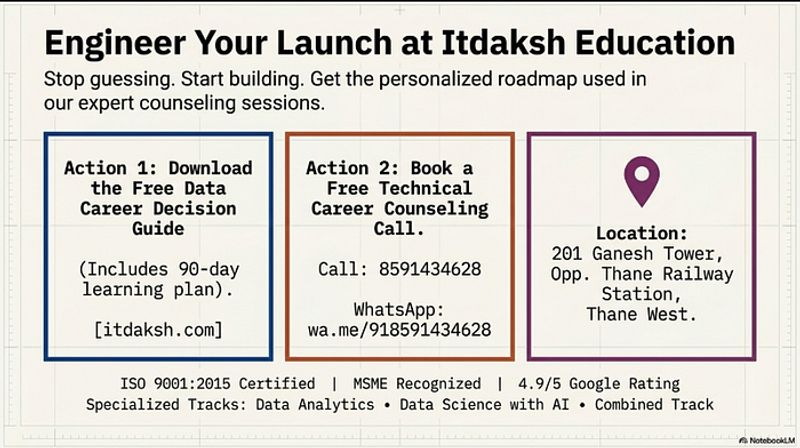
Download the Free Data Career Decision Guide the same personalised roadmap Itdaksh Education uses in career counselling sessions to help students choose between Data Analytics and Data Science. Includes the DSAT Matrix, course comparison, salary benchmarks, and a 90-day learning plan for each path.
A download card or branded CTA graphic for the free "Data Career Decision Guide" from Itdaksh Education — showing the guide's contents (DSAT Matrix, course comparison, salary benchmarks, 90-day learning plan), a prominent download button or arrow, and contact details (phone number and WhatsApp link) alongside the Itdaksh Education logo and ISO/MSME certification badges.
Book a Free Career Counselling | Call: 8591434628 | WhatsApp: 918591434628
Itdaksh Education 201 Ganesh Tower, Opposite Thane Railway Station, Thane West. ISO 9001:2015 & MSME Certified. Data Analytics | Data Science | Data Science with AI | Python Full Stack | Java Full Stack. Rated 4.9/5 on Google
# Data Science vs Data Analytics
#Data Analytics India 2026
# Data Scientist vs Data Analyst
#DSAT Matrix career decision
# Data Analytics salary Mumbai
#Data Science career India
#Itdaksh Education
#Analytics Engineer India
#descriptive vs predictive analytics
#data career guidance India

 Chat to Support