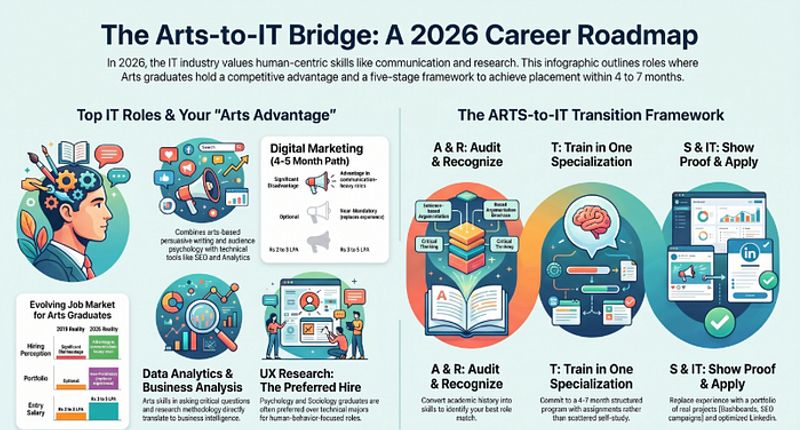
Yes, arts graduates can build real IT careers in 2026. Digital Marketing, Data Analytics, Business Analysis here's the honest roadmap and the skills you already have.
Mrityunjay Pandey
· 30 May 2026 ·15 min read
Share:
Contents
A career roadmap graphic showing the journey from "Arts Graduate" (represented by BA degree subjects — English, Psychology, Economics, Sociology, History) to "IT Professional" (represented by three destination roles — Digital Marketing Executive, Data Analyst, Business Analyst) with a forward-moving timeline or bridge connecting the two. The visual includes approximate transition timelines (4–7 months) for each role path and Itdaksh Education branding, establishing the core premise of the article visually before the first word is read.
Direct Answer:
Yes, an arts graduate can absolutely build a professional IT career in 2026, and the transition is not just possible in theory it is being done consistently by real people from BA backgrounds in India who are now working as Digital Marketing executives, Data Analysts, Business Analysts, UX Researchers, and Content Technology professionals at salaries that exceed most non-IT alternatives available to arts graduates.
The word “really” in the question is doing important work. It signals that you have probably been told this is not realistic. You have probably encountered the unspoken hierarchy that ranks engineering degrees above science degrees above commerce degrees above arts degrees in the Indian job market. That hierarchy exists. It is also, for specific IT career paths, increasingly irrelevant. This article will show you exactly which paths those are, why your arts background is an advantage in them, and what the honest timeline and salary look like.
Introduction: Why the “Arts Graduates Cannot Do IT” Belief Persists and Why It Is Wrong
A myth-versus-reality comparison graphic showing two contrasting columns — "Why the Belief Persists" (IT = coding stereotype, 2000s IT landscape, engineering degree hierarchy) versus "Why It Is Wrong in 2026" (IT expanded beyond engineering, roles now include marketing/analytics/research/content, arts skills are explicitly valued). The visual uses clear contrasting labels, timeline markers (2000 vs 2026), and role category icons to make the shift in the IT industry's composition immediately visible.
Why the “Arts Graduates Cannot Do IT” Belief Persists
The belief that arts graduates cannot enter IT careers is not malicious. It is outdated. It was formed during a period when IT careers meant software engineering, and software engineering required programming knowledge that arts curricula did not provide. In 2000 or even 2010, the overlap between arts education and IT careers was genuinely thin.
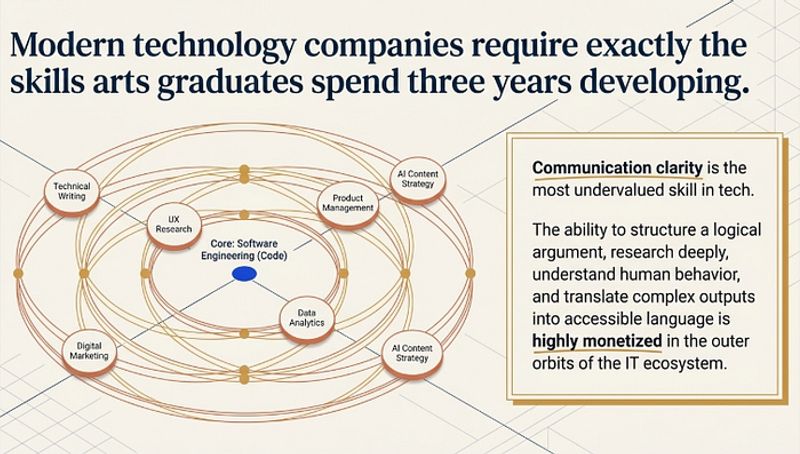
In 2026, the IT industry has expanded dramatically beyond its software engineering origins. It now includes digital marketing, data analytics, UX research, content strategy, business analysis, product management, technical writing, and AI-assisted creative roles fields that did not exist at scale twenty years ago and that require exactly the skills arts graduates develop: structured communication, research methodology, critical analysis, human behaviour understanding, and the ability to translate complex information into clear, accessible language.
The belief persists because the image of IT in public conversation is still dominated by the coding stereotype. When people picture an “IT professional,” they picture someone at a terminal writing code. But the reality of the modern tech company is that for every engineer writing code, there are teams of people doing digital marketing, data analysis, user research, content creation, business analysis, and product strategy. Arts graduates belong in most of those teams, with the right specialisation added.
What Arts Graduates Already Have That the IT Industry Values
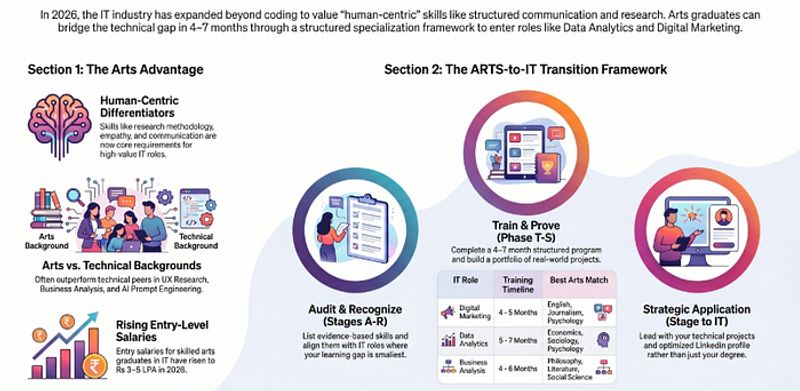
A skills translation infographic showing four key arts graduate competencies on the left — Communication Clarity, Research Methodology, Human Behaviour Understanding, Economic Reasoning — each with an arrow pointing to the specific IT roles or functions they translate into on the right (Technical Writing/UX Writing, Business Analysis/Data Analytics, UX Research, Data Analytics/BFSI Analytics). The visual makes the asset value of arts education in IT roles concrete and immediately scannable.
What Arts Graduates Already Have That the IT Industry Values
This is the section most arts graduates have never read. Not because the information does not exist, but because the IT industry rarely articulates it clearly.
Communication clarity is perhaps the most undervalued skill in technology companies. Engineers, data scientists, and developers often struggle to explain complex technical outputs to business stakeholders in plain language. The ability to write clearly, structure an argument logically, and communicate to a non-technical audience is a skill that every arts graduate has developed across three years of essays, presentations, and academic writing. Technical Writers, UX Writers, Content Strategists, and Business Analysts are paid specifically for this skill in IT companies.
Research methodology from humanities education translates directly into business analysis and data analyst work. A history graduate who knows how to evaluate sources, identify bias, and construct an evidence-based argument has the analytical foundation for business intelligence work. A sociology graduate who has conducted surveys, interpreted qualitative data, and written research reports has skills that map directly to user research and market analytics roles.
Human behaviour understanding from psychology and sociology provides a foundation for UX Research one of the fastest-growing specialisations in product-led technology companies. UX Researchers conduct user interviews, analyse behaviour patterns, identify friction points in product design, and communicate findings to product and engineering teams. A BA Psychology graduate who adds Figma basics, UX research methodology, and basic data analysis skills is competitive for junior UX Research roles at technology companies.
Economic reasoning from BA Economics provides the quantitative and analytical thinking that Data Analytics builds on. Economics graduates understand supply and demand, cost-benefit analysis, marginal reasoning, and basic statistical inference from their curriculum all of which are directly applicable to business intelligence and data analysis work. The transition from BA Economics to Data Analytics is arguably one of the shortest non-IT paths into a data career.
At Itdaksh Education, we have observed this pattern across multiple student cohorts. Arts graduates who choose the right IT specialisation Digital Marketing, Data Analytics, or Business Analysis and invest genuinely in the Skill Mastery Framework consistently reach placement readiness and receive interview calls within 5 to 7 months. The students who struggle are not those who came from arts backgrounds. They are those who choose technical specialisations that require programming foundations their arts background did not provide, without the appropriate preparation time.
The ARTS-to-IT Transition Framework Your Specific 5-Stage Path
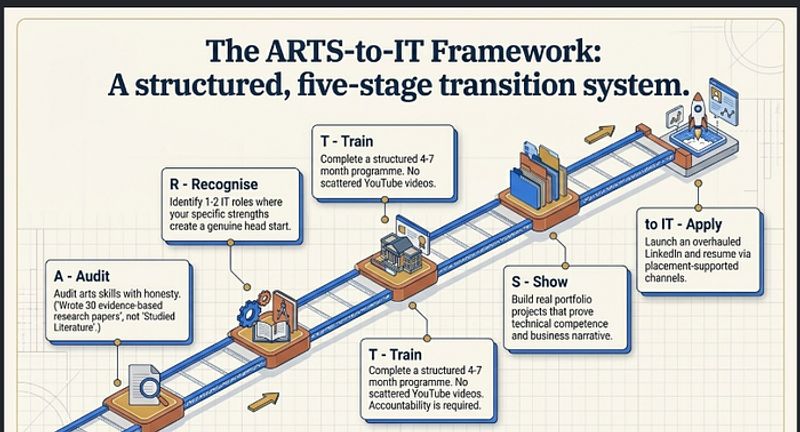
A five-stage sequential framework visual showing the ARTS-to-IT path A (Audit your arts skills honestly), R (Recognise your IT role alignment), T (Train in one focused specialisation), S (Show proof through real projects), and Apply (through placement-supported channels). Each stage is visually distinct with a letter label, brief description of the stage output, and a connecting arrow to the next stage. The framework is designed to be scannable in under 30 seconds and actionable as a standalone reference.
(See the framework visual above)
The ARTS-to-IT Transition Framework maps the journey from arts background to IT employment in five stages. Unlike generic “follow your passion” career advice, each stage has a specific output that must be completed before the next stage begins.
A Stage Audit Your Arts Skills With Honesty. List every skill you have actually developed across your arts education and any work experience. Not subjects you studied. Skills you built. “Wrote 30 research papers requiring evidence-based argumentation” is a skill audit entry. “Studied English Literature” is not. The audit produces a list of transferable skills that you will use in the next stage to identify your IT role match.
R Stage Recognise Your IT Role Alignment. Using your skills audit and the ARTS-to-IT mapping table above, identify one or two IT roles where your existing strengths create a genuine head start. This is not about choosing the highest-paying role. It is about choosing the role where the gap between where you are and where you need to be is smallest, so your transition is fastest and your early performance is strongest.
T Stage Train in One Focused Specialisation. Once the role is identified, enroll in a structured programme for that specific specialisation. Digital Marketing takes 4 to 5 months. Data Analytics takes 5 to 7 months for arts graduates. Business Analysis fundamentals take 4 to 6 months. The key word is “structured” not self-study through scattered online videos, but a programme with curriculum accountability, assignments, assessments, and placement preparation built in.
S Stage Show Proof Through Real Projects. A portfolio replaces the experience you do not yet have. For a Digital Marketing specialisation, this means a documented SEO campaign showing keyword research, on-page changes, and traffic results. For a Data Analytics specialisation, this means a Power BI dashboard built on real data with a business narrative explaining the insights. For UX Research, this means a documented user research project with interview findings and design recommendations. The project is the interview.
Stage to IT Apply Through Placement-Supported Channels. A resume that leads with your IT skills and projects (not your arts degree), a LinkedIn profile optimised for recruiter search, and placement support from your training institute that connects you to hiring companies in your target role. The application process with these assets in place is materially different from a cold application with only an arts degree on the resume.
The Three Best IT Roles for Arts Graduates in India in 2026
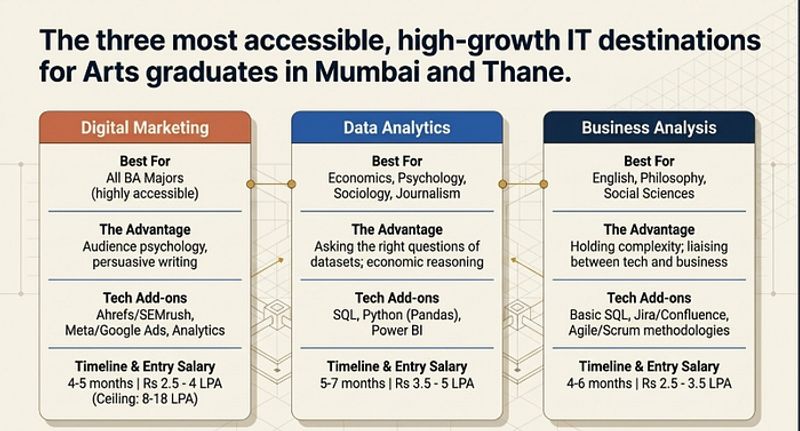
A three-role comparison card visual showing Digital Marketing, Data Analytics, and Business Analysis side by side — each with the matching arts stream (BA English/Journalism for Digital Marketing, BA Economics/Sociology/Psychology for Data Analytics, BA English/Philosophy/Social Sciences for Business Analysis), the training duration, entry salary range in Mumbai and Thane, and an indication of whether programming is required. The visual allows an arts graduate to identify their strongest role match within 15 seconds.
The Three Best IT Roles for Arts Graduates in India in 2026
Not every IT role is equally accessible from an arts background, and recommending “just learn Python” to a BA English graduate without any further context is bad advice. Here are the three roles with the strongest alignment to arts skills and the clearest transition path in Mumbai and Thane’s job market.
Digital Marketing
Digital Marketing is the single most accessible IT career path for arts graduates, and it is also one of the fastest-growing fields in India’s digital economy. The role combines content creation, data analysis, paid advertising, social media strategy, and search engine optimisation into a commercial discipline that technology companies, e-commerce firms, BFSI organisations, and every other sector actively hires for.
An arts graduate enters Digital Marketing with genuine strengths: the ability to write persuasively, understand audience psychology, structure a narrative, and conduct research. The additional skills required are technical but learnable without a programming background: SEO principles and tools like Ahrefs or SEMrush, Google Ads and Meta Ads Manager for paid campaigns, Google Analytics and Power BI for campaign performance analysis, and Content Marketing strategy. A structured 4 to 5 month programme covering these tools, combined with a live campaign project, produces a candidate who is genuinely competitive for Digital Marketing Executive roles in Mumbai and Thane at entry salaries of Rs 2.5 to Rs 4 LPA.
The ceiling for a Digital Marketing professional in India is not low. According to LinkedIn salary data, Performance Marketing Managers and Digital Marketing Leads at product companies and agencies in Mumbai earn Rs 8 to Rs 18 LPA at the mid-senior level. The path from entry Digital Marketing Executive to that ceiling is 3 to 5 years of progressive experience a timeline comparable to software development careers.
Data Analytics for arts graduates may seem counterintuitive, but it is a stronger match than most people expect particularly for graduates with Economics, Psychology, Sociology, or Journalism backgrounds who have experience working with data in their academic or professional lives.
The role of a Data Analyst is fundamentally about asking the right questions of a dataset, finding the answers, and communicating them clearly to business decision-makers. The first skill asking the right questions is something arts graduates do with training that engineers often lack. The third skill communicating clearly to non-technical stakeholders is a natural strength of most arts graduates. The middle skill the technical ability to work with data using SQL, Python, and Power BI is learnable from zero in 5 to 7 months of structured training.
A BA Economics graduate who adds SQL, Python at the Pandas level, and Power BI to their existing data literacy is not just entering a new field. They are combining domain understanding with technical capability to become a more complete analyst than a technically skilled but business-context-blind graduate from a pure programming background. This combination is specifically what the BFSI, e-commerce, and market research sectors in Mumbai hire.
Business Analysis sits at the intersection of technology and business strategy, and it is the IT role most naturally aligned with the skills arts graduates develop. A Business Analyst interprets business problems, documents requirements, liaises between technical teams and business stakeholders, and ensures that technology solutions actually solve the problem they were built to address. Communication, empathy, critical thinking, research, and the ability to hold complexity in mind while communicating simply are the core skills of this role.
Arts graduates from English, Psychology, Philosophy, and Social Science backgrounds are particularly well-matched. The additional technical skills required are relatively light compared to development or data science: basic SQL for data queries, familiarity with tools like Jira and Confluence for project tracking, understanding of Agile and Scrum methodologies, and the ability to create process flow diagrams using tools like Lucidchart or Visio. A 4 to 6 month Business Analysis programme that adds these technical elements to an arts graduate’s existing communication and analytical foundation produces a competitive candidate for junior BA roles at IT services companies and consulting firms in Mumbai and Thane.
The Contrarian Truth About Arts Graduates in IT That Will Surprise You
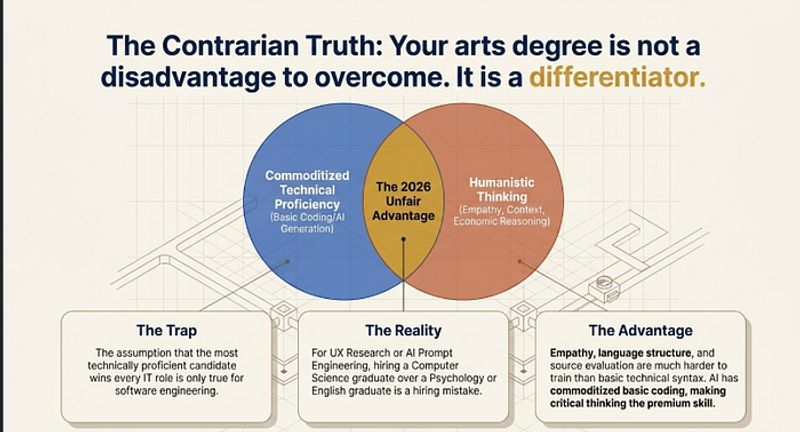
A contrarian insight graphic showing the roles where arts graduates have a genuine competitive advantage over technical graduates — UX Research, Technical Writing, AI Prompt Engineering, Content Strategy, and Business Analysis. For each role, the visual shows the primary professional skill required (qualitative research methodology, language precision, human empathy, analytical writing) and an indicator that arts education develops this skill more deliberately than technical curricula. The visual directly challenges the "technical always beats arts" assumption with specific, evidence-based role examples.
The Contrarian Truth About Arts Graduates in IT That Will Surprise You
Here is the insight that most career counsellors and technology industry commentators consistently overlook: in certain high-value IT roles, an arts background is not a disadvantage that needs to be overcome. It is a differentiator that technical graduates cannot easily replicate.
The common assumption in India’s career conversations is that every IT role is won by the most technically proficient candidate. This is true for software engineering. It is not universally true across all IT roles. For Digital Marketing strategy, user experience research, technical communication, and business analysis, the professionals who consistently advance fastest are those who combine adequate technical skill with exceptional communication, empathy, and humanistic thinking.
Consider UX Research. A UX Researcher who has formally studied qualitative research methodology, conducted interviews, coded themes from open-ended responses, and written research reports as part of a psychology or sociology degree has a foundation that computer science graduates cannot easily acquire without years of additional training. The technology company that hires a CS graduate over a psychology graduate for a UX Research role is prioritising degree hierarchy over role-relevant skill a hiring mistake that is becoming less common as companies become more sophisticated about talent acquisition.
For AI Prompt Engineering and AI Content Strategy roles two of the fastest-emerging roles in India’s technology sector in 2026 the ability to write precisely, think about language structure, understand context and ambiguity, and evaluate output quality is the core professional skill required. These are natural arts graduate strengths. A BA English or BA Journalism graduate who adds AI tool proficiency and prompt engineering fundamentals to their existing language capabilities is, in this specific field, more naturally suited than a computer science graduate who has never formally studied language, communication, or literary analysis.
Tactical Section: Your 60-Day Arts-to-IT Career Pivot Plan
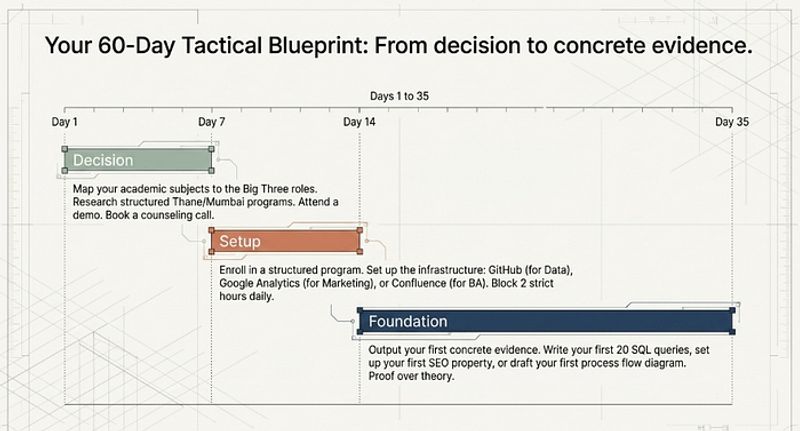
A day-range structured plan visual covering the first 35 days of an arts graduate's IT career pivot — Days 1–7 (role decision and programme selection), Days 8–14 (enrollment and learning environment setup — GitHub, Google Analytics, Confluence accounts), and Days 15–35 (foundation phase with specific outputs per track: first SQL queries and Pandas dataset for Analytics, first Google Analytics property for Digital Marketing, first requirements document for Business Analysis). Each phase has a colour-coded label, daily activity description, and a milestone output marker.
Day 1 to Day 35 Roadmap
Press enter or click to view image in full size
Day 35 to Day 60 Roadmap
If you are an arts graduate who has decided to make the transition to an IT career, this is your exact 60-day plan. Not motivation. Not general direction. Step-by-step actions with specific outputs at each stage.
Days 1 to 7 Role decision and programme selection.
Use the ARTS-to-IT mapping table above to identify your role. Choose between Digital Marketing, Data Analytics, or Business Analysis based on which row in the table best matches your arts subjects and work experience. Research structured programmes in Thane and Mumbai for your chosen path. Attend at least one free demo session. Book a career counselling call.
Days 8 to 14 Enroll and set up your learning environment.
Enroll in your chosen programme. Create a GitHub account (for Data Analytics projects), a Google Analytics demo account (for Digital Marketing), or a Confluence free account (for Business Analysis). These accounts are where your portfolio evidence will live. Set up a dedicated 2-hour daily study block the same time each day, every day.
Days 15 to 35 Foundation phase.
For Digital Marketing: complete SEO fundamentals and set up your first Google Analytics property. For Data Analytics: write your first 20 SQL queries and load your first dataset into Pandas. For Business Analysis: write your first requirements document and your first process flow diagram. These are small outputs. They are also the first concrete evidence that your transition is real and in progress.
Days 36 to 50 Tool depth phase.
For Digital Marketing: run your first Google Ads campaign on a test account with a small budget. For Data Analytics: build your first Power BI dashboard on a public dataset. For Business Analysis: conduct your first mock stakeholder interview and document the requirements it produces. Each of these is a portfolio piece.
Days 51 to 60 Resume and LinkedIn overhaul.
Rewrite your resume to lead with your IT skills and project outputs, not your arts degree. The arts degree is context; the skills and projects are the argument. Update your LinkedIn headline, summary, and skills section with the keywords from actual job postings for your target role. Connect with 10 people currently working in your target role and send three genuine, specific messages asking about their experience. These connections are early relationship-building, not cold outreach.
By day 60, you are 30 to 60 days into a structured programme, have two portfolio pieces in progress, a revamped professional presence, and an active network conversation in your target field. You are no longer researching whether the transition is possible. You are making it happen.
Career Landscape for Arts Graduates in IT: What Changed Between 2019 and 2026
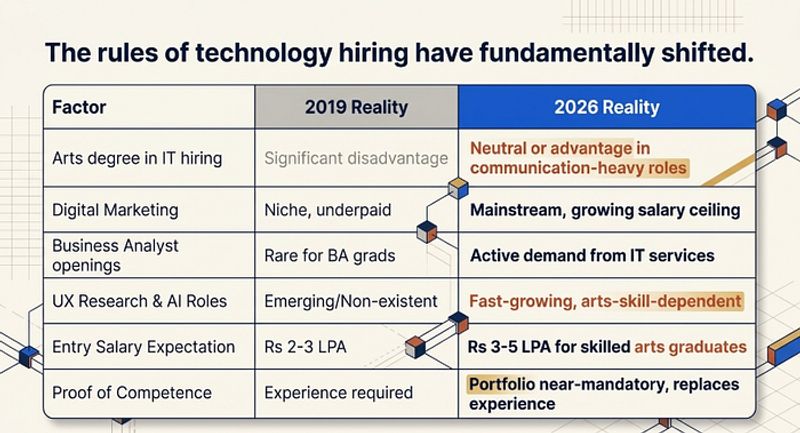
A before-and-after comparison table showing how the IT career landscape for arts graduates has shifted between 2019 and 2026 — covering factors such as role availability (narrow vs broad), degree hierarchy rigidity (high vs decreasing for specific roles), programming prerequisite (mandatory for most vs optional for three major paths), Digital Marketing growth (emerging vs mainstream), UX Research demand (rare vs growing), AI Prompt Engineering existence (non-existent vs emerging in 2026), structured training accessibility (limited vs established with placement support), and entry salary for skilled arts IT freshers (lower vs ₹2.5–5 LPA range).
What Changed Between 2019 and 2026
FAQs
Q1: Can a BA graduate get an IT job in India in 2026?
Yes. BA graduates can enter IT careers in Digital Marketing, Data Analytics, Business Analysis, UX Research, Technical Writing, Content Strategy, and AI-assisted communication roles. The transition requires a focused 4 to 7 month structured specialisation in one of these areas, combined with portfolio projects and placement preparation. The arts degree is not the barrier. The absence of a specific, demonstrable skill is the barrier, and that is fixable.
Q2: Which IT course is best for an arts graduate in Mumbai or Thane?
Digital Marketing is the most accessible and fastest path for most arts graduates, taking 4 to 5 months of structured training to reach entry-level readiness. Data Analytics is the strongest path for arts graduates from Economics, Psychology, or Sociology backgrounds, taking 5 to 7 months. Business Analysis is ideal for graduates from English, Philosophy, or Social Sciences who have strong communication and analytical thinking. The right choice depends on your specific subjects, your interest, and your target role.
Q3: How much can an arts graduate earn in IT in India in 2026?
Entry-level salaries for arts graduates who complete structured IT specialisation programmes in Mumbai and Thane in 2026 range from Rs 2.5 to Rs 3.5 LPA for Digital Marketing and entry Business Analysis roles to Rs 3.5 to Rs 5 LPA for Data Analytics roles. Mid-level salaries after 2 to 3 years of experience grow to Rs 5 to Rs 10 LPA in Digital Marketing and analytics disciplines, and Rs 7 to Rs 14 LPA for Business Analysis roles at senior levels in IT services and consulting.
Q4: Do arts graduates need to learn programming to enter IT?
Not for most of the roles discussed in this article. Digital Marketing requires no programming. Business Analysis requires only a basic understanding of SQL at a conceptual level. Data Analytics benefits from Python at the Pandas level, which is learnable from zero in 6 to 8 weeks, but does not require prior programming experience or knowledge of algorithms or computer science concepts.
Q5: Is there any IT role where arts graduate skills are genuinely better than technical graduates?
Yes. UX Research, Technical Writing, AI Prompt Engineering, Content Strategy, and Business Analysis are all roles where strong written communication, human behaviour understanding, research methodology, and the ability to translate complexity into clarity are the primary professional skills and these are skills that arts education develops more deliberately than technical curricula. In these roles, arts graduates with the right technical additions are not at a disadvantage. In many hiring situations, they are actively preferred.
Q6: Does Itdaksh Education offer courses suitable for arts graduates?
Yes. The Digital Marketing and Data Analytics programmes at Itdaksh Education are specifically designed to start from fundamentals accessible to students with no prior IT background. Both programmes follow the Skill Mastery Framework Attendance, Assignments, Exams, Projects, and Mock Interviews ensuring arts graduates build real, deployable skills rather than surface-level familiarity. Every prospective student from an arts background receives a free career counselling session to identify the strongest programme match for their specific subjects and career goal.
An arts graduate can build a real IT career in 2026. The transition is not theoretical. It is being done consistently by BA graduates across India who are now working as Digital Marketing executives, Data Analysts, Business Analysts, and UX Researchers.
Arts skills are not neutral in IT. Communication clarity, research methodology, human behaviour understanding, and economic reasoning are active competitive advantages in specific IT roles where technical graduates are often weaker.
The three IT roles with the strongest alignment to arts backgrounds are Digital Marketing (4 to 5 months), Data Analytics (5 to 7 months for arts graduates), and Business Analysis (4 to 6 months).
The ARTS-to-IT Transition Framework provides the five-stage path: Audit your arts skills, Recognise your IT role alignment, Train in one focused specialisation, Show proof through projects, and Apply through placement-supported channels.
The contrarian truth: in UX Research, Technical Writing, AI Prompt Engineering, and Business Analysis, arts graduates with appropriate technical additions are not at a disadvantage relative to technical graduates. In several of these roles, they are a preferred hire.
Programming is not required for Digital Marketing, Business Analysis, or UX Research IT careers. It is beneficial but not prerequisite for Data Analytics.
The 60-day pivot plan in this article turns decision into action. The cost of delay for an arts graduate is not just lost income. It is the compounding career advantage that starts only when training starts.
Download the Free Arts-to-IT Career Transition Roadmap the same guide used by Itdaksh Education’s career counsellors to help arts graduates identify the right IT specialisation, timeline, and first 90 days of learning. Includes the ARTS-to-IT mapping table, portfolio project ideas, and a skills gap checklist for each role.
Itdaksh Education 201 Ganesh Tower, Opposite Thane Railway Station, Thane West. ISO 9001:2015 and MSME Certified. Digital Marketing, Data Analytics, Data Science, Full Stack Development. Rated 4.9/5 on Google.
#arts graduate IT career India 2026 · BA graduate IT job India · Digital Marketing arts graduates · Data Analytics BA graduate · Business Analysis arts background · ARTS-to-IT framework · UX Research arts graduate · IT career without coding India · Itdaksh Education arts graduates · 60-day IT career pivot plan
#ArtsRaduateITCareerIndia2026
#BAGraduate
#ITjobIndia
#DigitalMarketing
#ArtsGraduates
#DataAnalytics
#BAgraduate
#BusinessAnalysis
#ArtsBackground
#ARTStoIT
#UXResearchArtsGraduate
#ITcareer
# WithoutCodingIndia
#ItdakshEducation
#60dayITCareerPivotPlan

 Chat to Support