How to Become a Full Stack Developer in 2026 (Complete Roadmap)
Master full stack development in 2026 with essential skills, tools, projects, and a clear career roadmap.
Mrityunjay Pandey
· 18 August 2026 ·9 min read
Share:
Contents
A recruiter scrolling through fifty resumes does not stop for someone who only knows HTML and CSS anymore. Every second profile now lists React alongside Node.js or Spring Boot, which explains why becoming a Full Stack Developer in 2026 is the default career move for anyone starting out in tech.
This guide walks through what that path looks like, skill by skill. A Full Stack Development Course in Thane is one practical starting point for anyone who prefers mentorship over solo tutorials.
How Do You Become a Full Stack Developer in 2026?
You get there by learning six core skills in order for a Full Stack Developer in 2026, then proving each through a project that ties them together.
The order matters more than people expect. Jump ahead to React before understanding plain JavaScript, and gaps show up the moment an interviewer asks about closures.
Companies now expect a Full Stack Developer in 2026 to move comfortably between browser and server, an expectation that grew as hiring budgets shrank and generalists began replacing specialists on smaller teams.
What Skills Do You Need to Become a Full Stack Developer in 2026?
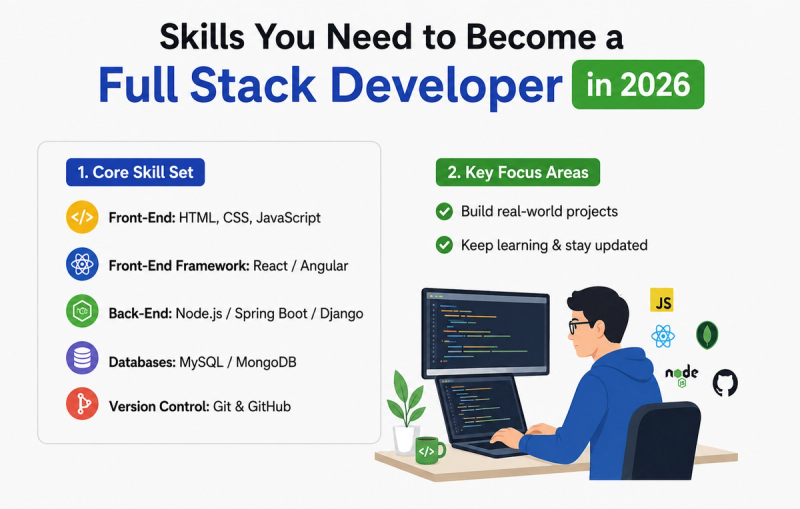
Strong programming basics, one front-end framework, one back-end framework, and working database knowledge cover most of it:
Core programming - Java, Python, or JavaScript fundamentals
Front-end basics - HTML, CSS, and JavaScript
A front-end framework - React or Angular
Back-end development - Node.js, Spring Boot, or Django
Databases - MySQL or MongoDB
Version control - Git and GitHub
Full Stack Developer Skills
Miss any one of these, and a Full Stack Developer in 2026 candidate tends to stall in the technical round, right when the interviewer asks how the pieces connect.
Which Learning Path Works Best for a Full Stack Developer in 2026?
It depends on free time and discipline, though structured coaching gets most people job-ready faster than solo study.
Self-study is fine on paper. Reality looks different once a doubt sits unanswered for days because a forum thread went cold.
A guided course fixes the pace and reviews code before it reaches a job application, since interviews for a Full Stack Developer in 2026 role now lean on practical skill over memorised theory. A well-structured Full Stack Development Course in Thane builds this review into the syllabus.
What Projects Should a Full Stack Developer in 2026 Build?
Projects where the front end depends on the back end, not disconnected exercises stitched together for a portfolio:
A task manager with login and session handling
An online store with a working cart and checkout
A blog platform with an admin panel
A booking system with real-time availability
Push each one to GitHub with a clear readme. Recruiters check that link before opening a resume.
Why Is Demand High for a Full Stack Developer in 2026?
Because companies would rather hire one person for both ends of an application than pay two specialists.
Open a few job postings from Bangalore, Pune, Noida, or Thane and the pattern repeats: React or Angular listed right next to Spring Boot or Node.js, in the same posting. Companies aren't hiding what they want anymore. A Full Stack Developer in 2026 who can move across both sides of that list has an edge over someone stuck on just one.
Startups notice this first. A five-person team can't afford three separate specialists, so they hire generalists and let them jump between tasks as needed. That is also why enrolment for a Full Stack Development Course in Thane keeps climbing among people switching careers - they are chasing exactly this kind of flexibility.
How Long Does It Take to Become a Full Stack Developer in 2026?
Most people need four to six months, though prior background and daily practice shift that number.
Someone starting from zero usually needs the full six months to get comfortable across all six areas. Anyone who knows basic programming can finish faster, often in three to four.
A structured course tends to shorten this, cutting out the trial-and-error that eats time for self-taught learners.
What Does the Hiring Process Look Like for a Full Stack Developer in 2026?
Expect a coding round, a project discussion, and a system design conversation:
Resume screening based on visible, working projects
A technical round covering data structures
A project walkthrough where the candidate explains their own code
A final round on basic system design
Interviewers can tell within minutes whether someone built a project or copied one from a tutorial. A candidate who explains their own decisions clearly moves through this process faster than one relying on memorised answers.
Frequently Asked Questions
1. Is it hard to become a Full Stack Developer in 2026?
Not with a structured path. Random tutorials without a sequence make it harder than needed.
2. Do I need a computer science degree?
No. Many Full Stack Developer in 2026 candidates come from non-technical backgrounds, some through a Full Stack Development Course in Thane.
3. Which language should I start with?
JavaScript is a common starting point since it works on both front end and back end.
4. Can I become job-ready in three months?
Only with prior experience and daily practice. Most beginners need four to six months.
5. What salary can a fresher expect?
It varies by city and company, but strong projects and interview preparation lead to better offers.
Follow us on Facebook and Instagram for the latest course updates, career tips, industry insights, student success stories, and exclusive learning resources.
 Chat to Support