How to Start an IT Career in Thane with Zero Experience in 2026
Can you start an IT career in Thane with zero experience in 2026? Yes in 6 to 9 months. Here's the honest, step-by-step roadmap that actually works.
I
ITDaksh Team
· 16 May 2026 ·16 min read
Share:
Contents
A structured comparison table showing IT career options available to freshers in Thane in 2026. The table lists roles including Data Analyst, Python Full Stack Developer, Java Full Stack Developer, and Data Science with AI — alongside the required background, key skills needed, and realistic job-ready timelines for each role.
Direct Answer
Yes, you can start an IT career in Thane with zero coding experience in 2026 and the realistic timeline from your first day of structured training to your first IT job offer is 6 to 9 months, depending on which role you target and how consistently you apply yourself.
That answer makes a lot of people uncomfortable, because it is simultaneously more achievable than they feared and more demanding than they hoped. This guide will not tell you it is easy. It will tell you exactly how it works step by step, role by role, month by month and it will be honest about what actually separates the freshers who get hired from the ones who complete courses and stay stuck.
Introduction: The Honest Reality of Starting an IT Career with No Experience
Every week in Thane, hundreds of graduates open a laptop, type “how to get into IT without experience,” and spend the next two hours reading articles that say things like “learn Python,” “do projects,” and “network on LinkedIn” without telling them what any of that actually means in practice.
Here is what those articles skip: the reason most freshers with zero experience fail to enter IT is not a lack of intelligence or effort. It is a structural problem. They are trying to learn without a system, building without feedback, and applying without preparation. They are doing all the right activities in completely the wrong sequence.
Think of it like trying to build a house by starting with the roof. The effort is real. The direction is wrong. The result is collapse not because you are not capable, but because the sequence matters as much as the work.
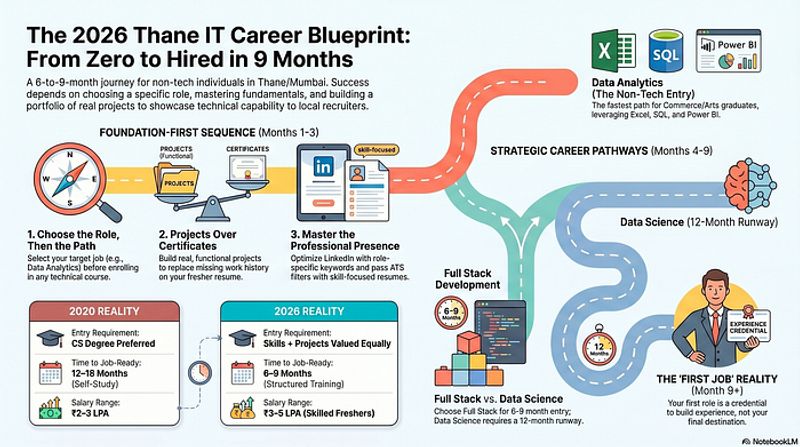
The freshers who successfully enter IT in Thane do three things differently. They choose a specific role first, then learn the skills that role requires, then build proof of those skills before applying. Not simultaneously. In sequence. This sounds obvious until you realise that most self-guided learners never actually do it this way.
Why Thane in 2026 Is Actually a Strong Market for Freshers
Thane is not just a suburb of Mumbai. It is an increasingly independent IT talent hub. The Thane-Belapur Road and Eastern Express Highway corridor has seen significant growth in mid-sized technology companies, fintech firms, and IT service providers over the past five years. Companies including those in BFSI, e-commerce, healthcare technology, and IT services regularly hire from Thane and the surrounding Navi Mumbai region, reducing the commute burden that historically pushed Thane-based talent toward Mumbai’s Bandra-Kurla Complex and Lower Parel.
According to placement data from Itdaksh Education’s 100+ placement drives, the majority of placed students find roles within the Mumbai Metropolitan Region including companies in Thane West, Airoli, Mahape, Turbhe, and Andheri without needing to relocate. This is a meaningful shift from five years ago, when the assumption was that every serious IT career required a BKC address on the offer letter.
The IT industry in India is projected to continue hiring at scale through 2026 and beyond, driven by digital transformation mandates in banking, insurance, healthcare, and government. NASSCOM data indicates that over 300,000 IT professionals are expected to be added to India’s workforce this year, with a significant share from tier-2 cities and MMR-adjacent talent pools. Thane-based freshers who are genuinely skilled are not at a disadvantage. They are in the right place at a good moment.
Step 1 — Choose a Specific Role Before You Choose a Course
This is where 80% of freshers make their first mistake. They choose a course based on what sounds impressive or what a friend recommended and then discover six months later that they are not sure what job they are actually qualified for.
The right sequence is the reverse. Choose the role first, then work backwards to the course that teaches you what that role requires.
(See the IT Career Options table above for roles, skills, and timelines)
If you are coming from a non-technical background commerce, arts, or any non-IT degree Data Analytics is the fastest and most accessible entry point into IT. It builds on skills you likely already have (Excel, logical thinking, data interpretation) and introduces programming and visualisation tools in a structured progression. The learning curve is gentler, the job market is wide, and the salary trajectory is strong.
If you have a technical background any engineering degree, BCA, BSc IT, or MCA and want to enter software development, Full Stack Development (Python or Java) is the appropriate path. The technical foundations you already have reduce the time needed to understand programming logic, which means you progress through the curriculum faster.
If you are interested in the intersection of AI, statistics, and data, Data Science with AI is the highest-ceiling option in 2026 but it requires the longest runway. Committing to this path means committing to 9 to 12 months of consistent, structured learning before you are genuinely job-ready at a competitive level.
At Itdaksh Education, every prospective student goes through a free career counselling session before enrollment. The purpose is not to sell a course. It is to understand the student’s background, timeline, financial situation, and goal and then recommend the track that matches all four. We turn students away from courses that do not fit their profile. It is an uncomfortable conversation in the moment, and the right one in the long run.
Step 2 Learn in the Right Sequence (This Is Everything)
Once you have chosen your role and enrolled in the right course, the single biggest factor in your success is the sequence in which you learn. Most self-guided learners get this completely wrong, and even some institutes get it wrong.
Here is the sequence that actually works, regardless of which IT track you choose:
You start with fundamentals not the tools. For a developer, this means understanding how the internet works, what a server does, how a database stores information, and what a programming language actually is before you write a single line of code. For a data analyst, this means understanding what data is, how it is structured, and what a business problem looks like before you open Power BI. This foundation phase feels slow. It is the most important part.
Then you learn the core tool of your track Python, Java, SQL, or Excel. You write small programmes, run queries, build formulas. You make errors. You fix them. This is not optional. The ability to debug your own mistakes is one of the most valuable skills an IT professional has, and it only develops through repeated error-and-correction cycles.
Then you move to frameworks and advanced tools Django, Spring Boot, Machine Learning libraries, Power BI, Tableau. These make sense only because you built the foundation first. Students who jump straight to frameworks without the foundation spend twice as long because they are simultaneously learning the tool and the concepts it relies on.
In Itdaksh Education’s curriculum, this sequence is built into the programme structure. We call it the “Foundation-First Principle.” Every batch, regardless of track, starts from absolute fundamentals before introducing frameworks. Students who have already studied IT sometimes find the first three weeks frustratingly basic. By week eight, they understand why — and they consistently outperform self-taught peers who skipped the foundation phase.
Step 3 Build Projects That Prove Your Skills
This is the step that separates job-ready students from course-completers. A certificate tells an interviewer you attended a programme. A project tells them what you can actually do.
For freshers with no experience, a project is not a nice-to-have. It is the primary evidence you have. Your resume has no work history. Your LinkedIn has no job titles. Your portfolio of real, functional, deployed projects is the only thing that can replace what experience would otherwise provide.
A project does not need to be sophisticated to be effective. It needs to be real and it needs to solve a genuine problem. A data analyst who has built a Power BI dashboard tracking sales performance for a hypothetical retail company has more to show in an interview than a person with two years of non-technical work experience. An interviewer at a company like Biztran Solutions or MCM Pvt. Ltd does not want to hear that you understand joins and aggregations. They want to see a query you wrote, a dashboard you built, and hear you explain the problem it solved.
At Itdaksh Education, project work is not supplementary it is a core pillar of the Skill Mastery Framework. Every student completes a capstone project before being considered eligible for placement support. The project is reviewed by faculty, refined through feedback, and then becomes the centrepiece of the student’s portfolio and interview performance. Students who present their own projects in interviews rather than memorised answers to conceptual questions consistently receive stronger interviewer responses.
Step 4 Build Your Professional Presence Before You Apply
Most freshers apply for jobs the moment they feel they have learned enough. This is too early. There is a step between learning and applying that almost everyone skips and skipping it costs them dozens of rejections that could have been avoided.
Your professional presence is the package around your skills. It includes three things: your resume, your LinkedIn profile, and your GitHub or portfolio link. Each one is a separate communication to a recruiter, and each one needs to be built with intention.
Your resume as a fresher should not be a template downloaded from the internet. It should be ATS-friendly meaning it is structured to pass automated screening tools that filter resumes before a human reads them. It should lead with your skills and projects, not your education and grades. A recruiter reading a fresher resume spends 6 to 8 seconds on it before deciding to continue or discard. Your projects and tools must be visible in those seconds.
Your LinkedIn profile should use keywords from the job descriptions you are targeting. If you are applying for Data Analyst roles, your profile headline, about section, and skills section should contain the words “Data Analyst,” “SQL,” “Power BI,” and “Python” because recruiters search LinkedIn using these exact terms. A profile without keywords is invisible to search, regardless of how impressive the underlying experience is.
At Itdaksh Education, resume building and LinkedIn optimisation are integrated into the placement preparation phase not an afterthought. Every student’s resume is reviewed against actual job descriptions for their target role before it is considered ready for distribution.
Step 5 Practise Interviews Until the Real Thing Feels Routine
The most underestimated step in starting an IT career is interview preparation. Most freshers spend 90% of their effort on learning and 10% on interview readiness. The job market rewards the opposite ratio in the final month before active applications.
An IT interview in 2026 has multiple rounds. A technical screening often on HackerRank or a live coding platform filters candidates before a human interview. A technical interview then tests your understanding of tools, projects, and problem-solving. An HR round evaluates your communication, confidence, and cultural fit. Freshers who have only studied and never practised under simulated pressure consistently underperform in all three rounds relative to their actual knowledge level.
Mock interviews serve a specific and irreplaceable function. They convert knowledge which lives in your memory into performance, which lives in your responses under pressure. The first mock interview is always uncomfortable. The fifth one is almost routine. By the tenth, you have developed the muscle memory for structured, confident answers to the questions that interviewers consistently ask.
At Itdaksh Education, mock interviews are the fifth pillar of the Skill Mastery Framework. Students who clear the mock interview requirement are the ones we consider eligible for placement support. Not because we are gatekeeping but because we know from 100+ placement drives and 12,000+ students trained that the students who crack real interviews are overwhelmingly the ones who practised under real interview conditions first.
The Contrarian Truth About Getting Your First IT Job
Here is the thing nobody will say directly to a fresher: your first IT job will almost certainly not be your dream job. And that is completely fine because your first job is not your career. It is your credential.
Most freshers spend months waiting for the perfect role the right company, the right salary, the right tech stack, the right location. Meanwhile, their classmates who accepted a ₹3 LPA role at a smaller firm are six months into building real work experience. By the time the first group finally lands their ideal company, the second group has already moved up internally or switched to a better company with a year of experience behind them.
The first IT job in Thane is not about the package. It is about the proof. Once you have a year of professional IT experience, the job market opens dramatically and you now negotiate from a position of demonstrated capability rather than potential. The fresher who holds out for the perfect entry is often outrun by the fresher who entered imperfectly and iterated.
This is exactly the mindset we instil at Itdaksh Education. We help students target appropriate entry-level roles not undersell themselves, but also not hold out for roles their profile cannot yet command. Career growth is a function of continuous movement, not a single perfect landing.
Tactical Section: Your Week-by-Week Action Plan for the First 90 Days
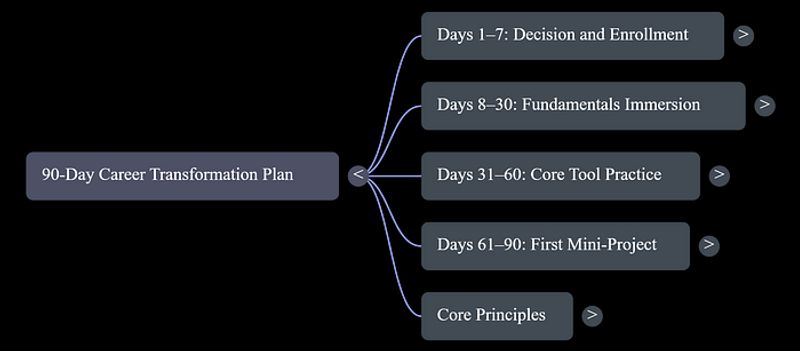
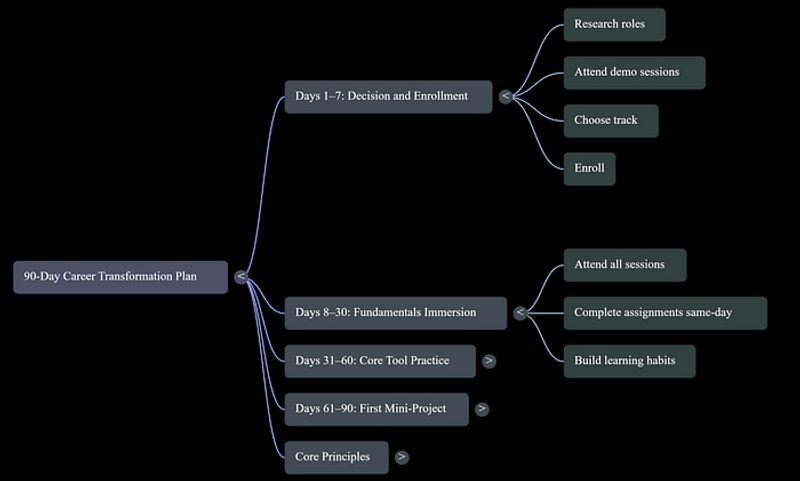
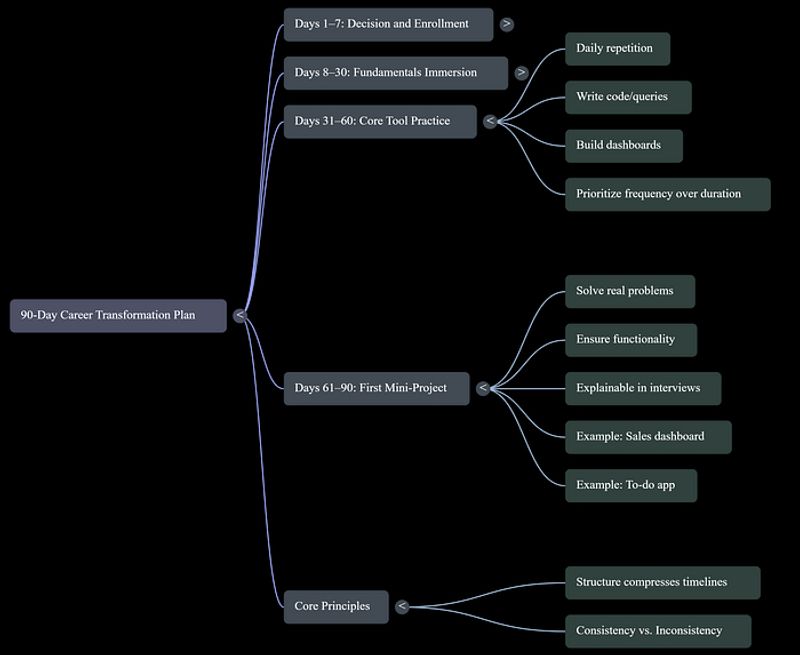
A week-by-week visual action plan covering Days 1 through 30 of an IT fresher's journey — showing the decision and enrollment phase (Days 1–7) and the fundamentals immersion phase (Days 8–30) with daily learning goals and milestones.A continuation of the 90-day IT career roadmap visual covering Days 31 through 60 — the core tool practice phase. Shows daily coding, querying, and dashboard-building activities with guidance on frequency and consistency of practice for freshers in Thane. The final segment of the 90-day IT career roadmap visual covering Days 61 through 90 — the first mini-project phase. Illustrates project ideas such as a sales dashboard, a to-do web application, and a customer segmentation model, with guidance on making the project functional and interview-explainable.
If you are starting from zero today, here is exactly what to do in the first 90 days. This is the plan, not the philosophy.
Days 1–7 Decision and enrollment.
Research roles using the career options table above. Attend free demo sessions at structured institutes. Choose the track that matches your background and timeline. Enroll. Do not spend more than 7 days deciding.
Days 8–30 Fundamentals immersion.
Attend every session. Complete every assignment the same day it is given. Do not skip. Do not postpone. The first 30 days set the learning habit that carries the next 5 months. If the habit does not form here, it will not form later.
Days 31–60 Core tool practice.
Write code, run queries, build dashboards every single day even if it is 30 minutes. Daily repetition at this stage is worth more than 4-hour weekend sessions. The brain builds skill through frequency, not duration.
Days 61–90 First mini-project.
Start building something that solves a real problem you can explain. A sales dashboard. A to-do web application. A customer segmentation model. It does not need to be impressive. It needs to be yours, functional, and explainable in an interview.
By day 90, if you have followed this plan, you will be further along than most freshers who started six months before you without structure. Structure compresses timelines. Inconsistency extends them.
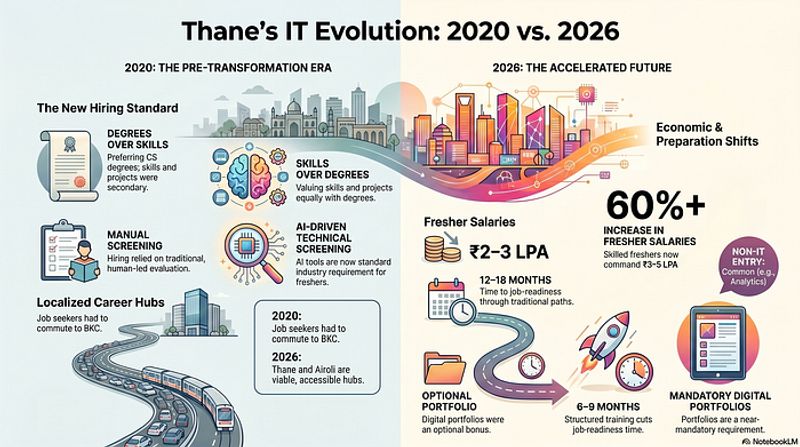
Thane Then vs Thane Now: The IT Career Landscape Has Shifted
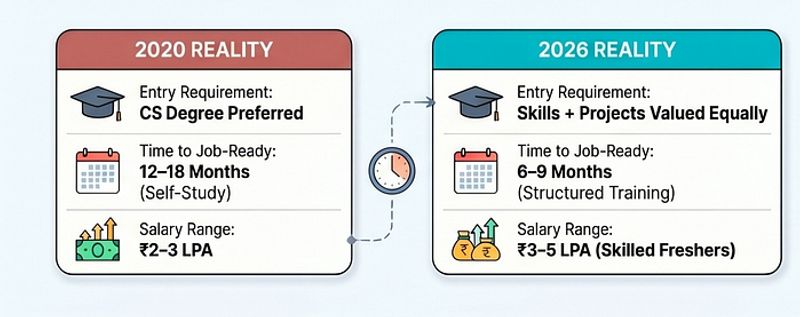
A before-and-after comparison table contrasting the IT job market in Thane in 2020 versus 2026. Covers factors including local hiring availability, commute requirements, self-study timelines, structured training effectiveness, and the volume of online learning noise affecting fresher career decisions.
The structural shift that matters most is the last row. In 2020, a self-motivated fresher with no formal guidance could realistically enter IT in 12 to 18 months of disciplined self-study. In 2026, the same path takes longer not because IT has become harder, but because the noise has increased exponentially. YouTube channels, bootcamps, online courses, and free resources have flooded the market. The person trying to self-navigate through this noise spends as much time figuring out what to learn as they do actually learning it. Structured training with a proven curriculum removes that navigation cost entirely and replaces it with focused execution time.
A visual summary highlighting the most significant structural shift in Thane's IT hiring landscape — specifically showing how self-guided learning timelines have increased from 12–18 months in 2020 to longer in 2026 due to information overload, and how structured training now provides a decisive competitive advantage for freshers.
FAQs
Q1: Can I get an IT job in Thane without a computer science degree?
Yes, and this is increasingly common. A significant proportion of IT freshers placed by institutes including Itdaksh Education come from non-IT educational backgrounds BBA, BSc, BCom, BA, and even diploma holders. What hiring companies evaluate is demonstrated skill, not the degree that preceded it. A Data Analyst role, for example, does not require a CS degree it requires SQL proficiency, a working knowledge of Power BI or Tableau, Python basics, and the ability to present insights from data. These are learnable skills, and a degree does not grant or deny them.
Q2: How long does it realistically take to get a first IT job from zero experience in Thane?
For a Data Analyst or Digital Marketing role, the realistic timeline with structured training is 5 to 7 months. For Python Full Stack or Java Full Stack Developer roles, it is 6 to 9 months. For Data Science roles, plan for 9 to 12 months. These timelines assume consistent daily practice, completion of real projects, and active mock interview preparation in the final month. Self-study without structure typically doubles these timelines.
Q3: Is it too late to enter IT at 25, 27, or 30 years old?
No. Age is a significantly smaller barrier than most people believe. Hiring managers in IT evaluate technical skill and cultural fit not date of birth. The more relevant question is whether your learning timeline matches your financial situation. A 30-year-old with 3 months of savings to invest in training and a 6-month runway to first employment is in a perfectly viable position. A 22-year-old with no discipline and no project portfolio is in a worse one, regardless of age.
Q4: What is the minimum salary I should expect in my first IT job in Thane?
For a genuinely skilled fresher someone with a real project, a clean resume, and mock interview practice the realistic expectation in Thane and Mumbai MMR in 2026 is ₹3 to ₹4 LPA for Data Analytics and entry-level developer roles. Do not accept less than ₹2.5 LPA for any IT role that requires programming skills. The highest salary drawn among Itdaksh Education’s placed alumni stands at 8 LPA, demonstrating the ceiling that structured training can reach.
Q5: Which IT course is best for a commerce or arts graduate with no coding experience in Thane?
Data Analytics is the most accessible first step. It leverages skills you likely already have working with numbers, understanding business context, logical organisation of information and adds SQL, Excel, Python, Power BI, and Tableau in a structured sequence. Most commerce graduates who choose this path find the first month significantly less intimidating than they expected. The Data Science & Analytics combined programme at Itdaksh Education is specifically designed for students with no prior coding experience, beginning from absolute fundamentals.
Q6: Do IT companies in Thane hire freshers directly from training institutes?
Yes. Itdaksh Education alone has conducted 100+ placement drives with a hiring network of 1,500+ companies, including placements at Biztran Solutions, MassTech Solutions, EPCPROMAN Pvt. Ltd, Infohybrid, and MCM Pvt. Ltd. The key distinction is that companies hire from institutes whose training they trust meaning the students they interview consistently demonstrate real skill. This is why placement support from a reputable, system-driven institute is materially different from a generic job board listing.
Starting an IT career in Thane with zero experience in 2026 is realistic the timeline is 6 to 9 months with structured, disciplined training.
The most common mistake is choosing a course before choosing a role. Always decide the destination first and work backwards to the path.
The sequence that works: Choose role → Learn fundamentals first → Build real projects → Create professional presence → Practise mock interviews → Apply with preparation.
Thane’s IT job market has matured significantly. Freshers no longer need to commute to BKC or Andheri for credible IT employment opportunities.
A project portfolio replaces experience for freshers. Without one, you are competing on your resume alone the hardest possible position as a fresher.
The first IT job is not the destination. It is the credential. Do not hold out for perfect. Enter well and grow from there.
Structured training compresses the timeline that self-study extends. The noise in the self-learning landscape in 2026 is the real barrier not the concepts.
Download the Free Zero-to-One IT Career Roadmap the same 90-day plan Itdaksh Education uses to take students from zero experience to job-ready in Thane. Includes daily study schedule, project ideas, and interview prep checklist.
Book a Free Career Counselling Session: 8591434628
WhatsApp: 918591434628
Itdaksh Education 201 Ganesh Tower, Opposite Thane Railway Station, Thane West. ISO 9001:2015 & MSME Certified. 12,000+ Students Trained. 4.9/5 on Google.
#IT career Thane
#fresher IT job India 2026
#zero experience IT
#data analytics Thane
# full stack developer Thane
# IT training institute Thane
#Itdaksh Education
#IT placement Mumbai MMR
#career switch to IT India
#IT fresher guide

 Chat to Support