Java Full Stack Developer Roadmap with Practical Projects and Placement
Explore a practical Java Full Stack Developer roadmap with projects, skills, tools, and placement strategies.
Mrityunjay Pandey
· 11 August 2026 ·9 min read
Share:
Contents
Rohan sent out forty job applications after a six-week React course and heard back from two companies. His code worked, but in an interview he froze when asked how a button click ended up saving a row in MySQL. That gap is what a Java Full Stack Developer Roadmap is built to close.
What Is a Java Full Stack Developer Roadmap?
A Java Full Stack Developer Roadmap is a fixed order of skills, starting at Core Java and ending at deployment.
Picture it as a build sequence, not a checklist. Jumping into React before JavaScript feels solid, or opening Spring Boot before Core Java feels comfortable, just pushes the confusion further down the line.
Why Do You Need a Java Full Stack Developer Roadmap in 2026?
Companies hiring for entry-level roles in 2026 rarely split front-end and back-end work between two juniors. A posting out of Pune, Noida, Bangalore, or Thane now routinely asks for both React or Angular and Spring Boot. Candidates without a Java Full Stack Developer Roadmap tend to answer only half the interview well.
What Are the Key Stages in a Java Full Stack Developer Roadmap?
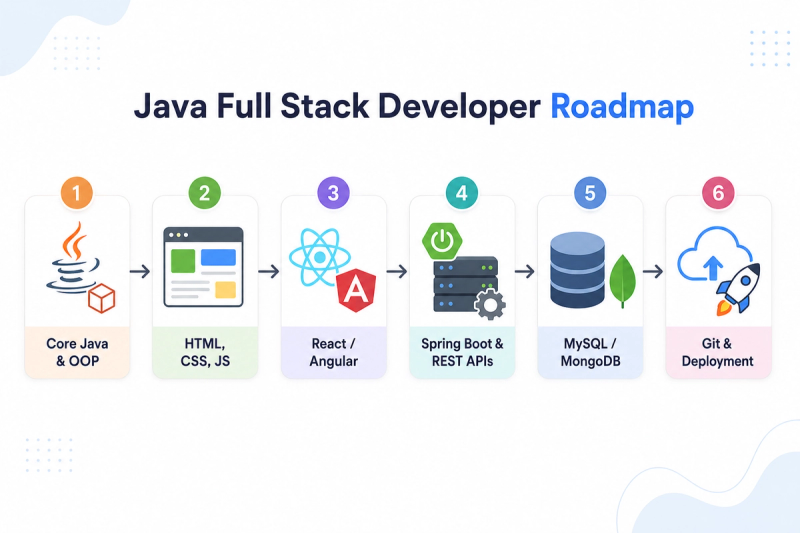
The roadmap runs through six stages: Core Java, front-end basics, a front-end framework, back-end development, databases, and deployment.
Core Java and OOP - classes, objects, inheritance, exception handling
Front-end basics - HTML, CSS, JavaScript
A front-end framework - React or Angular, one is enough
Back-end development - Spring Boot and REST APIs
Databases - MySQL or MongoDB
Deployment - Git, GitHub, basic cloud hosting
Most learners are already sketching out small applications by this stage, instead of copying code.
Key Stages in a Java Full Stack Developer Roadmap
Which Practical Projects Fit Into a Java Full Stack Developer Roadmap?
The projects worth your time are ones where the front end depends on the back end, not two disconnected exercises in a portfolio.
A student management system on Spring Boot and MySQL
An online bookstore with React and a REST API
A task manager with login and sessions
A product catalog with search
Push each one to GitHub with a short readme. Interviewers often open that link before the resume, which is why a Java Full Stack Developer Roadmap without something to show rarely carries weight.
How Does a Java Full Stack Developer Course Support Your Java Full Stack Developer Roadmap?
A Java Full Stack Developer Course mainly gives the roadmap a deadline, something self-paced learning rarely has. Left alone, most learners stall around the framework stage. A decent Java Full Stack Developer Course keeps a fixed weekly rhythm and checks your work before you apply.
How Do You Choose the Right Java Full Stack Developer Coaching for a Java Full Stack Developer Roadmap?
The Java Full Stack Developer Coaching worth paying for involves a live person reading your code, not a pre-recorded video series with a forum attached. Learners near Thane often find in-person Java Full Stack Developer Coaching clears doubts faster. ITDaksh runs a Java Full Stack Development course in Thane built around classroom teaching plus project work, a fit for this stage of Java Full Stack Developer Coaching.
The real difference between one Java Full Stack Developer Institute and another usually comes down to whether a mentor reads your code line by line, or just confirms it runs.
Factor
Self-Study
Java Full Stack Developer Institute
Structure
Built by you, adjusted as you go
Fixed, sequenced syllabus
Doubt resolution
Forums and trial and error
Direct mentor access
Project feedback
Rare
Reviewed line by line
Placement support
None
Resume and interview prep
Time to job-ready
Often 8 to 10 months
Usually 4 to 6 months
Self-study can work if discipline and free time are on your side. Most professionals get through a Java Full Stack Developer Roadmap faster with a Java Full Stack Developer Institute setting the pace.
How Does a Java Full Stack Developer Roadmap Lead to Placement?
The roadmap earns its keep at the end, when it hands an interviewer something concrete to judge: a resume, a working project, and a candidate who can explain their choices.
Resume review built on real outcomes
Mock interviews with usable feedback
Data structures and coding practice
A basic grounding in system design
A Java Full Stack Developer Course usually folds this stage in near the end, and a Java Full Stack Developer Institute bundles it into the final weeks. Candidates who skip straight to applying without it tend to lose momentum fast.
Frequently Asked Questions
How long does a Java Full Stack Developer Roadmap take to complete?
Four to six months with steady practice, longer part-time.
Do I need prior coding experience to start?
No. Core Java is where most learners begin from zero.
Is Spring Boot necessary in a Java Full Stack Developer Roadmap?
Yes, most Indian companies expect it as the back-end.
Can I follow a Java Full Stack Developer Roadmap through self-study alone?
Yes, though a Java Full Stack Developer Course or Java Full Stack Developer Institute usually shortens the timeline.
What salary can a fresher expect after this roadmap?
It varies by city, but solid projects and real Java Full Stack Developer Coaching help.
Follow us on Facebook and Instagram for the latest course updates, career tips, industry insights, student success stories, and exclusive learning resources.
#Java Full Stack Developer
#Java Full Stack Developer Course

 Chat to Support