What is a Python Full Stack Developer? Roles, Skills & Salary in 2026
Job postings for Python Full Stack Developer are everywhere right now. And the salary numbers attached to them are hard to ignore. But before you go enroll in some course, it helps to actually understand what the job involves, what you need to learn, and what realistic expectations look like in 2026.
The Role, Explained Simply
Websites are not one thing. They are two things working together.
Whatever you see on your screen when you visit a site - the design, the buttons, the navigation, the forms - someone had to code that. That someone works on the frontend.
Whatever processes your data behind the scenes - saving your account info, checking your password, fetching the right products - someone coded that too. That is the backend.
A Python Full Stack Developer codes both. They are not a specialist. They are a generalist who moves across both layers without needing to hand off work to another developer.
Python is their primary backend language. Django and Flask are the two frameworks they usually pick from. On the frontend, they work with the standard web trio - HTML, CSS, JavaScript - often with React on top.
The Actual Work
No two weeks look the same in this role. The work shifts depending on what the product needs.
Some days it is CSS issues that only show on mobile. Other days it is database queries, API debugging, or a form that refuses to save data correctly.
Work that typically falls on their plate:
- Writing frontend pages using HTML, CSS, JavaScript, and React
- Handling all the backend logic through Django or Flask
- Building the APIs that allow the frontend and backend to exchange data
- Working with databases like PostgreSQL, MySQL, and MongoDB
- Pushing code, handling deployments, and sorting out production issues
- Using Git for version control, Docker for containers, and cloud tools for hosting
The advantage of hiring a Python Full Stack Developer over two separate specialists is speed. They do not need to coordinate with another person to move a feature from design to working code.
What You Need to Actually Know
The skill list looks long. It gets manageable when you stop trying to learn it all at once.
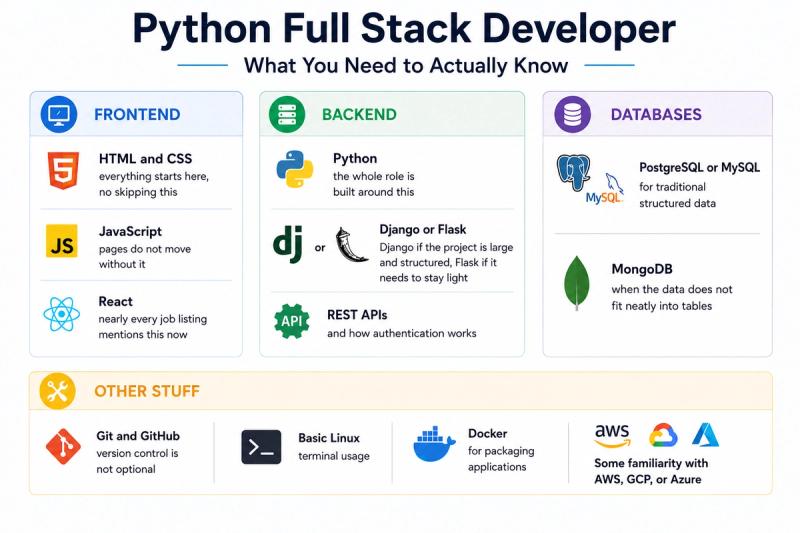
Frontend:
- HTML and CSS - everything starts here, no skipping this
- JavaScript - pages do not move without it
- React - nearly every job listing mentions this now
Backend:
- Python - the whole role is built around this
- Django or Flask - Django if the project is large and structured, Flask if it needs to stay light
- REST APIs and how authentication works
Databases:
- PostgreSQL or MySQL for traditional structured data
- MongoDB when the data does not fit neatly into tables
Other Stuff:
- Git and GitHub - version control is not optional
- Basic Linux terminal usage
- Docker for packaging applications
- Some familiarity with AWS, GCP, or Azure
Most people who go this route start with Python, move into Django, get a couple of projects working, and then pick up the remaining skills as they go. Trying to learn everything in parallel usually ends badly.
Where This Role Fits in a Company
Python Full Stack Developer is not one fixed position. It means different things at different companies.
- At a large company, a junior in this role mostly works on small features and gets a lot of code review
- Mid-level developers take ownership of entire features and start weighing in on technical decisions
- Senior developers design how systems are built and often manage other developers
- At a startup, someone with this title frequently handles frontend, backend, database, deployment, and sometimes product decisions - all of it
- As a freelancer, you are the entire team for whoever hired you
The reason startups lean hard on this profile is obvious - one Python Full Stack Developer covers ground that would otherwise need multiple hires.
Pay in 2026
India:
- 0 to 1 year of experience: Rs. 4 LPA to Rs. 7 LPA
- 2 to 4 years: Rs. 8 LPA to Rs. 16 LPA
- 5 years and above: Rs. 20 LPA to Rs. 35 LPA, sometimes higher
United States:
- Starting out: $70,000 to $90,000 per year
- A few years in: $100,000 to $130,000 per year
- Senior level: $140,000 to $180,000 and above
Freelancers working independently charge anywhere from $50 to $150 per hour. The rate depends on experience, niche, and how well they can market themselves.
Python's expanding role in AI-backed products is also pushing compensation higher for this profile. More companies are building with Python across both the web layer and the intelligence layer - and they want one developer who understands both.
Why Python Keeps Winning
Node.js, PHP, Ruby - all valid choices. Yet Python keeps pulling ahead.
The syntax is easier to read than most alternatives. Maintaining a Python codebase months later is far less painful than many other languages.
Django removes a huge amount of setup work. Authentication, admin tools, database management - it ships with all of that ready to go. A Python Full Stack Developer using Django ships products faster than most other stacks allow.
Python also powers the machine learning world. A developer who knows Python web development can move into AI product work without learning a new language entirely. That flexibility matters long-term.
Time to Get Job-Ready
Realistically, 6 to 12 months of daily practice gets someone from zero to hirable as a Python Full Stack Developer. With a programming background already in place, that range drops to 4 to 6 months.
Progress comes from building things, not from watching things being built. Pick one small project and actually complete it - connect a Django backend to a simple frontend, get data flowing both ways, deploy it somewhere. That experience is worth more than dozens of unfinished tutorial projects.
For aspiring developers looking to accelerate their learning, our Python Full Stack Developer Course in Thane offers practical training, live projects, and placement-focused preparation.
FAQ
Q1. Is Python actually good for full stack work?
Very much so. Django handles most backend requirements out of the box. Flask works well for lightweight APIs. Both connect cleanly with React on the frontend side.
Q2. No degree - can I still get hired?
Yes. Employers in this field generally care about what you have built. A GitHub profile with real, working projects gets more attention than academic credentials.
Q3. Should I start with Django or Flask?
Django is the better starting point. It has more structure built in, which helps new developers understand how different pieces of a web application fit together. Flask involves more decision-making upfront, which gets difficult when you are still learning.
Q4. How much daily practice is realistic?
Two hours of focused work daily is enough to make consistent progress. The quality of those two hours matters more than the number.
Q5. What order should I learn things in?
Python first. Then HTML and CSS. Then basic JavaScript. Then Django. Then build a project that puts all of it together. One completed full stack project teaches more than months of isolated skill-building.
Final Thoughts
The demand for a skilled Python Full Stack Developer is not a trend that is going away. The pay is solid, the work is varied, and Python's growing importance in AI means the role keeps getting more valuable. Getting there takes time, but the path is not complicated - just consistent.
For more insights and updates, follow us on Instagram and Facebook now.
 Chat to Support