Python Full Stack vs Java Full Stack in 2026 — A Brutally Honest Career Decision Guide
I
ITDaksh Team
· 13 May 2026 ·13 min read
Share:
Contents
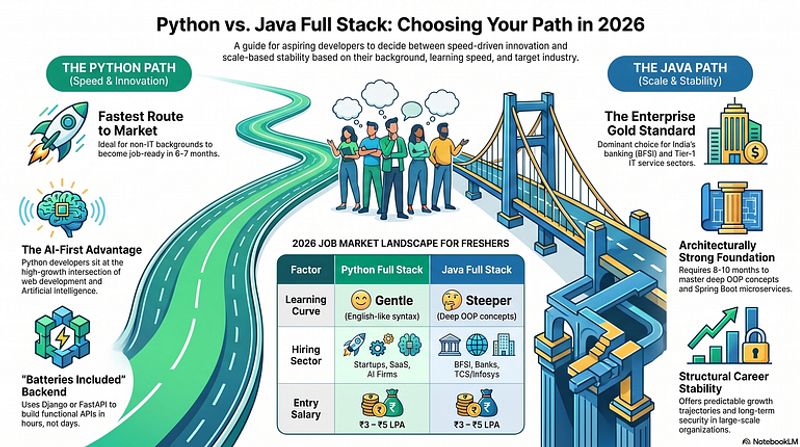
Comparison chart of Python Full Stack and Java Full Stack architecture for developers in 2026
Direct Answer
If you are a complete beginner with no prior coding experience, Python Full Stack is the smarter starting point in 2026. If you come from a computer science or engineering background and want to target enterprise companies, banking, and large-scale system roles, Java Full Stack has a stronger long-term ceiling in those specific domains.
That is the direct answer. But the decision you are actually making is far more nuanced than a language preference and getting it wrong costs you 6 to 9 months of effort pointed in the wrong direction. So before you enroll in anything, read this completely.
Introduction : The Question Nobody Is Actually Asking
Most articles frame this as a technical debate. Python is readable. Java is verbose. Python has a simpler syntax. Java is strongly typed. And so on.
But here is what none of them tell you: the language is almost irrelevant to your career decision. What matters is the ecosystem each language lives in, the companies that use it, the roles it leads to, and the salary trajectory it produces over 3 to 5 years not just the starting package.
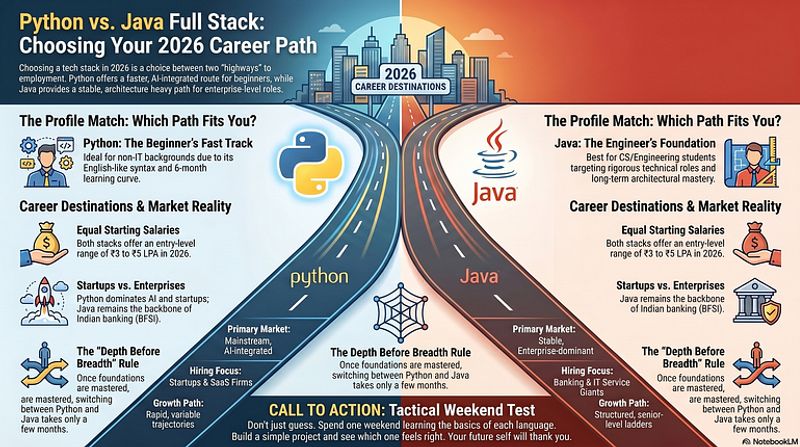
Think of it like choosing between two roads to the same city. One is a well-lit, newer highway with clear signage and lighter traffic. The other is an older, wider highway that has been carrying heavier vehicles for decades. Both reach the city. The one you choose depends on what you are driving and how fast you need to get there.
Python Full Stack is the newer highway. Java Full Stack is the older one established, heavy, and deeply embedded in India’s largest enterprises. Neither is wrong. Both lead to employment. The question is which one is right for your specific situation.
What You Actually Learn in Each Path
(See the architecture comparison above)
Both Python Full Stack and Java Full Stack share the same frontend foundation HTML, CSS, JavaScript, and a modern UI framework like React. The difference begins at the backend and compounds from there.
In Python Full Stack, the backend is built using Python with Django, Flask, or the increasingly popular FastAPI. Python’s backend frameworks are designed to move fast. Django, for example, follows a “batteries included” philosophy it gives you authentication, admin panels, ORM, and routing out of the box. A developer can build a functional API in hours. This speed is why startups, product companies, and AI-first organisations overwhelmingly choose Python for their backend systems.
In Java Full Stack, the backend is built on Core Java with Spring Boot as the primary framework, alongside Hibernate for database mapping and often Microservices architecture for large-scale systems. Spring Boot is not fast to set up, but it is extraordinarily powerful, deeply configurable, and battle-tested at enterprise scale. Companies like TCS, Infosys, Wipro, and the entire BFSI (Banking, Financial Services, and Insurance) sector in India run critical systems on Java Spring Boot. These systems do not fail, do not need to be rebuilt every two years, and require engineers who understand the architecture deeply — not just the syntax.
This is where most articles either sugarcoat Java or oversimplify Python. Here is the reality.
Python has a gentler entry. Its syntax reads almost like English. A beginner can write a working Django REST API within two to three weeks of consistent practice. The mental overhead is lower in the early weeks, which means you progress faster, stay motivated longer, and reach project-building stage sooner. For someone switching from a non-IT background commerce, arts, science, or any field without prior programming Python’s early momentum is a genuine career advantage, not just a technical preference.
Java demands more upfront. Core Java concepts like Object-Oriented Programming, inheritance, polymorphism, interfaces, and exception handling must be solid before Spring Boot makes any sense. This is not a flaw it is architecture. Java forces you to understand the foundations because the systems it powers cannot afford a developer who has skipped those fundamentals. The learning curve is steeper in weeks 1 through 8. But the developer who survives that curve comes out structurally stronger.
At Itdaksh Education, we observe a consistent pattern across both our Python Full Stack and Java Full Stack batches. Students from non-IT backgrounds who choose Java often hit a difficult wall around week 3 not because they lack intelligence, but because the abstract nature of Java’s OOP concepts requires a different mental model than they have ever used before. Students from CS or engineering backgrounds, on the other hand, typically find Java’s structure familiar and move through it with more confidence. This is one of the primary reasons we counsel students individually before course selection the right path is not universal.
According to job postings on LinkedIn and Naukri as of early 2026, Java-based roles Spring Boot Developer, Java Backend Developer, Full Stack Java Engineer have a higher volume of listings from large enterprises and BFSI companies in India. This is not surprising. India’s banking sector, insurance industry, and tier-1 IT service companies run hundreds of thousands of lines of Java code that need to be maintained, upgraded, and extended. That demand is structural and stable.
Python-based full stack roles, however, are growing at a faster rate, particularly in startups, SaaS companies, fintech product firms, and AI-first organisations. The explosion of generative AI, machine learning integration, and data-driven product development has placed Python developers at the centre of a wave that is still building. A Python Full Stack developer in 2026 sits at the intersection of web development and AI and that intersection is where the most interesting and highest-growth opportunities currently exist.
For freshers in India, the salary difference at the entry level is less dramatic than most people expect. Both paths start in the ₹3 to ₹5 LPA range for genuinely skilled freshers. The divergence happens at the mid-level 2 to 4 years of experience. Java developers in large enterprise and BFSI roles tend to have structured increments and senior-level roles with high stability. Python developers in product companies tend to have faster growth trajectories but more variable career paths.
The highest salary drawn among Itdaksh Education’s placed alumni across both Full Stack programmes currently stands at 8 LPA, with placed students working at companies including Biztran Solutions, MassTech Solutions, and Infohybrid — roles that span both Python and Java stacks.
The Contrarian Truth: The Stack You Learn Is Not the Stack That Limits You
Here is what most comparison articles will never say, because it undermines the entire premise of making a definitive choice: after 2 years of professional experience, the stack you started with matters far less than most people believe.
The developers who grow fastest in their careers are not the ones who chose the “right” language. They are the ones who built a deep understanding of how software systems work APIs, databases, authentication, deployment, version control, scalability and then applied that understanding to whatever stack their employer uses.
Python and Java are both means to that end. The developer who completes a rigorous Python Full Stack programme, builds real projects, understands REST API design, knows how databases work, and has deployed an application to AWS that developer can learn Spring Boot in 3 months on the job. Similarly, a strong Java Full Stack developer can pick up Django in weeks because they already understand MVC architecture, ORM, and backend logic.
The dangerous myth is that you are permanently committing to one language. You are not. You are committing to one learning methodology. Choose the path that gets you to project-building fastest and job-ready most reliably. The language will evolve. Your foundational understanding is what carries you.
At Itdaksh Education, we follow what we call the “Depth Before Breadth” principle in our curriculum. Whether a student is in the Python or Java Full Stack programme, the first phase is always the same: understand how the web works, how HTTP requests travel, what a server does, and why a database exists before you write a single line of framework-specific code. This foundation is why our students are not just syntax-trained — they are architecturally literate. And architecturally literate developers switch stacks far more easily than those who have only memorised commands.
Who Should Choose Python Full Stack
Python Full Stack is the right choice if you match most of the following profile:
You come from a non-IT educational background commerce, science, arts, or any stream without formal programming training. Python’s syntax is forgiving in the early weeks, which gives non-technical beginners momentum rather than frustration.
You want to enter the job market within 6 to 7 months. Python’s ecosystem allows you to build a functional, deployable full stack application faster than Java’s, which means your portfolio grows more quickly.
You are interested in the intersection of web development and AI. Python is the dominant language in machine learning, data science, and generative AI. A Python Full Stack developer in 2026 is one upskilling step away from becoming an AI-integrated developer and the market is paying a premium for that combination.
You want to target startups, SaaS companies, fintech product firms, or any organisation building new digital products rather than maintaining legacy enterprise systems.
Java Full Stack is the right choice if you match most of the following profile:
You come from a computer science, IT engineering, or any technical background where you have already been introduced to Object-Oriented Programming concepts. Java’s structure will feel logical rather than foreign.
You are targeting large enterprises TCS, Infosys, Wipro, Capgemini, Accenture or the BFSI sector, where Spring Boot and Java microservices are the dominant technology stack. These companies hire Java developers at scale.
You are willing to invest 8 to 10 months to build a genuinely strong foundation before entering the job market. The extra time you spend on Core Java OOP, Spring Boot, and Hibernate pays dividends at the interview stage in these companies, where technical rounds are rigorous and architecture-aware.
You value long-term stability over rapid early growth. Large enterprise Java roles offer structured increments, strong job security, and a well-defined seniority ladder that smaller product companies often do not.
Five years ago, the comparison was simpler. Java had massive enterprise dominance. Python was primarily the language of data science, not web development. A fresher choosing Java Full Stack had access to a deeper job pool and a more established career path. Python web developers were largely working in smaller firms or early-stage startups.
By 2026, that landscape has shifted substantially. Python’s web frameworksparticularly FastAPI and Django have matured significantly. Cloud-native development, containerised applications, and AI-integrated products have created a new wave of Python backend demand that did not exist in 2021. At the same time, Java’s Spring Boot ecosystem has not shrunk it has consolidated. The enterprise companies that run on Java have not migrated and will not migrate in the near term, which means Java demand is stable, deep, and consistent. What has changed is that Python has opened a new market rather than taken Java’s existing one.
For a fresher in 2026, this means both paths have genuine employment depth. It is no longer the case that Python Full Stack is the “risky” choice or that Java is the only safe one. The risk lies only in making the choice without understanding your own profile which is exactly what the PATH Framework above is designed to prevent.
Tactical Section: How to Test Your Stack Decision Before You Commit
Before you spend a rupee on any course, do this. It takes one weekend and will tell you more than any comparison article.
Day 1 — Try Python: Install Python and VS Code. Follow a free 2-hour Django introduction on YouTube. Build a simple “Hello World” web page that accepts a form input and displays it back. Note how you feel frustrated, curious, energised, or confused.
Day 2 — Try Java: Install JDK and IntelliJ IDEA. Follow a free 2-hour Core Java OOP tutorial. Write a simple class with inheritance and a main method. Note how it feels compared to yesterday.
This is not about which was easier. This is about which made you more curious. Curiosity is a stronger predictor of completion than ease. If day 1 made you want to know what else Django can do, choose Python. If day 2 made you want to understand how the class structure works more deeply, choose Java. Your instinct at this stage is more accurate than any algorithm.
At Itdaksh Education, we offer free demo classes for both Python Full Stack and Java Full Stack programmes precisely for this reason. The demo is not a sales exercise it is a diagnostic. Students who attend both demos consistently make better enrollment decisions than those who choose based on articles alone.
Career timeline comparison of Python Full Stack versus Java Full Stack from 2021 to 2026 in India
FAQs
Q1: Is Python Full Stack easier to learn than Java Full Stack for a complete beginner? In the early weeks, yes. Python’s syntax is significantly more readable than Java’s, and Django’s “batteries included” approach means beginners build functional applications faster. However, “easier” does not mean better. Java’s structured approach forces you to learn Object-Oriented Programming deeply, which builds a stronger software foundation over time. For a complete beginner with no coding background, Python’s early momentum reduces dropout risk, which is a real and underappreciated factor in course completion.
Q2: Which pays more — Python Full Stack or Java Full Stack in India in 2026? At the fresher level, the difference is marginal both typically range from ₹3 to ₹5 LPA for genuinely skilled developers. The divergence appears at the mid-level. Java developers in enterprise and BFSI companies often have more structured increments. Python developers in product companies and AI-integrated organisations tend to have faster ceiling growth but more variable paths. The highest salary Itdaksh Education has placed a Full Stack graduate at is 8 LPA, achieved by students from both stacks.
Q3: Can I switch from Python Full Stack to Java Full Stack later? Yes, and more easily than most people expect. The shared foundations REST API design, database management, frontend development, Git, and deployment are identical across both stacks. What changes is the backend framework. A Python Full Stack developer with 1–2 years of experience typically needs 2 to 4 months to learn Spring Boot adequately for a mid-level Java role. The reverse is equally true.
Q4: Which Full Stack is better for getting placed in Thane and Mumbai? Both have active hiring networks in the Mumbai Metropolitan Region. Python Full Stack roles are concentrated in startups, product companies, and fintech firms along Thane-Belapur Road, Powai, and Lower Parel. Java Full Stack roles are concentrated in the large enterprise and IT services firms in Airoli, Mahape, and TCS/Infosys campuses across the MMR. Your target company type determines your optimal stack more than your target city.
Q5: Is there a third option learning Full Stack without choosing between Python and Java? Yes. A general Full Stack Development course typically covers both frontend and backend fundamentals, often with Node.js as the backend language, giving you breadth before depth. At Itdaksh Education, we offer a Full Stack Development programme alongside the dedicated Python and Java tracks. The general programme is ideal for students who are still exploring and want exposure before committing to a specialisation. However, for placement purposes, a specialised track produces stronger interview performance than a generalised one.
Q6: How long does it take to get job-ready in Python Full Stack vs Java Full Stack? Through Itdaksh Education’s structured programmes: Python Full Stack is a 6-month programme designed to take a beginner from zero to placement-ready. Java Full Stack is also 6 months, but requires more consistent effort in the first 8 weeks due to Core Java’s steeper initial curve. Students who follow the Skill Mastery Framework attending consistently, completing assignments, clearing internal assessments, building the capstone project, and clearing mock interviews become job-ready within the programme timeline on both tracks.
Key Takeaways
Python Full Stack and Java Full Stack are not better or worse than each other they serve different career destinations. The right choice depends on your background, target company type, timeline, and appetite for the learning curve.
Use the PATH Framework: evaluate your Purpose, Appetite for complexity, Timeline, and History before deciding.
Python is faster to entry-level readiness and sits at the intersection of web development and AI a uniquely valuable position in 2026.
Java is the dominant backend for BFSI, enterprise IT services, and large-scale systems with stable, structured career paths in those sectors.
The stack you start with is not a permanent commitment. Deep foundations transfer. What does not transfer is time wasted learning the wrong way.
Test before you commit one weekend of actual coding in both languages will tell you more than any comparison article, including this one.
At Itdaksh Education, both programmes run on the Skill Mastery Framework Attendance, Assignments, Exams, Projects, and Mock Interviews ensuring students are interview-ready, not just course-complete, regardless of which stack they choose.
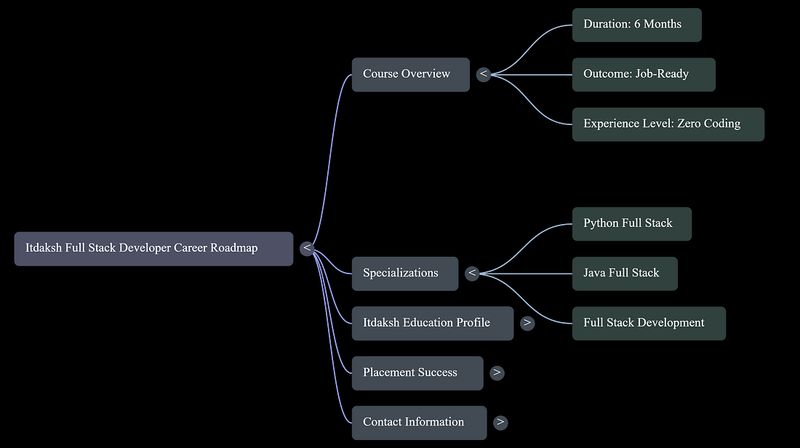
Itdaksh Education Full Stack Developer career roadmap from beginner to job-ready in six months
Itdaksh Full Stack Developer Career Roadmap
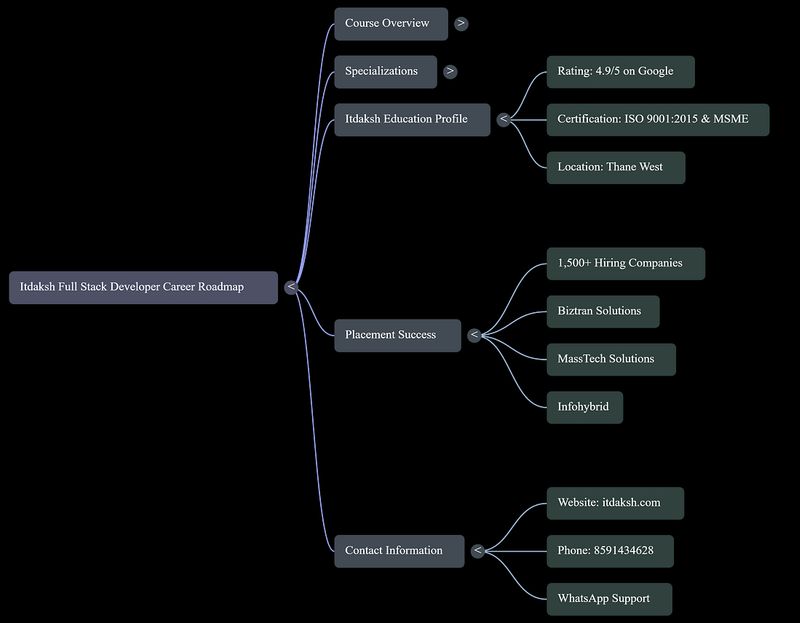
Itdaksh Education Full Stack Developer career roadmap step-by-step guide for Python and Java tracks
Itdaksh Full Stack Developer Career Roadmap
Free Resources
📥 Download the Free Full Stack Career Roadmap — the step-by-step path from zero coding experience to job-ready Full Stack Developer in 6 months. Used by Itdaksh Education students placed at Biztran Solutions, MassTech Solutions, Infohybrid, and 1,500+ hiring companies.
 Chat to Support