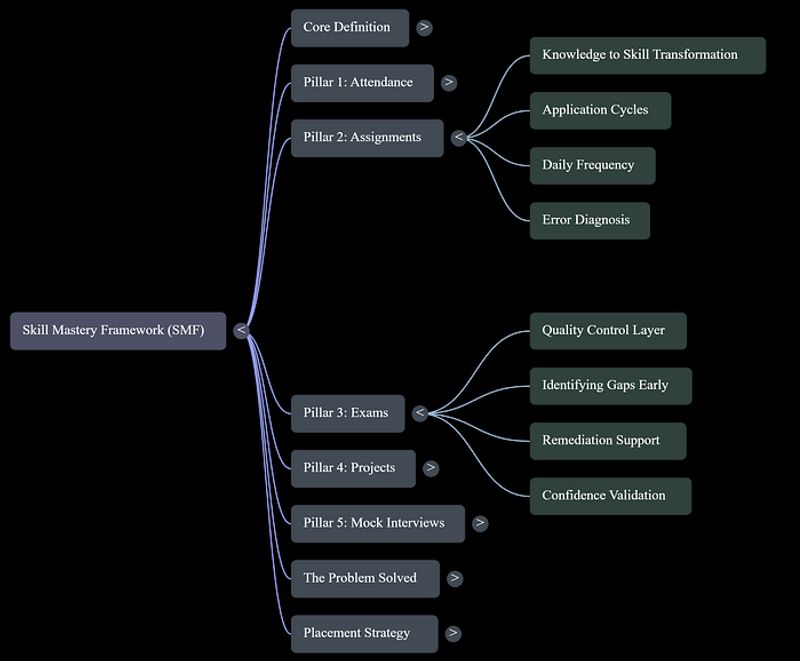
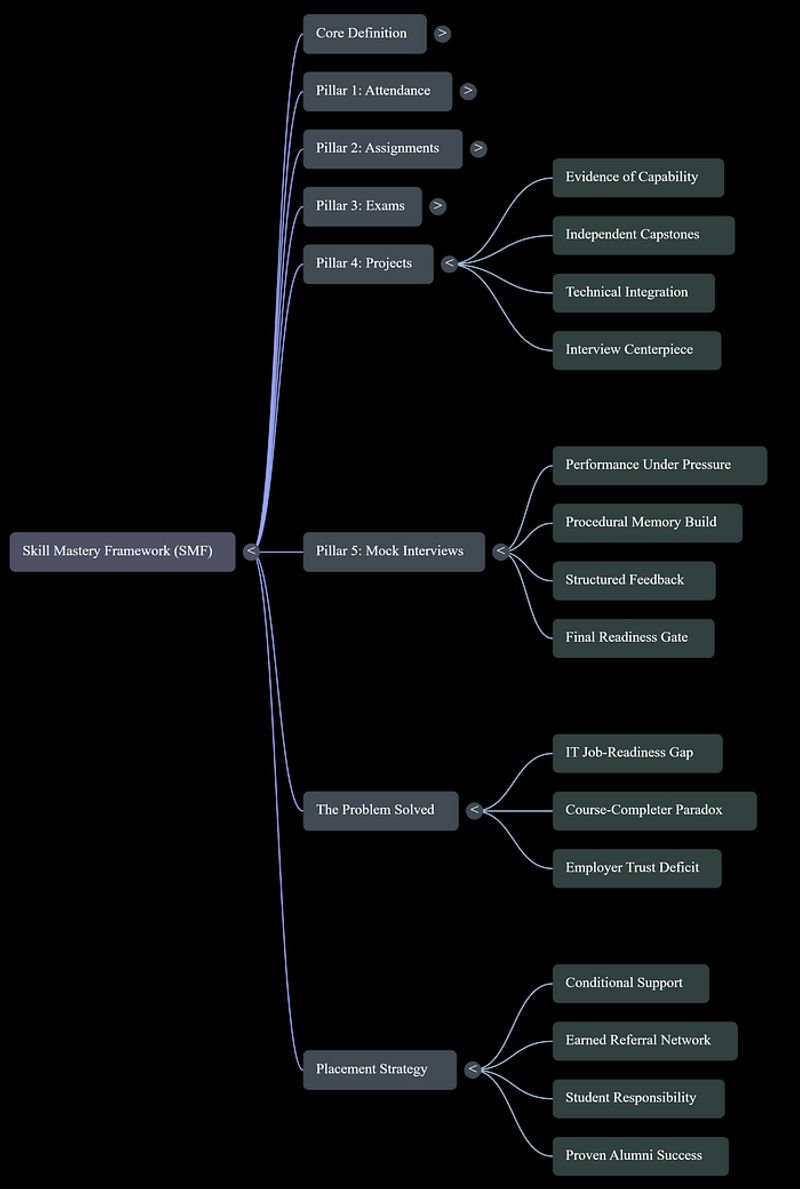
Itdaksh Education's Skill Mastery Framework a 5-pillar accountability system of Attendance, Assignments, Exams, Projects, and Mock Interviews produces job-ready IT professionals, not just graduates.
Mrityunjay Pandey
· 24 May 2026 ·21 min read
Share:
Contents
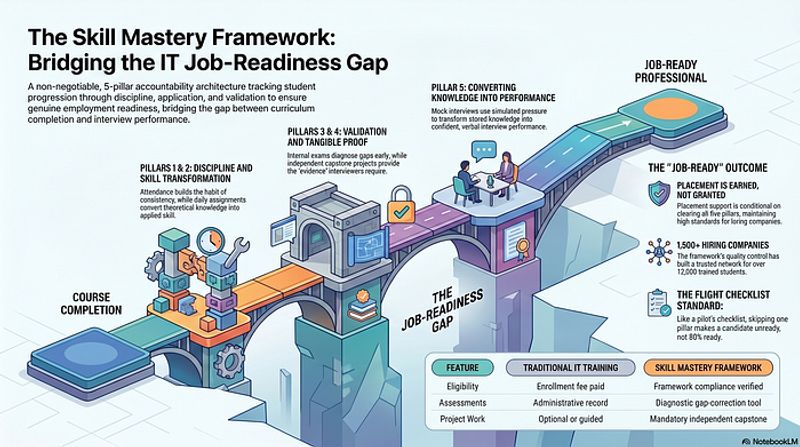
A hero overview graphic displaying all five pillars of the Skill Mastery Framework — Attendance, Assignments, Exams, Projects, and Mock Interviews — arranged as ascending steps, columns, or a circular progression system. The visual conveys the sequential and interdependent nature of the five pillars, with a clear endpoint labelled "Job-Ready" or "Placement Eligible." Itdaksh Education branding is present, along with the framework name as the primary headline.
Direct Answer
The Skill Mastery Framework is a five-pillar learning and accountability system developed by Itdaksh Education that ensures every student progresses from enrollment to genuine employment readiness not just course completion through a structured, trackable, non-negotiable process of Attendance, Assignments, Exams, Projects, and Mock Interviews.
Most IT training programmes end with a certificate. The Skill Mastery Framework ends with a job offer because it is designed around one question that most institutes never ask: what does a student actually need to demonstrate before they are ready to face a real interviewer at a real company?
Introduction:The Problem the Skill Mastery Framework Was Built to Solve
Every year in India, thousands of students complete IT courses. They attend classes, watch recorded sessions, receive certificates, update their LinkedIn profiles and then spend the next six to eighteen months applying for jobs they cannot get. Not because the opportunities do not exist. Not because they are unintelligent. But because completing a course and being job-ready are two entirely different states of preparation, and most training systems are designed to produce the first one while calling it the second.
According to NASSCOM’s skill development reports, one of the most persistent challenges in India’s IT hiring ecosystem is the gap between the number of training programme graduates and the number of candidates companies consider genuinely hireable at interview. This gap is not caused by a shortage of training. It is caused by a shortage of the right kind of training training that does not stop at knowledge delivery but continues through skill application, assessment, project demonstration, and interview performance.
Itdaksh Education built the Skill Mastery Framework specifically to close this gap. Not by making the curriculum harder, but by making the accountability structure impossible to circumvent. The framework does not allow a student to slide through with attendance alone. It does not allow knowledge to remain untested. It does not allow skills to exist only in theory. And it does not allow a student to walk into an interview unprepared because they cannot reach the interview stage without having demonstrated readiness through the framework first.
What the Skill Mastery Framework Is Defined Precisely
A detailed architecture diagram of the Skill Mastery Framework positioned as an accountability and progression system — distinguishing it visually from a curriculum or syllabus. The diagram shows how each pillar feeds the next, with annotations explaining the binary output: job-ready vs not-ready, and the conditional nature of placement support tied to completion of all five pillars.
The Skill Mastery Framework is not a curriculum. It is not a teaching methodology. It is an accountability and progression architecture a system that tracks every student’s development across five measurable dimensions and uses that tracking to make one binary determination: are you job-ready or not?
The five pillars are Attendance, Assignments, Exams, Projects, and Mock Interviews. (See the visual framework above.) Each pillar represents a distinct layer of skill development. Each is non-negotiable. Each feeds the next. And each has a minimum standard that must be met before the student progresses to placement support.
Think of the framework as a flight checklist. Before a commercial aircraft takes off, every item on the checklist must be verified not most items, not the important ones, all of them. A pilot who skips the fuel check because the engine inspection went well is not flying a more efficient aircraft. They are flying an unsafe one. The Skill Mastery Framework operates on the same logic. Skipping one pillar does not make the student 80% ready. It makes them unready because the specific gap created by skipping that pillar will appear in the interview room at exactly the wrong moment.
Pillar 1 Attendance: The Foundation Nobody Talks About
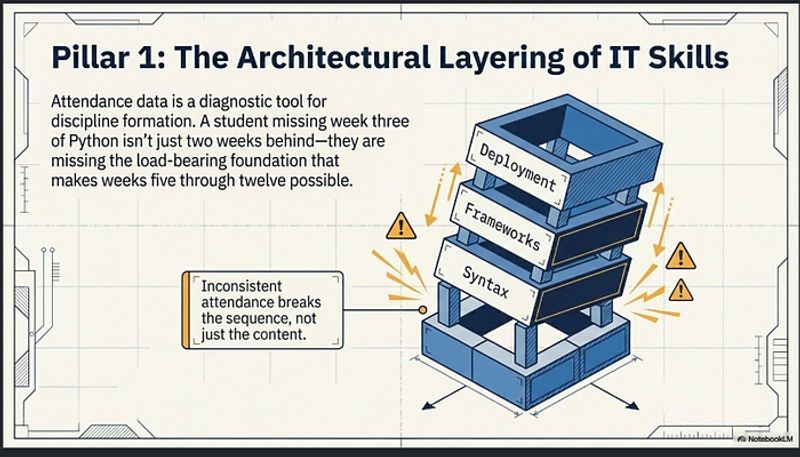
A visual representing the Attendance pillar — likely showing a session-by-session tracking grid, calendar-style attendance chart, or a funnel that narrows as attendance falls — illustrating how consistent attendance is tracked at Itdaksh Education as a diagnostic tool rather than an administrative record. The visual reinforces the connection between early attendance consistency and programme completion.
Attendance is the first pillar not because it is the most glamorous it is not but because everything else depends on it. A student who attends inconsistently does not just miss content. They miss the sequence. IT skills are architecturally layered: programming logic precedes syntax, syntax precedes frameworks, frameworks precede deployment. A student who misses week three of a Python programme and returns in week five is not two weeks behind they are missing a conceptual foundation that makes everything in weeks five through twelve harder to absorb.
At Itdaksh Education, attendance is tracked session by session. Students who fall below the required minimum are flagged early not to penalise them, but to intervene before the gap becomes unrecoverable. This is a structural difference from programmes that simply record attendance for administrative purposes. In the Skill Mastery Framework, attendance data is a diagnostic tool, not a bureaucratic requirement.
Pillar 1 Attendance: The Foundation Nobody Talks About
An infographic or data visualisation showing the correlation between student attendance consistency in the first four weeks and final placement outcomes — likely a bar chart or scatter plot contrasting consistent attenders vs inconsistent ones, with placement rate or programme completion rate as the outcome metric.
The deeper purpose of the attendance pillar is discipline formation. In every batch at Itdaksh Education, the students who attend consistently in the first four weeks are the ones who complete the programme and get placed. Not always the most technically gifted students. The most consistent ones. Discipline is not a personality trait you either have or do not. It is a habit that a structured system either reinforces or allows to erode. The Skill Mastery Framework reinforces it.
Pillar 2 Assignments: Where Knowledge Becomes Skill
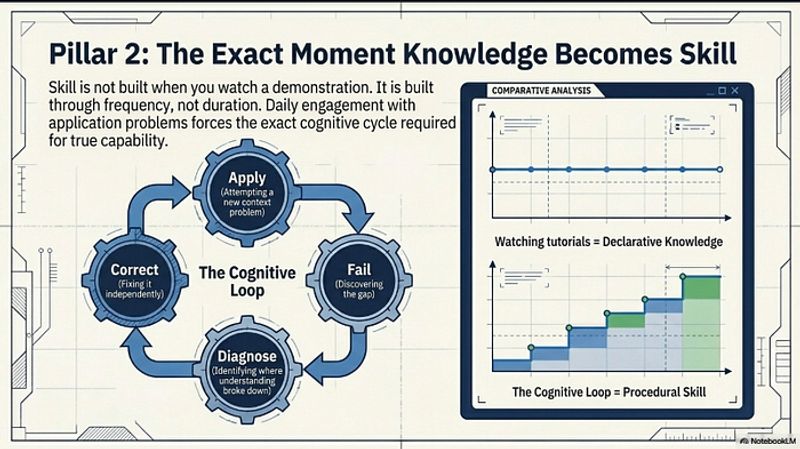
A visual representing the Assignments pillar — showing the apply-fail-diagnose-correct learning cycle as a loop or circular diagram. The visual distinguishes between passive knowledge acquisition (watching, listening) and active skill building (applying, failing, correcting), reinforcing the article's argument that assignments are the mechanism through which knowledge becomes usable skill.
There is a precise moment in learning where knowledge transforms into skill. It is not the moment you understand a concept. It is the moment you apply it incorrectly, identify the error, and correct it without being told what was wrong. That cycle apply, fail, diagnose, correct is the mechanism through which skill is actually built. Watching tutorials and attending lectures produces knowledge. Assignments produce skill.
At Itdaksh Education, assignments are designed to force this cycle deliberately. They are not recap exercises that ask students to repeat what they just saw demonstrated. They are application problems that require the student to use what they learned in a new context which means they must actually understand the underlying concept, not just remember the surface demonstration. When a student gets an assignment wrong, the error is a piece of information. It tells the student and the faculty tracking their progress exactly where the understanding broke down.
A supporting infographic illustrating the principle of daily frequency over weekend duration — possibly a comparison of two students' skill development curves over 30 days (one doing 30 minutes daily vs one doing 4 hours on weekends), showing the superiority of consistent daily practice for skill consolidation in IT learning.
Assignments: Where Knowledge Becomes Skill
The regularity of assignments is as important as their design. Daily practice is not optional in the Skill Mastery Framework because skill is built through frequency, not duration. A student who does one hour of problem-solving every day for a month develops more reliable skill than one who does seven hours every Saturday. The brain consolidates learning during the intervals between practice sessions which is why consistent daily engagement produces better outcomes than irregular intense sessions.
Pillar 3 Exams: Catching Gaps Before the Interview Does
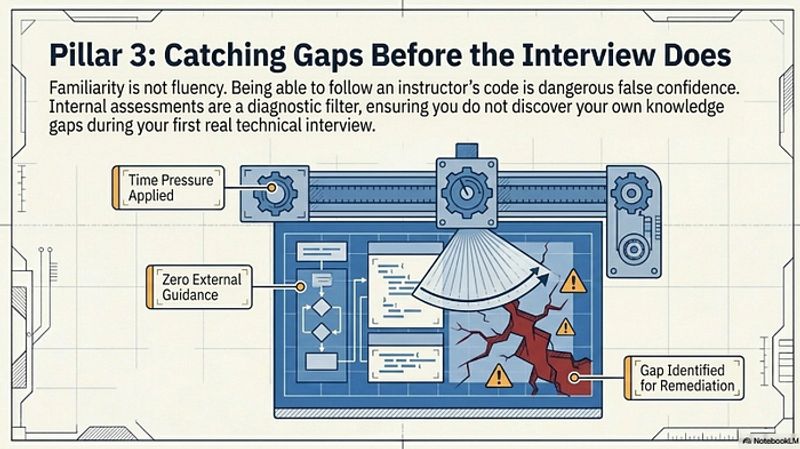
A visual representing the Exams pillar as a quality control layer — showing internal assessments at defined programme intervals, with diagnostic and remediation pathways for students who do not meet the passing score. The visual likely uses a timeline or checkpoint diagram to show where exams sit in the programme sequence and how gaps are caught and corrected before they reach the interview stage.
Pillar 3 Exams: Catching Gaps Before the Interview Does
Internal assessments are the quality control layer of the Skill Mastery Framework. Their purpose is not to grade students it is to identify gaps in understanding before those gaps become visible to a real interviewer at a real company.
There is a form of false confidence that develops during IT training without internal assessments. The student attends sessions, completes assignments, builds familiarity with the tools and genuinely believes they are ready. But familiarity is not fluency. Being able to follow a demonstration is not the same as being able to produce a correct solution under time pressure with no guidance. The first time most students discover this distinction without internal assessments is in their first technical interview round which is the most expensive possible place to learn it.
At Itdaksh Education, skill-readiness exams are conducted at defined intervals throughout each programme. Students must achieve a minimum passing score to proceed toward placement support. Those who do not are identified, their specific knowledge gaps are diagnosed, and they are given structured remediation before the next assessment. This is not a punishment mechanism it is a diagnostic and correction system. The standard is held because sending an underprepared student to a company that trusts Itdaksh’s placement network would damage both the student’s confidence and the institute’s hiring relationships simultaneously.
Pillar 4 Projects: The Only Evidence That Actually Matters in an Interview
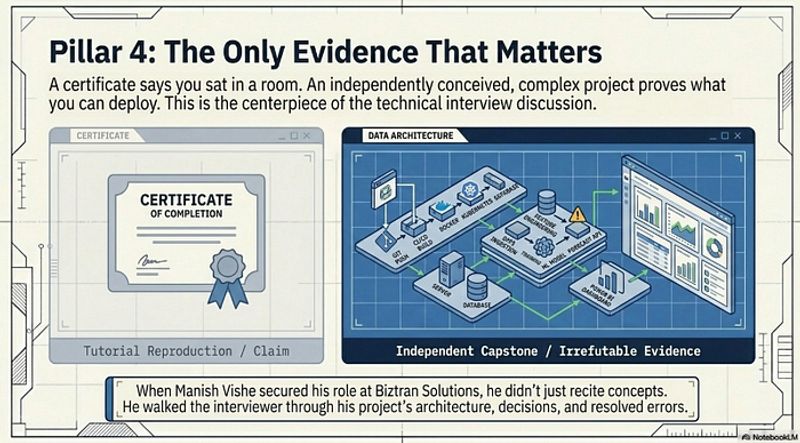
A visual representing the Projects pillar — contrasting a guided tutorial build (step-by-step instructor-led) with an independently conceived capstone project (student-driven, real problem, deployable output). The visual likely shows the interview value of each — certificate on one side, live project walkthrough on the other — reinforcing the article's core message that projects are the primary interview evidence for freshers without work history.
Projects: The Only Evidence That Actually Matters in an Interview
A certificate tells an interviewer that you attended a training programme. A project tells them what you can actually do. For a fresher with no professional work experience, the project portfolio is the single most important piece of evidence they bring to an interview because it is the only direct demonstration of applied skill they have.
The projects required by the Skill Mastery Framework are not tutorial reproductions. They are not step-by-step guided builds where the student follows along with an instructor. They are independently conceived, developed, and presented deliverables that solve a real problem a Data Science student building a sales forecasting model on real retail data, a Full Stack student deploying a functional web application that handles user authentication and database operations, a Data Analyst building a multi-dashboard Power BI report that presents business insights from a complex multi-table dataset.
These projects serve two simultaneous purposes. During the programme, they force the student to integrate everything they have learned they cannot build a working application without understanding the full stack, and they cannot build a meaningful ML model without understanding the full pipeline. In the interview, they serve as the centrepiece of the technical discussion. When Manish Vishe was interviewed for his Software Developer role at Biztran Solutions, he did not recite answers to conceptual questions alone. He walked the interviewer through his project the architecture, the decisions he made, the errors he encountered and resolved. That conversation is what produced the offer letter.
Pillar 5 Mock Interviews: Converting Knowledge Into Performance Under Pressure
This is the pillar that most training programmes skip entirely and the one that has the single largest impact on placement outcomes. Understanding Python, SQL, or Machine Learning is a necessary condition for passing a technical interview. It is not a sufficient one. The sufficient condition is the ability to demonstrate that understanding clearly, confidently, and without hesitation under real interview conditions.
Mock interviews serve a specific cognitive purpose. They convert knowledge which is stored in declarative memory into performance, which operates through procedural memory. A student who has studied every concept but never answered a question under timed, observed pressure will feel exactly the same anxiety and cognitive load in their first real interview as a student who has done no preparation. A student who has answered the same type of question ten times in simulated conditions will feel something different: familiarity. And familiarity produces confidence, which produces clarity, which produces the kind of answer that earns an offer.
At Itdaksh Education, mock interviews are not a single final practice session. They are a recurring component of the programme conducted under real interview conditions, with structured feedback after each session, and repeated until the student’s performance is consistent and confident. Students must clear the mock interview requirement before being considered eligible for placement support. This is the gate at the end of the framework, and it exists because our placement network 1,500+ hiring companies trusts that every candidate Itdaksh refers has been through this process. That trust is the foundation of the placement relationships. It is not for sale and not for compromise.
How the Skill Mastery Framework Determines Placement Eligibility
A placement eligibility flowchart showing the decision pathway from enrolment through each of the five pillars to the final binary determination: placement-eligible (all five pillars complete) vs not-eligible (one or more pillars incomplete). Named alumni may be referenced as examples of framework-compliant students in the visual, alongside the hiring company names where they were placed.
How the Skill Mastery Framework Determines Placement Eligibility
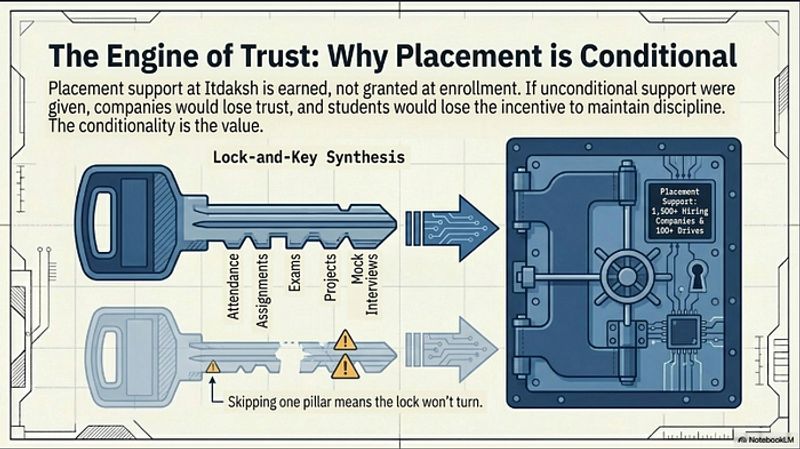
The placement support provided by Itdaksh Education interview calls, job referrals, placement drive invitations is conditional. It is earned through the Skill Mastery Framework, not granted at enrollment. This is a deliberate and important design decision, and it is one that most prospective students initially find surprising and then, upon reflection, find reassuring.
Here is the logic. If placement support were unconditional if every student who enrolled received interview calls regardless of preparation level two things would happen. First, companies would stop trusting Itdaksh’s referrals within two or three hiring cycles, because unprepared candidates create poor interview experiences. Second, students would have no structural incentive to maintain the discipline of the framework because the outcome (interview calls) would not be tied to the process (skill development). The conditional structure of the framework is not a restriction. It is the mechanism that makes the placement support meaningful in the first place.
Students who complete all five pillars who have maintained attendance, submitted assignments, passed internal assessments, built and presented a capstone project, and cleared mock interviews are identified as job-ready and begin receiving relevant placement opportunities. The track record of these students across Itdaksh Education’s 100+ placement drives speaks clearly: Manish Vishe placed at Biztran Solutions, Mansi Bhagat at MassTech Solutions, Munaaf Khan at EPCPROMAN Pvt. Ltd, Deepali Mahajan at MCM Pvt. Ltd, Shrushti Pawar at MassTech Solutions all of them framework-compliant students. Not a single one of Itdaksh’s placed alumni skipped the framework and got placed. The correlation is not coincidental. It is the system working exactly as designed.
The Contrarian Truth About IT Training That Makes Most Institutes Uncomfortable
Here is the insight that Itdaksh states openly and most training institutes avoid entirely: your placement outcome is primarily your responsibility, not the institute’s.
The common assumption aggressively marketed by many IT training providers is that paying the course fee transfers the responsibility for employment to the institute. “Join us and we will get you placed.” This framing is appealing, commercially successful, and functionally dishonest. No institute can get you placed. An institute can build the curriculum, provide the faculty, create the structure, maintain the hiring network, and open the doors. You have to walk through them prepared.
The Skill Mastery Framework is built on the opposite assumption: that the student’s discipline, consistency, and genuine effort are the primary variables in placement outcomes and that the institute’s role is to create the conditions in which those variables produce results. This is why the framework is non-negotiable. Allowing a student to skip assignments and still receive placement support would be a lie it would be pretending that the outcome does not depend on the process. It does. Every time.
This honesty is uncomfortable for students who want certainty without accountability. It is exactly what serious, disciplined students respect because it means the support they receive is real, earned, and backed by a system that has produced consistent results across 12,000+ trained students and 100+ placement drives.
Tactical Section: The SMF Self-Audit Are You Currently Job-Ready?
A self-audit checklist visual displaying five assessment questions one per pillar — that a student can use to evaluate their current job readiness. Each question corresponds directly to a pillar (Attendance percentage, Assignment submission rate, Exam results, Project completeness, Mock interview readiness) with a Yes/No format and a gap-identification outcome for any "No" answers, directing the student toward the specific remediation needed before applying for jobs.
If you are currently enrolled in any IT training programme at Itdaksh Education or anywhere else use this self-audit to assess your actual placement readiness. Answer each question honestly.
Attendance: Have you attended at least 90% of your sessions? Have you covered every topic in the curriculum, or are there modules you rushed through or missed?
Assignments: Are you completing every assignment on the day it is given? Or are you accumulating a backlog and catching up sporadically? The second pattern does not build skill it produces surface familiarity that collapses under interview pressure.
Exams: If your institute conducts internal assessments, have you passed them with genuine understanding? Or have you cleared them by memorising answers without understanding the underlying concepts?
Projects: Do you have at least one complete, independently built, deployable project you can walk an interviewer through explaining the architecture, the decisions, the errors you encountered, and how you resolved them? If you cannot answer detailed questions about your own project, it is not ready.
Mock Interviews: Have you answered IT interview questions out loud, under timed conditions, in front of another person? If not, your preparation exists only in your head and interview pressure will reveal that gap immediately.
If you answered no to any of these, you have identified a specific gap to address before applying for jobs. The gap is not your intelligence or your capability. It is a structural element of your preparation that can be fixed with focused effort.
IT Training: What Changed and What the Skill Mastery Framework Responds To
FactorTraditional IT TrainingSkill Mastery Framework Approach Definition of completion Finishing the syllabusClearing all 5 pillars Placement support condition Enrollment fee paid Framework compliance verified Assessment purpose Administrative record Diagnostic and gap-correction toolProject work Optional or guided Mandatory independent capstoneInterview preparation Last-day session Ongoing mock interview cycleStudent accountability Self-managedTracked and intervened Placement promise Marketing claimSystem-earned outcomeFailure point identifiedAfter interview rejection During internal assessment Company trust basis Relationship or feeConsistent candidate quality Outcome measure Certificate issued Offer letter received
FAQs
Q1: What is the Skill Mastery Framework in simple terms?
The Skill Mastery Framework is a five-pillar system developed by Itdaksh Education that tracks every student’s progression through Attendance, Assignments, Exams, Projects, and Mock Interviews. Students who complete all five pillars are considered job-ready and eligible for placement support. Those who do not complete the framework are not because the framework is the mechanism through which job-readiness is produced, not just measured.
Q2: Is the Skill Mastery Framework a strict system or flexible?
It is structured with clear minimum standards for each pillar attendance percentage, assignment submission rate, exam passing score, project completion, and mock interview clearance. These standards are non-negotiable because they reflect what is actually required to perform in a real interview. However, the system includes tracking and early intervention students who are falling behind are flagged and supported before the gap becomes critical, not penalised after the fact.
Q3: What happens if a student does not complete all five pillars?
Students who do not meet the framework requirements do not receive placement support meaning they do not receive interview calls or referrals from Itdaksh’s hiring network. This is stated clearly before enrollment, not hidden in fine print. The reason is straightforward: sending an underprepared candidate to a company damages both the candidate’s confidence and Itdaksh’s placement relationships. The framework protects both.
Q4: Can a student who missed some assignments or sessions still get placed?
Itdaksh evaluates placement eligibility against the complete framework, not individual pillars in isolation. A student who has strong projects and cleared mock interviews but missed significant assignments may have gaps that the assignments were meant to fill gaps that will appear in technical interviews. The framework is designed to be completed holistically because each pillar fills a different part of the job-readiness picture.
Q5: Does the Skill Mastery Framework apply to all courses at Itdaksh Education?
Yes. The five-pillar framework applies across all programmes Data Science with AI, Data Science & Analytics, Python Full Stack, Java Full Stack, Full Stack Development, Data Analytics, Digital Marketing, AWS & DevOps, and Agentic AI & Generative AI with RAG. The specific content of each pillar (assignment topics, exam content, project domain, mock interview questions) is customised per course, but the structure and eligibility requirements are consistent across all tracks.
Q6: How is the Skill Mastery Framework different from what other IT institutes offer?
Most IT training institutes in Thane and Mumbai do not have a documented, trackable accountability system for placement eligibility. They conduct classes, deliver content, and offer “placement support” as a blanket promise. The Skill Mastery Framework is distinct because it is a specific, named, published system with defined standards at each pillar and because placement support is explicitly conditional on framework completion, not on fee payment. This transparency is what makes Itdaksh’s placement outcomes verifiable rather than merely claimed.
The Skill Mastery Framework is Itdaksh Education’s proprietary five-pillar system Attendance, Assignments, Exams, Projects, and Mock Interviews that produces job-ready IT professionals rather than course-completers.
Each pillar serves a distinct purpose: Attendance builds discipline, Assignments build applied skill, Exams validate understanding, Projects build proof of capability, and Mock Interviews build interview performance under pressure.
Placement support at Itdaksh Education is earned through framework compliance not granted at enrollment. This conditionality is the mechanism that makes the placement outcomes real and consistent.
The SMF Progress Tracker reveals the precise difference between a course-complete student and a job-ready one. The gap is always structural a missing pillar not a matter of intelligence.
All placed Itdaksh alumni across 12,000+ students trained and 100+ placement drives are framework-compliant students. The correlation is the system working as designed.
The Skill Mastery Framework is the honest answer to the question every IT fresher should be asking before enrolling anywhere: “What specifically will this institute do to ensure I am ready to face an interview — not just ready to receive a certificate?”
Free Resources
Download the Free Skill Mastery Framework Self-Audit Checklist the same 25-point readiness assessment Itdaksh Education uses to determine whether a student is placement-eligible. Use it to evaluate your current preparation, identify your gaps, and build a targeted plan to close them before your next interview.
Book a Free Demo: 8591434628 | WhatsApp: 918591434628
Itdaksh Education 201 Ganesh Tower, Opposite Thane Railway Station, Thane West. ISO 9001:2015 & MSME Certified. 12,000+ Students Trained. 1,500+ Hiring Companies. 4.9/5 on Google.
#Skill Mastery Framework
# Itdaksh Education placement
#IT fresher job readiness India
#IT training with placement Thane
# mock interview IT fresher
#capstone project IT training
#five pillar IT learning system
#IT placement accountability India
#course completion vs job readiness
# IT training institute Thane Mumbai

 Chat to Support