Top 50 Python Interview Questions for Freshers in 2026 With Answers and Interviewer Insights
50 Python interview questions for freshers in 2026 with answers, code examples, interviewer intent, and a 7-day preparation sprint plan.
ITDaksh Team
· 21 May 2026 ·20 min read
Share:
Contents
A visual framework card illustrating the STAR-P method for answering Python interview questions — showing five sequential steps: State the concept, Tell the difference from related concepts, Add a code example, give Real-world Relevance, and include a Project Reference. The framework is presented as a structured flow or labelled diagram to help freshers structure strong interview answers beyond basic definitions.
Direct Answer
The 50 Python interview questions in this guide cover every topic area a fresher will face in 2026 from basic data types to OOP, functions, exception handling, and advanced concepts along with what the interviewer is actually testing with each question, not just the textbook answer.
Most interview preparation makes one critical mistake: it teaches you what to say without teaching you why those answers matter to the person across the table. An interviewer asking “what is the difference between a list and a tuple?” is not testing your ability to recall a definition. They are testing whether you understand mutability, and whether that understanding will translate into better code decisions on the job. When you understand the intent behind the question, your answer becomes automatically more impressive.
Before the questions two things that matter more than memorisation.
Introduction: How to Use This Guide (And How Not To)
Do not read this article once and assume you are prepared. The purpose of a question-and-answer guide is to give you the raw material for practice, not replace it. For each question, read the answer, understand the concept, write it in your own words without looking, and then explain it out loud to yourself, to a friend, or to a wall. If you cannot explain it in plain language, you do not know it well enough yet.
Apply the STAR-P Method to any question that goes beyond a simple definition. (See the framework above.) State the concept, Tell the difference from related concepts, Add an example, give Real-world Relevance, and where possible, connect it to a Project you built. The Project Reference is the single element that separates forgettable fresher answers from memorable ones because it proves that your knowledge is applied, not just theoretical.
At Itdaksh Education, mock interview preparation is a core pillar of the Skill Mastery Framework. Students do not just read question lists they answer questions on camera, receive structured feedback, and re-answer until confidence is consistent. The difference between a student who has read 50 questions and one who has answered them under pressure is visible within the first two minutes of any real interview.
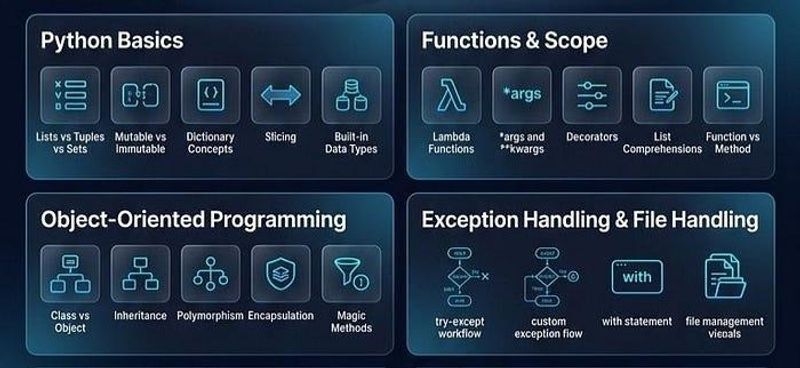
A supporting visual likely a topic overview card or preparation roadmap — showing the six Python interview topic categories (Basics, Functions, OOP, Exception Handling, Advanced Python, Problem Solving) with their approximate interview weightage percentages, helping freshers prioritise their preparation time effectively.A preparation checklist or visual guide showing the components of effective Python interview readiness — likely covering understand, rewrite, code, and explain steps — reinforcing the guide's core message that reading answers is not the same as being able to deliver them under pressure.A visual representing Itdaksh Education's mock interview preparation process for Python Full Stack students — showing the cycle of answering on camera, receiving structured feedback, and re-answering until confidence is consistent, as part of the Skill Mastery Framework before placement drives begin.
Q1. What is Python and what makes it different from other programming languages?
Python is a high-level, interpreted, dynamically-typed, general-purpose programming language known for its clean, readable syntax. Unlike compiled languages such as C or Java, Python executes code line by line through an interpreter, which makes debugging faster and development cycles shorter. Its dynamic typing means variable types are determined at runtime rather than declared explicitly, which reduces boilerplate code significantly.
What the interviewer is testing: Can you articulate what you are working with not just use it?
Q2. What are Python’s key features?
Python is interpreted, dynamically typed, object-oriented, and supports multiple programming paradigms including functional and procedural programming. It has an extensive standard library, strong community support, and platform independence. In 2026, its dominance in data science, machine learning, and backend web development makes it one of the most in-demand languages for freshers entering the job market.
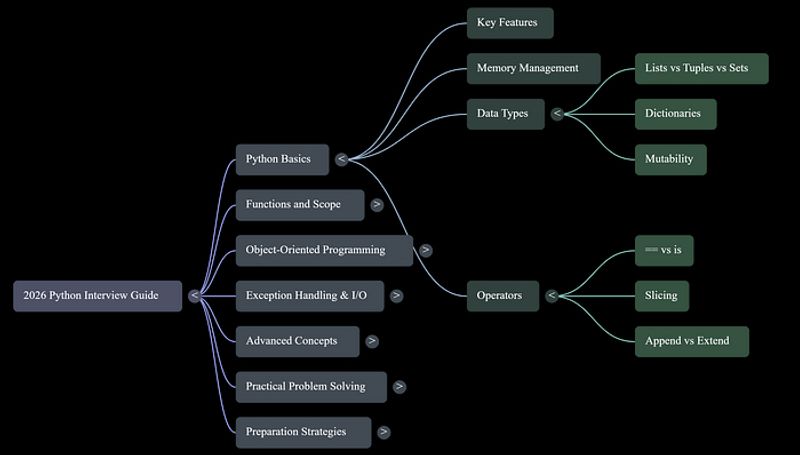
Q3. What is the difference between a list, a tuple, and a set in Python?
A list is an ordered, mutable collection you can change, add, or remove items after creation. A tuple is ordered but immutable once created, its elements cannot be changed. A set is unordered and mutable, but stores only unique elements no duplicates allowed.
What the interviewer is testing: Your understanding of mutability and when to choose which structure. A strong answer explains use cases: use a tuple when data should not change (coordinates, config values), use a set for membership testing and de-duplication.
Q4. What is the difference between == and is in Python?
== compares values it returns True if two objects hold the same value. is compares identity it returns True only if both variables point to the exact same object in memory.
a = [1, 2, 3]b = [1, 2, 3]print(a == b) # True — same valuesprint(a is b) # False — different objects in memory
What the interviewer is testing: Understanding of Python’s memory model. Freshers who confuse these two operators make subtle bugs that are difficult to trace.
Q5. What are Python’s built-in data types?
Python’s built-in data types include: Numeric (int, float, complex), Sequence (list, tuple, range, str), Mapping (dict), Set (set, frozenset), Boolean (bool), and Binary types (bytes, bytearray, memoryview). None is a special type representing the absence of a value.
Q6. What is a dictionary in Python and when would you use it?
A dictionary is an unordered (in Python 3.6 it became insertion-ordered) collection of key-value pairs. Keys must be unique and immutable. Dictionaries offer O(1) average-time lookup, making them ideal for scenarios where you need fast access to data by a named key such as storing student records, configuration settings, or API response data.
student = {"name": "Rahul", "course": "Python Full Stack", "score": 92}print(student["course"]) # Python Full Stack
Q7. What is the difference between append() and extend() in Python lists?
append() adds its argument as a single element at the end of the list if you append a list, it becomes a nested list. extend() iterates over its argument and adds each element individually.
a = [1, 2, 3]a.append([4, 5]) # [1, 2, 3, [4, 5]]
b = [1, 2, 3]b.extend([4, 5]) # [1, 2, 3, 4, 5]
Q8. What is slicing in Python?
Slicing extracts a portion of a sequence list, tuple, or string using the [start:stop:step] syntax. It returns a new object and does not modify the original.
What the interviewer is testing: Practical familiarity with Python syntax. Slicing questions are often followed by a live coding exercise know the step parameter well.
Q9. What are Python’s mutable and immutable types?
Mutable objects can be changed after creation: list, dict, set, bytearray. Immutable objects cannot: int, float, str, tuple, frozenset, bool. This distinction matters in function arguments passing a mutable object allows the function to modify the original; passing an immutable one does not.
Q10. How does Python handle memory management?
Python manages memory using a private heap space. The memory manager allocates memory, and Python’s garbage collector handles deallocation through reference counting when an object’s reference count drops to zero, it is removed. The gc module provides manual control for handling circular references that reference counting alone cannot resolve.
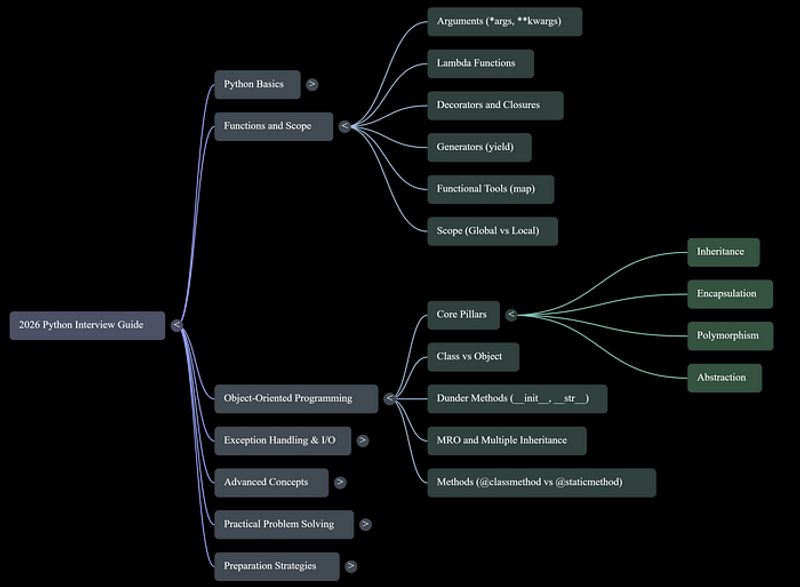
Functions and Scope (~15% of Fresher Interviews)
Q11. What is the difference between a function and a method in Python?
A function is a standalone block of reusable code defined with def. A method is a function that belongs to a class and operates on an instance of that class. The key syntactic difference is that methods receive self as their first parameter, referring to the instance they belong to.
Q12. What are *args and **kwargs in Python?
*args allows a function to accept any number of positional arguments as a tuple. **kwargs allows any number of keyword arguments as a dictionary. They are useful when the number of arguments is not known in advance.
python
def display(*args, **kwargs): print(args) # tuple of positional args print(kwargs) # dict of keyword args
What the interviewer is testing: Flexibility in function design. Strong freshers explain a real use case — such as building a utility function that wraps another function’s arguments.
Q13. What is a lambda function?
A lambda is an anonymous, single-expression function defined with the lambda keyword. It is used for short, throwaway operations — especially as arguments to higher-order functions like map(), filter(), and sorted().
Q14. What is the difference between return and print in a function?
print() outputs a value to the console it is for display only and returns None. return sends a value back to the caller, making it available for further use in the programme. In production code, functions should almost always use return, not print this is a distinction that separates beginners from developers.
Q15. What are Python decorators?
A decorator is a function that takes another function as input and extends or modifies its behaviour without changing its source code. Decorators use the @ syntax and are widely used in web frameworks Django and Flask use decorators extensively for routing, authentication, and middleware.
What the interviewer is testing: Whether you understand higher-order functions and closures prerequisites for understanding Django’s view decorators and Flask’s route decorators.
Q16. What is a generator in Python?
A generator is a function that uses yield instead of return to produce a sequence of values lazily one at a time, on demand rather than computing and storing all values in memory at once. Generators are memory-efficient for processing large datasets.
python
def count_up(n): for i in range(n): yield i
gen = count_up(5)print(next(gen)) # 0print(next(gen)) # 1
Q17. What is a list comprehension and when should you use it?
A list comprehension is a concise, Pythonic way to create a list from an iterable in a single line. It is faster than a for loop for simple transformations because it is optimised at the bytecode level.
python
squares = [x**2 for x in range(10)]evens = [x for x in range(20) if x % 2 == 0]
Use comprehensions for simple, readable one-liners. Avoid them when the logic is complex a multi-condition comprehension that requires reading three times is worse than a clear for loop.
Q18. What is the difference between global and local scope in Python?
A variable defined inside a function is local visible only within that function. A variable defined outside any function is global visible throughout the module. To modify a global variable inside a function, you must declare it with the global keyword. Python also supports nonlocal for modifying variables in an enclosing (but not global) scope.
Q19. What is a closure in Python?
A closure is a nested function that remembers and has access to variables from its enclosing scope even after the outer function has finished executing. Closures are the foundation of decorators and are used for data encapsulation without classes.
Q20. What does map() do in Python?
map() applies a function to every element of an iterable and returns a map object (iterator). It is a functional programming tool that replaces explicit for loops for transformation operations.
Object-Oriented Programming (~20% of Fresher Interviews)
Q21. What is Object-Oriented Programming and how does Python support it?
OOP is a programming paradigm that organises code around objects instances of classes rather than functions and procedures. Python supports OOP fully through classes, inheritance, polymorphism, encapsulation, and abstraction. Every entity in Python is an object including integers, strings, and functions.
Q22. What is the difference between a class and an object?
A class is a blueprint it defines the structure (attributes) and behaviour (methods) that its instances will have. An object is a specific instance of that class created from the blueprint with actual values.
python
class Student: def __init__(self, name, course): self.name = name self.course = course
s1 = Student("Rahul", "Python Full Stack") # s1 is an object
Q23. What is __init__ in Python?
__init__ is the constructor method in Python it is called automatically when a new object is created from a class. It initialises the object's attributes. The self parameter refers to the instance being created.
What the interviewer is testing: Understanding of object initialisation. A strong answer adds that __init__ is not the same as memory allocation — Python's __new__ handles that. Mentioning this shows depth.
Q24. What is inheritance in Python?
Inheritance allows a child class to acquire the attributes and methods of a parent class, enabling code reuse and hierarchical relationships. Python supports single, multiple, and multilevel inheritance.
python
class Animal: def speak(self): return "Some sound"
class Dog(Animal): def speak(self): return "Woof"d = Dog()print(d.speak()) # Woof
Q25. What is the difference between method overriding and method overloading?
Method overriding occurs when a child class redefines a method from its parent class as shown in Q24. Method overloading defining multiple methods with the same name but different parameters is not natively supported in Python. Python achieves similar results using default arguments or *args.
What the interviewer is testing: Whether you understand Python’s specific approach to polymorphism, rather than applying Java or C++ concepts incorrectly.
Q26. What is encapsulation in Python?
Encapsulation restricts direct access to an object’s internal state by making attributes private — using a double underscore prefix (__attribute). Access is then controlled through getter and setter methods. This protects data integrity and hides implementation details.
Q27. What are Python’s dunder (magic) methods?
Dunder methods double-underscore methods like __init__, __str__, __repr__, __len__, __add__allow you to define how objects behave with Python's built-in operations. For example, defining __str__ controls what print(object) outputs.
class Product: def __init__(self, name, price): self.name = name self.price = price
Polymorphism allows different classes to implement the same method name and be used interchangeably through a common interface. Python achieves this through method overriding and duck typing if an object has the required method, Python uses it regardless of the object’s actual class type.
Q29. What is the difference between @classmethod and @staticmethod?
A @classmethod receives the class itself (cls) as the first argument and can access or modify class-level state. A @staticmethod receives no implicit first argument and behaves like a regular function inside a class namespace — it has no access to the class or instance.
Q30. What is multiple inheritance and what is the MRO (Method Resolution Order)?
Multiple inheritance allows a class to inherit from more than one parent class. The Method Resolution Order determined by Python’s C3 linearisation algorithm defines the sequence in which Python searches parent classes when resolving a method call. Use ClassName.__mro__ to inspect the resolution order.
What the interviewer is testing: Whether you know Python handles multiple inheritance with a defined, predictable algorithm and that you are aware of potential conflicts it can create.
Exception Handling and File I/O (~10% of Fresher Interviews)
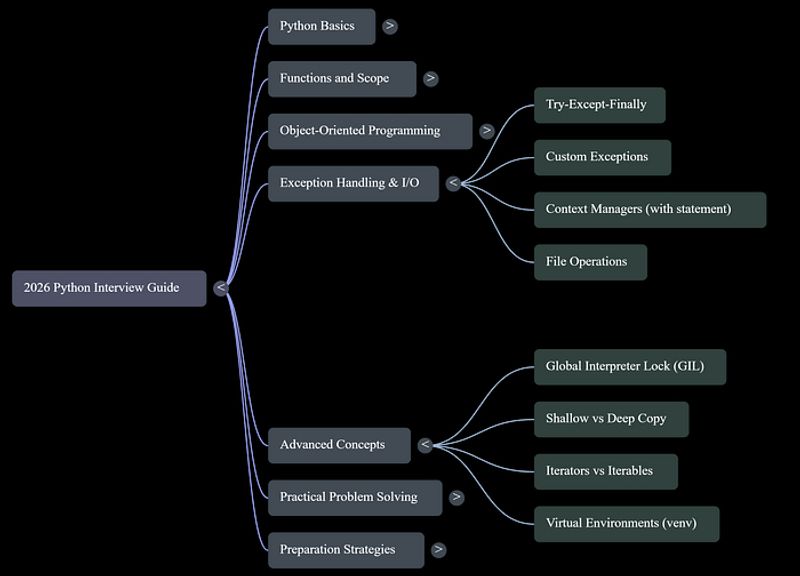
Q31. What is exception handling in Python?
Exception handling allows a programme to respond to runtime errors gracefully rather than crashing. Python uses try, except, else, and finally blocks. Code in try is executed; if an exception occurs, control passes to except; else runs if no exception occurred; finally always runs regardless.
try: result = 10 / 0except ZeroDivisionError as e: print(f"Error: {e}")finally: print("Execution complete")
Q32. What is the difference between Exception and BaseException?
BaseException is the root of all exceptions including system-exiting ones like SystemExit and KeyboardInterrupt. Exception is its subclass and is the base for all regular, catchable exceptions. You should almost always catch Exception or a specific subclass not BaseException in application code.
Q33. How do you create a custom exception in Python?
Create a class that inherits from Exception and optionally override __init__ to add custom attributes or messages.
python
class InvalidCourseError(Exception): def __init__(self, course_name): self.course_name = course_name super().__init__(f"'{course_name}' is not a valid course.")
Q34. What is the with statement and context manager?
The with statement ensures that resources like file handles or database connections are properly acquired and released, even if an exception occurs. Any object that implements __enter__ and __exit__ methods can be used as a context manager.
with open("data.txt", "r") as f: content = f.read()# file is automatically closed here
Q35. How do you read and write files in Python?
Use open() with mode "r" for reading, "w" for writing (overwrites), "a" for appending, and "rb"/"wb" for binary. Always use with to ensure the file is closed after use.
Advanced Python (~15% of Fresher Interviews)
Q36. What is the Global Interpreter Lock (GIL) in Python?
The GIL is a mutex in CPython that allows only one thread to execute Python bytecode at a time even on multi-core systems. This simplifies memory management but limits true multi-threading for CPU-bound tasks. CPU-bound parallelism in Python uses multiprocessing instead; I/O-bound parallelism uses threading or asyncio effectively because the GIL is released during I/O waits.
What the interviewer is testing: Awareness of Python’s concurrency model. A fresher who knows the GIL exists and what it means practically stands out immediately.
Q37. What is the difference between deepcopy and shallow copy?
A shallow copy creates a new object but references the same nested objects. A deep copy creates a completely independent copy new object and new copies of all nested objects. Use copy.copy() for shallow and copy.deepcopy() for deep copies.
Q38. What are iterators and iterables?
An iterable is any object you can loop over lists, tuples, strings, dicts. An iterator is an object that keeps track of its current state and returns the next element when next() is called. All iterators are iterables, but not all iterables are iterators. Use iter() to convert an iterable into an iterator.
Q39. What is the difference between range() and xrange() in Python?
xrange() was a Python 2 function that returned a lazy iterator. In Python 3, range() itself is lazy it does not generate all values in memory at once. xrange() does not exist in Python 3. Knowing this confirms you are working with modern Python.
Q40. What are Python virtual environments and why are they important?
A virtual environment is an isolated Python environment that allows each project to have its own dependencies and package versions without conflicts. Use venv (built-in) or virtualenv. In professional development, every project runs in its own virtual environment this is industry-standard practice, and interviewers at product companies specifically ask about it.
Practical Problem Solving (~15% of Fresher Interviews)
These questions are asked as live coding exercises. Practice writing and running each.
Q41. Reverse a string in Python without using [::-1].
python
def reverse_string(s): result = "" for char in s: result = char + result return result
print(reverse_string("Python")) # nohtyP
Q42. Check if a string is a palindrome.
def is_palindrome(s): s = s.lower().replace(" ", "") return s == s[::-1]
def find_duplicates(lst): seen = set() duplicates = [] for item in lst: if item in seen: duplicates.append(item) seen.add(item) return list(set(duplicates))
Q44. Count the frequency of each word in a string.
def word_frequency(text): words = text.lower().split() freq = {} for word in words: freq[word] = freq.get(word, 0) + 1 return freq
Q45. Write a function to check if a number is prime.
def is_prime(n): if n < 2: return False for i in range(2, int(n**0.5) + 1): if n % i == 0: return False return True
What the interviewer is testing: Optimisation awareness — iterating only up to the square root rather than n-1 shows you think about efficiency, not just correctness.
Q46. Flatten a nested list.
def flatten(nested): result = [] for item in nested: if isinstance(item, list): result.extend(flatten(item)) else: result.append(item) return result
Q47. Swap two variables without a temporary variable.
a, b = 5, 10a, b = b, aprint(a, b) # 10, 5
What the interviewer is testing: Python-specific unpacking syntax. Most freshers know this but cannot explain why it works — Python evaluates the right side first, then assigns.
Python in Real Projects (~Bonus Questions)
Q48. What is pip and how do you use it?
pip is Python's package installer. It installs, upgrades, and removes packages from PyPI (Python Package Index). In any professional Python project, you manage dependencies with pip and document them in a requirements.txt file.
Q49. What is the difference between __str__ and __repr__?
__str__ is designed for human-readable output it is what print() calls. __repr__ is designed for developer-readable output that ideally allows the object to be recreated it is what the interactive shell displays. If __str__ is not defined, Python falls back to __repr__.
Q50. How do you handle missing keys in a dictionary?
Three approaches: use dict.get(key, default) to return a default value without raising an error; use a try/except KeyError block; or use collections.defaultdict when all missing keys should return the same default type automatically.
d = {"name": "Rahul"}print(d.get("age", "Not found")) # Not foundprint(d["age"]) # KeyError
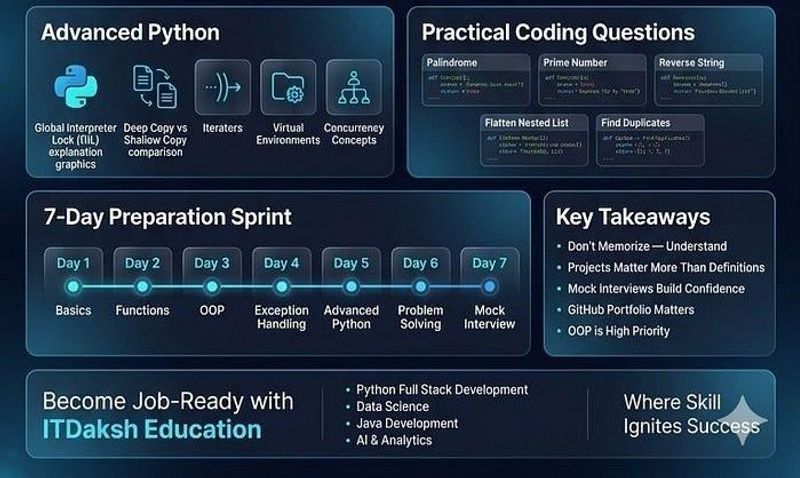
Tactical Section: Your 7-Day Python Interview Preparation Sprint
If your interview is in 7 days and you have this article, here is the exact daily plan.
Day 1 — Basics and data structures (Q1–Q10). Read each answer, rewrite it without looking, then explain it to yourself out loud. Focus on the list/tuple/set distinction it appears in nearly every Python fresher interview.
Day 2 — Functions and scope (Q11–Q20). Write and run every code example. Understanding decorators and generators places you in the top 30% of fresher candidates immediately.
Day 3 — OOP (Q21–Q30). Write a complete class from scratch with __init__, inheritance, and at least one dunder method. This is the most heavily weighted topic in mid-sized company and product company interviews.
Day 4 — Error handling and file I/O (Q31–Q35). Build a small file-reading application with proper exception handling and with statements. Having a working code example in memory is more valuable than a memorised definition.
Day 5 — Advanced Python (Q36–Q40). The GIL, virtual environments, and deep vs shallow copy are the three advanced questions most likely to appear. Know them conceptually you do not need to implement the GIL, but you must explain what it is and why it matters.
Day 6 — Problem solving (Q41–Q50). Code every problem by hand. Set a 10-minute timer per question interview conditions. Check your solution, understand any mistakes, recode from memory.
Day 7 — Full mock interview. Answer all 50 questions out loud with no notes. Record yourself. Watch it back. The questions where you hesitate, ramble, or go quiet are your preparation gaps. Fix those before the real interview.
At Itdaksh Education, every student in the Python Full Stack programme goes through this type of mock interview cycle before placement calls begin. The students who stumble on Day 7 spend Day 8 fixing specific gaps and re-doing the mock. The ones who feel ready on Day 7 attend interviews on Day 8. That discipline is what produces consistent placement outcomes across 100+ drives.
(Read more: [Insert Internal Link — Python Full Stack Course at Itdaksh Education — Curriculum and Placement Details])
Python Interview Preparation: Then vs Now
Factor 2020 Approach 2026 Requirement Memory vs understanding Memorise answers Explain concepts in your own words Coding rounds Rare at fresher level Standard across most companies OOP depth required Surface level Applied understanding expected Project discussion OptionalNear-mandatory — “show me your code”Framework questions Rarely asked Django/Flask basics common in web rolesLive coding platform Rare Hacker Rank/CoderPad standard Communication assessed Minimal Increasingly scored formally GitHub profile checked Uncommon Routine in product company hiring
A before-and-after comparison table contrasting Python fresher interview expectations in 2020 versus 2026 — covering factors including memorisation vs understanding, coding round frequency, OOP depth required, project discussion expectation, live coding platform use (HackerRank/CoderPad), GitHub profile checking, and communication assessment standards.
FAQs
Q: How many Python questions are typically asked in a fresher interview?
A technical screening round typically covers 5 to 10 conceptual questions, followed by 2 to 3 live coding problems. A full technical interview round may go deeper into OOP or problem-solving based on how you answered the initial questions. The breadth covered in this article is deliberately wider than any single interview preparation breadth produces performance confidence even when only a subset is tested.
Q: Is Python easy to learn for non-IT freshers preparing for interviews?
Python is one of the most accessible first languages for non-IT backgrounds due to its readable syntax and minimal boilerplate. However, interview readiness requires more than syntax familiarity it requires the ability to explain concepts clearly, write correct code under time pressure, and connect theory to project experience. Structured training with mock interview practice bridges that gap more reliably than self-study alone.
Q: What is the most common mistake freshers make in Python
interviews? The most consistent mistake observed across Itdaksh Education’s 100+ placement drives is over-relying on definitions without examples. Freshers answer “what is a decorator?” with a textbook definition and stop. The interviewer is waiting for the next sentence an example, a use case, or a mention of the student’s project. That next sentence is what most freshers never deliver.
Q: Do I need to know Django or Flask for a Python fresher interview?
For Python Full Stack Developer roles, yes a working knowledge of Django’s MVT architecture, URL routing, views, and models is expected at the fresher level. For Python Developer roles in data-focused companies, Django knowledge is a bonus rather than a requirement. Know which role you are interviewing for and prepare accordingly.
Q: How important is it to have a GitHub profile before a Python interview?
For product companies and well-structured tech firms in Mumbai and across India, a GitHub profile with at least 2 to 3 committed projects has become a near-standard expectation. It signals active coding practice, project completion, and professional awareness. Freshers who walk into interviews with a live GitHub link consistently receive more positive interviewer engagement than those who do not.
A visual summary of the 7-day Python interview preparation sprint plan — showing the daily topic schedule from Day 1 (Python basics and data structures) through Day 7 (full mock interview with no notes), serving as a quick-reference revision tool for freshers in the week before their interview.
Key Takeaways
These 50 questions cover the full scope of a Python fresher interview in 2026 basics, data structures, functions, OOP, exception handling, advanced concepts, and live coding.
Do not memorise answers. Understand the concept, write it in your own words, code the example, and connect it to a project you built.
Use the STAR-P Method for complex questions: State, Tell the difference, Add an example, Real-world Relevance, Project Reference.
OOP is the highest-weight topic area in interviews above entry level. Spend the most revision time here.
The GIL, virtual environments, generators, and decorators are the advanced questions that separate average freshers from exceptional ones they are asked in fewer than 40% of interviews but answered well in fewer than 15%.
A GitHub profile with real projects is no longer optional for Python developer roles. Build one before applying.
The 7-day sprint in the Tactical Section above will prepare you for 95% of what a real Python fresher interview contains.
Free Resources
Download the Free Python Interview Preparation Checklist the same 50-point readiness guide Itdaksh Education uses before sending students to placement interviews. Includes topic weightings, answer templates, and a 7-day study schedule.

 Chat to Support