What is Agentic AI A Complete Beginner’s Guide for 2026
Agentic AI doesn't just respond it plans, acts, and completes goals. Here's what it is, how it works, and why it's the most important AI shift of 2026.
ITDaksh Team
· 22 May 2026 ·15 min read
Share:
Contents
What is Agentic AI? A full Blog about Agentic AI.
Direct Answer
Agentic AI refers to artificial intelligence systems that can independently plan, make decisions, use tools, and take sequences of actions to complete a complex goal without needing a human to direct every step along the way.
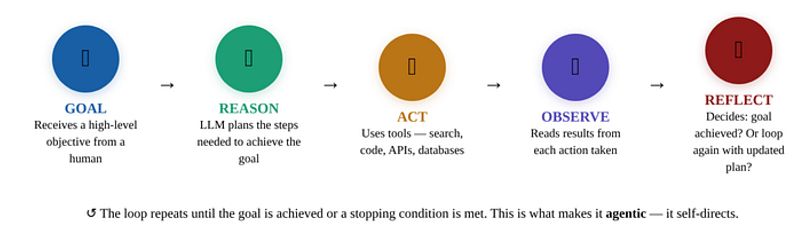
the loop repeats until the goal is achieve or a stopping condition is met. this is what makes it Agentic it sekf directs. the five pillars is Goal, Reason, Act , Observe, Reflect.
If ChatGPT is a very knowledgeable assistant who answers whatever you ask, an AI agent is a knowledgeable assistant who you can assign a project to and trust to figure out the steps, execute them, check the results, and come back to you with a finished outcome. That distinction between responding and autonomously doing is the entire difference between Generative AI and Agentic AI. And that difference is why Agentic AI is the most significant shift in the AI landscape since ChatGPT launched in late 2022.
Introduction: Why You Are Suddenly Hearing “Agentic AI” Everywhere
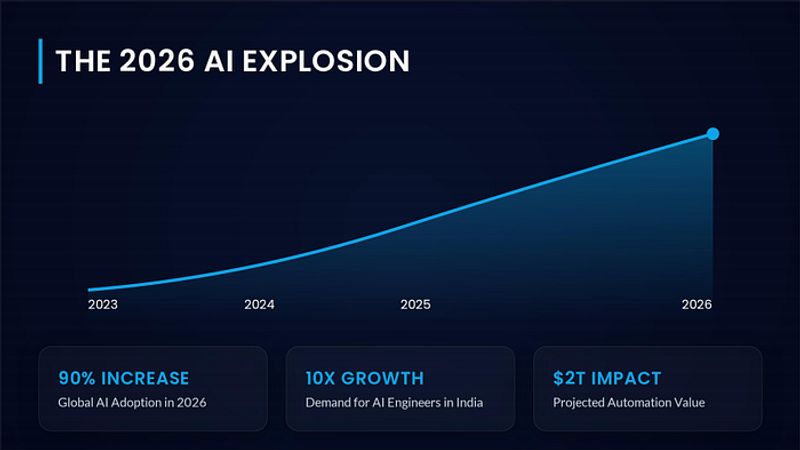
A visual timeline or trend graph showing the evolution of AI from the ChatGPT launch in late 2022 through the shift to Agentic AI in 2024–2026 — illustrating key milestones including OpenAI's o1/o3 extended reasoning models, Anthropic's tool use research, and Google's Gemini long-context memory, converging toward the "AI that operates" paradigm. Likely presented as a horizontal timeline or a rising trend curve with labelled inflection points.
A year ago, the dominant conversation in AI was about prompts. Write a better prompt, get a better answer. The intelligence was in the question, not in the system’s ability to act.
That conversation has moved on fast. The frontier AI labs including OpenAI, Anthropic, Google DeepMind, and Meta AI have each published research and released products in 2024 and 2025 that shift the emphasis from AI that responds to AI that operates. OpenAI’s o1 and o3 models introduced extended reasoning chains. Anthropic’s research on constitutional AI and tool use pushed Claude toward multi-step task completion. Google’s Gemini 1.5 Ultra integrated long-context memory. Each of these moves points in the same direction AI that does not just answer but acts.
According to the World Economic Forum’s Future of Jobs Report 2025, AI and automation are expected to create 69 million new jobs while displacing 83 million and the roles being created are overwhelmingly in AI development, deployment, and oversight. The McKinsey Global Institute has noted that agentic AI systems represent the next wave of automation, extending from information tasks (what Generative AI covers) to decision and execution tasks. For an IT professional in India whether a fresher or a working professional this is not a trend to observe from a distance. It is a career decision to make now.
What Agentic AI Actually Means Explained From First Principles
The word “agentic” comes from “agency” the capacity to act independently, to initiate behaviour rather than only react to it. An AI system with agency does not wait to be asked. It pursues a goal through its own planned sequence of actions.
The simplest analogy: imagine you hire a new employee and give them two different types of tasks.
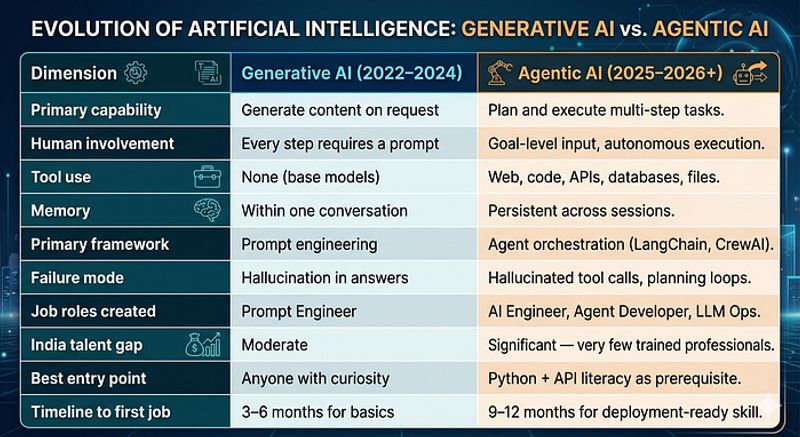
For the first type, you sit with them and ask specific questions one at a time. “What is the revenue for Q3?” They answer. “Which product had the highest return rate?” They answer. “What does that suggest?” They answer. This is Generative AI knowledgeable, responsive, powerful in the right hands, but entirely dependent on your questions to produce value.
For the second type, you say: “I need a competitive analysis report of our top three competitors market positioning, pricing, and customer sentiment by Friday.” Then you leave. The employee searches the web, reads reports, compiles data, identifies patterns, writes a draft, fact-checks it, formats the output, and sends you a document. This is Agentic AI. You defined the goal. The system determined and executed the path.
The technical architecture that makes this possible involves four components working together: a reasoning engine (typically a Large Language Model like GPT-4o, Claude, or Gemini), a memory system (short-term context and long-term storage), a tool library (web search, code execution, database queries, API calls), and an action loop (the cycle of plan → act → observe → reflect → repeat). (See the AGENT Loop above.)
The Difference Between Generative AI, RAG, and Agentic AI
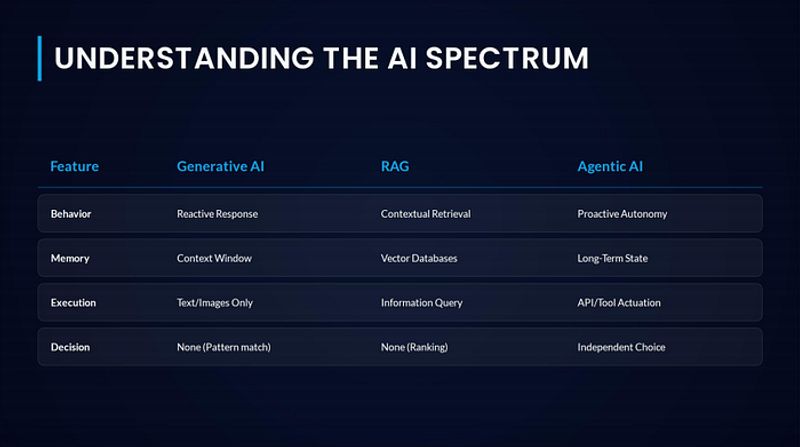
A three-column or tiered comparison diagram clearly distinguishing Generative AI, RAG (Retrieval Augmented Generation), and Agentic AI — showing each system's capability level, how it processes information, whether it is reactive or proactive, and example tools or use cases for each. The visual makes the stack relationship clear: Generative AI is the core, RAG adds retrieval, Agentic AI adds tools, memory, and autonomous planning on top.
These three terms are often used interchangeably by people who do not fully understand them which creates genuine confusion for anyone trying to learn. Here is the clean distinction.
Generative AI refers to AI models that generate content text, images, code, audio based on patterns learned during training. ChatGPT, Gemini, and Claude in their basic form are Generative AI. They are extraordinarily capable at producing outputs but have no ability to take actions in the world, access real-time information, or complete multi-step tasks without human guidance at each step.
RAG Retrieval Augmented Generation is an architectural pattern that connects a Generative AI model to an external knowledge source. Instead of relying solely on training data, the system first searches a document store (using vector embeddings and semantic similarity), retrieves relevant chunks, and feeds them into the model’s context before generating a response. A company using RAG can build a customer support chatbot that answers questions based on its internal documentation rather than general internet knowledge. RAG significantly improves accuracy and reduces hallucinations for domain-specific use cases, but it is still fundamentally reactive it answers questions, it does not complete projects.
Agentic AI combines the reasoning power of an LLM with tools, memory, and autonomous planning. The model does not just answer it decides what actions to take, executes them using available tools, observes the results, and determines whether to continue, revise its plan, or conclude. Frameworks like LangChain, LangGraph, CrewAI, and Microsoft’s AutoGen are the primary development platforms for building agentic systems today. OpenAI’s Assistants API provides a managed infrastructure for deploying AI agents with tool use built in.
The relationship between them is not a competition it is a stack. Most production agentic systems use RAG as one of the agent’s tools, and Generative AI as the reasoning core. Understanding all three is the literacy required to work in AI development in 2026.
Abstract explanations only go so far. Here is what Agentic AI actually looks like when it is deployed in real environments some of which you have likely already encountered.
GitHub Copilot Workspace is one of the most visible examples of an agentic coding system. When a developer opens a GitHub issue, Copilot Workspace can read the issue, explore the relevant codebase, propose a plan to fix the bug or implement the feature, write the code, run tests, identify failures, revise the code, and prepare a pull request all with minimal human input between steps. The developer reviews and approves, but the sequence of planning, coding, testing, and revising is executed autonomously.
AI research agents built using frameworks like LangChain with web search tools can be given a research question, search multiple sources autonomously, synthesise findings, identify contradictions, and produce a structured summary. What would take a human analyst several hours takes an agentic system minutes. The value is not that the AI is smarter it is that it can perform the sequential, multi-tool workflow without fatigue or context loss.
Customer support agents at companies like Klarna and Notion now operate as first-response systems that do not just answer FAQs. They can check a customer’s account, identify their issue, execute a refund or account change via API calls, confirm the action, and follow up completing the entire service workflow without human escalation for standard cases.
Data analysis agents built on Python with Pandas integration can receive a dataset, identify patterns, generate visualisation code, execute it, interpret the charts, and write a business narrative around the findings. For a Data Analyst, this is both a productivity tool and a preview of the direction the role is heading which is toward higher-level problem framing and oversight rather than manual data manipulation.
In India specifically, companies in BFSI, e-commerce, and IT services are piloting agentic systems for process automation, customer interaction, and internal knowledge management. According to NASSCOM’s 2025 AI talent report, demand for professionals with LLM integration and AI agent development skills is among the fastest-growing segments of IT hiring in India.
The Four Components Every AI Agent Has
Understanding what is inside an agentic AI system is essential before you start learning to build one. Regardless of the framework LangChain, CrewAI, or custom-built every meaningful AI agent has these four components.
Reasoning Engine the LLM at the core. This is the “brain” the model responsible for understanding instructions, planning steps, interpreting tool outputs, and generating responses. In 2026, GPT-4o, Claude 3.5 Sonnet, Gemini 1.5 Pro, and open-source models like Llama 3 are the primary reasoning engines used in production agents. The choice of model affects capability, cost, speed, and privacy depending on the application.
Memory agents need to remember context across multiple steps and potentially across multiple sessions. Short-term memory lives in the model’s context window the information actively present in the current conversation. Long-term memory uses external storage typically vector databases like Pinecone, ChromaDB, or FAISS where past interactions and retrieved documents are stored as embeddings and searched semantically when relevant.
Tools this is what gives an agent the ability to act rather than just reason. Tools are functions the agent can call: web search, Python code execution, database queries, file reading, API calls, email sending, calendar access. The more tools an agent has access to, and the more reliably it learns to choose the right tool for each situation, the more capable it becomes.
Action Loop the orchestration logic that runs the agent: present the goal, get a plan from the LLM, execute the first step with a tool, feed the result back to the LLM, get the next step, repeat until the goal is achieved or a stopping condition is reached. Frameworks like LangGraph allow developers to define this loop as a graph with conditional branches, error handling, and human-in-the-loop checkpoints.
The Contrarian Truth About Agentic AI That Nobody in India Is Saying
Here is the insight that most AI content including the content published by the major tech companies carefully avoids: Agentic AI in 2026 is not reliable enough to deploy without human oversight, and the professionals who understand its limitations will be more valuable than those who only know how to build it.
The hype cycle around Agentic AI is real and justified in terms of direction the technology is moving toward meaningful autonomous capability faster than most expected. But the current reality is that agents fail in non-trivial ways. They hallucinate tool calls. They get stuck in planning loops. They misinterpret ambiguous instructions. They make confident errors when tools return unexpected formats. Deploying an agent in a production system without a human-in-the-loop checkpoint for high-stakes decisions is, in most cases in 2026, premature.
The professionals who will command the highest salaries and most interesting roles in Agentic AI are not those who can build an agent that works in a demo. They are those who understand why agents fail, how to design evaluation systems for agent reliability, how to build appropriate guardrails, and how to explain these systems to non-technical stakeholders in a way that builds informed trust rather than uncritical enthusiasm.
At Itdaksh Education, this is the approach we take in our Agentic AI & Generative AI with RAG programme the only structured IT training programme in Thane covering this curriculum. We do not just teach students to build agents using LangChain. We teach them why agents behave the way they do, where they break, and how to build systems that a real business can actually trust and deploy. That depth is what the market will pay for not the ability to run a tutorial notebook.
The standard advice in Indian IT career conversations is to wait until a technology matures before investing in learning it. Java was worth learning when enterprises adopted it. Cloud was worth learning when AWS became mainstream. Machine learning was worth learning when companies started deploying ML models in production. Each time, the professionals who entered before mainstream adoption established a career position that compounders over years.
Agentic AI is at the Java moment of 2000 or the cloud moment of 2013. The technology is real, the enterprise adoption is beginning, and the talent gap is significant. According to LinkedIn’s 2025 Jobs on the Rise report for India, AI-related roles including LLM engineer, AI product developer, and AI integration specialist are among the fastest-growing job categories in the country. The supply of trained professionals in these specific areas is a fraction of the declared demand.
A fresher in Thane who completes a structured Agentic AI programme in 2026 is entering a market where the competition is minimal and the demand is rising. That is the first-mover advantage in career terms. In three years, when Agentic AI skills become the new baseline expectation as cloud skills have become the professionals who entered now will be the senior engineers and architects that companies pay premium salaries to retain.
This is not speculation. It follows the exact same pattern that Data Science followed between 2017 and 2022. The freshers who entered Data Science in 2017 and 2018, when the field was “emerging,” are the Data Scientists and Analytics Managers earning ₹15 to ₹25 LPA today. The ones who waited until 2022, when it became mainstream, entered a far more competitive market at a lower salary band.
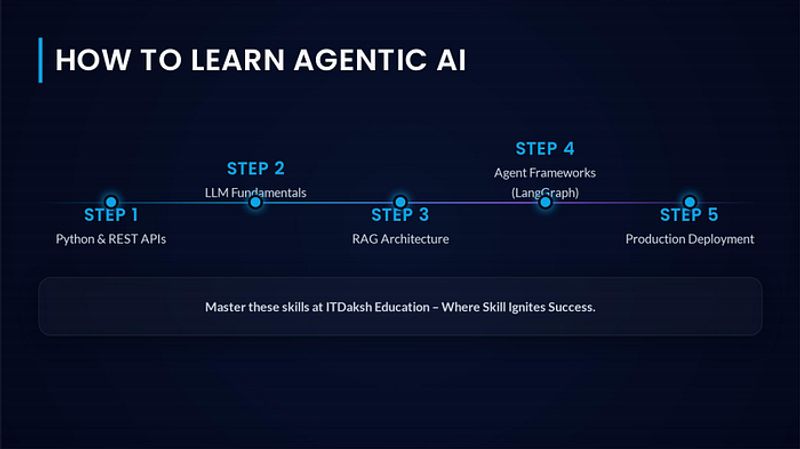
What You Need to Learn Agentic AI A Realistic Prerequisites Map
A layered learning roadmap or pyramid diagram showing the five prerequisite layers for Agentic AI in ascending order — Python (foundation), REST API integration, LLM fundamentals (prompts, context windows, system prompts), RAG architecture (vector embeddings, semantic search, LangChain/LlamaIndex), and Agentic AI development (tools, ReAct pattern, CrewAI, AutoGen, agent evaluation) — with approximate learning time or difficulty indicators at each level.
Agentic AI is not a beginner’s first topic. It builds on a stack of prior knowledge, and understanding where you are in that stack tells you what to learn next.
The foundation is Python. Not advanced Python but comfortable, confident Python. You need to write functions, work with dictionaries and lists, call APIs with the requests library, and read and write files without looking up syntax. If you are not here yet, this is your starting point.
The next layer is API integration understanding how REST APIs work, how to authenticate with an API key, how to send a POST request and handle a JSON response. LLM-based systems are fundamentally API-driven, and every major model (GPT-4o, Claude, Gemini) is accessed through an API.
Above that is LLM fundamentals understanding what a prompt is, how a system prompt differs from a user message, what temperature and token limits mean, and how context windows affect model behaviour. This is the conceptual literacy that lets you reason about why an agent behaves the way it does.
Then comes RAG understanding vector embeddings conceptually, how semantic search differs from keyword search, and how to connect a document store to an LLM using a framework. LangChain and LlamaIndex are the dominant frameworks here.
Agentic AI builds on top of all of this introducing the concept of tools, planning prompts, the ReAct (Reasoning + Acting) pattern, multi-agent orchestration with CrewAI or AutoGen, and agent evaluation. This is the frontier layer where the scarcest skills currently live.
The good news is that this entire stack can be learned in 9 to 12 months with structured, hands-on training. The challenge is that almost no institute in India and none in Thane currently teaches it as an integrated, beginner-to-deployment programme. Itdaksh Education’s Agentic AI & Generative AI with RAG course is built specifically to address this starting from Python basics and progressing through LLM fundamentals, RAG architecture, and full agent development using production-grade frameworks.
Tactical Section: Build Your First Simple AI Agent in Python (Conceptual Walkthrough)
You do not need to be an ML engineer to understand how an agent is built. Here is a conceptual walkthrough of the simplest possible agent architecture a research assistant agent using Python and the OpenAI API.
Step 1 Define the goal and tools. The agent’s goal is to answer a research question using web search. Its tools are: web_search(query) which returns search results, and summarise(text) which summarises a block of text.
Step 2 Write the system prompt. The system prompt tells the LLM its role and the tools available to it. Something like: “You are a research assistant. To answer questions, use the web_search tool to find relevant information, then use summarise to condense it. Continue searching until you have enough information to give a complete answer.”
Step 3 Implement the action loop. In Python, this is a while loop. Each iteration: send the current conversation state to the LLM, receive a response, check if the response contains a tool call, execute the tool with the given arguments, append the result to the conversation history, and loop. Exit when the LLM produces a final answer without a tool call.
Step 4 Handle the output. The final answer is the last non-tool-call response from the LLM. Format and return it.
This four-step structure system prompt, tool definitions, action loop, output handling is the skeleton of every AI agent from the simplest research tool to the most complex multi-agent pipeline. The complexity in production systems comes from adding more tools, more sophisticated planning prompts, memory management, error handling, and multi-agent coordination. But the skeleton remains the same.
Understanding this architecture before writing a single line of framework code is exactly what Itdaksh Education’s Agentic AI curriculum begins with. Frameworks like LangChain are powerful but students who understand the underlying loop use them with far more intentionality than those who follow tutorials without understanding what the abstraction is hiding.
Agentic AI: The Shift in Plain Numbers
A data visualisation or statistics card showing key numbers that quantify the Agentic AI shift — likely including: WEF's 69 million new jobs vs 83 million displaced, NASSCOM's demand figures for LLM and AI agent skills in India, LinkedIn's fastest-growing AI roles data for 2025, and the Data Science parallel (2017 entry vs 2022 entry salary comparison) — presented as a clean infographic with bold numbers and brief labels.
FAQs
Q1: What is Agentic AI in simple terms?
Agentic AI is an AI system that can be given a goal and will independently figure out the steps to achieve it using tools like web search, code execution, and APIs without needing a human to direct every action. Unlike ChatGPT, which responds to one question at a time, an AI agent plans, acts, checks its results, and continues until the task is done.
Q2: What is the difference between Agentic AI and Generative AI?
Generative AI generates content text, images, code when prompted. It is reactive. Agentic AI goes further: it receives a goal, creates a plan, uses tools to execute that plan, evaluates results, and iterates until the goal is met. It is proactive and autonomous. Generative AI is the reasoning engine inside an AI agent but an agent is much more than a Generative AI model alone.
Q3: What is RAG and how does it relate to Agentic AI?
RAG Retrieval Augmented Generation is a technique that gives an LLM access to an external document store before generating a response. Instead of relying only on training data, the model searches relevant documents and uses them as context. In Agentic AI systems, RAG is typically one of the agent’s tools the agent uses retrieval when it needs domain-specific information, alongside other tools like web search and code execution.
Q4: Do I need to know Machine Learning to learn Agentic AI?
No. Agentic AI development in 2026 primarily involves working with pre-trained LLMs through APIs you are using models, not training them. The prerequisite skills are Python programming, API integration, and an understanding of how LLMs work conceptually. Deep machine learning knowledge (neural networks, backpropagation, model training) is a separate specialisation and is not required to build production-grade AI agents.
Q5: Is Agentic AI a good career in India in 2026?
Yes and the timing is favourable in the same way Data Science was favourable in 2017 to 2019. Demand is real and growing. Trained professionals are scarce. Companies in BFSI, IT services, e-commerce, and product development across India are actively building AI agent capabilities. The professionals who enter this space now with genuine, deployment-level skills rather than tutorial familiarity will establish a career position that compounds significantly over 3 to 5 years.
Q6: Which institute in Thane offers an Agentic AI course?
Itdaksh Education is currently the only IT training institute in Thane offering a structured Agentic AI & Generative AI with RAG programme. The course covers Python fundamentals through LLM integration, RAG architecture, and full agent development using LangChain, CrewAI, and the OpenAI Assistants API designed for both freshers with a Python foundation and working IT professionals looking to add AI development to their skill stack.
Agentic AI is AI that plans, acts, and self-corrects to complete a goal not just responds to a question. It is the most significant evolution in practical AI since ChatGPT.
The AGENT Loop Goal → Reason → Act → Observe → Reflect is the architecture that makes AI agentic. Understanding this loop is the foundation of everything in this field.
Generative AI responds. RAG retrieves then responds. Agentic AI plans, uses tools, and executes these are meaningfully different capability levels, not just marketing terms.
Every AI agent has four components: a reasoning engine (LLM), memory, tools, and an action loop. The frameworks (LangChain, CrewAI, AutoGen) are abstractions on top of this skeleton.
The contrarian truth: building an agent that works in a demo is easy. Building one that a business can trust in production requires understanding failure modes, evaluation, and guardrails that depth is what the market pays for.
India’s talent gap in Agentic AI is significant and growing. The professionals who enter now are entering at the Java moment of 2000 early enough to establish a durable career advantage.
Prerequisites in order: Python → REST APIs → LLM fundamentals → RAG → Agentic AI. The full stack is learnable in 9 to 12 months with structured training.
Itdaksh Education is the only IT training institute in Thane currently offering a curriculum that covers this complete stack from Python to full agent deployment.
Free Resources
Download the Free Agentic AI Learning Roadmap the step-by-step path from Python basics to your first deployed AI agent, used by Itdaksh Education’s Agentic AI programme. Includes tool list, framework comparison, and 90-day study plan.
Book a Free Demo: 8591434628 | WhatsApp: wa.me/918591434628
Itdaksh Education 201 Ganesh Tower, Opposite Thane Railway Station, Thane West. ISO 9001:2015 & MSME Certified. Agentic AI & Generative AI with RAG | Data Science | Python Full Stack | Java Full Stack. Rated 4.9/5 on Google.
#what is Agentic AI
#Agentic AI 2026
#Generative AI vs Agentic AI
#LangChain CrewAI AutoGen
#AI agent India
#RAG retrieval augmented generation
#Agentic AI course Thane
#LLM agent development
#AI career India 2026
# Itdaksh Education AI

 Chat to Support