What IT Skills Should You Learn After 12th in Mumbai in 2026?
Stream-specific IT skills guide for 12th students in Mumbai 2026 Python, Data Analytics, Digital Marketing with salary data, degree vs course debate, and a 45-day plan.
Mrityunjay Pandey
· 1 June 2026 ·18 min read
Share:
Contents
Direct Answer:
The most valuable IT skill to learn after 12th in Mumbai depends on your HSC stream: Science students with Mathematics or Computer Science should start with Python Full Stack Development or Data Science; Commerce students should start with Data Analytics or Digital Marketing; and Arts students should start with Digital Marketing, which offers the fastest, most accessible entry into a technology career from a humanities background.
That is the direct answer. But if you read only that sentence and close this article, you will be missing the context that makes the decision actually work for your specific situation. The stream recommendation above is the starting point. The rest of this guide gives you the why, the timeline, the salary, and the specific first steps for each path.
Introduction: Why the Decision You Make in the Next 60 Days Matters More Than You Think
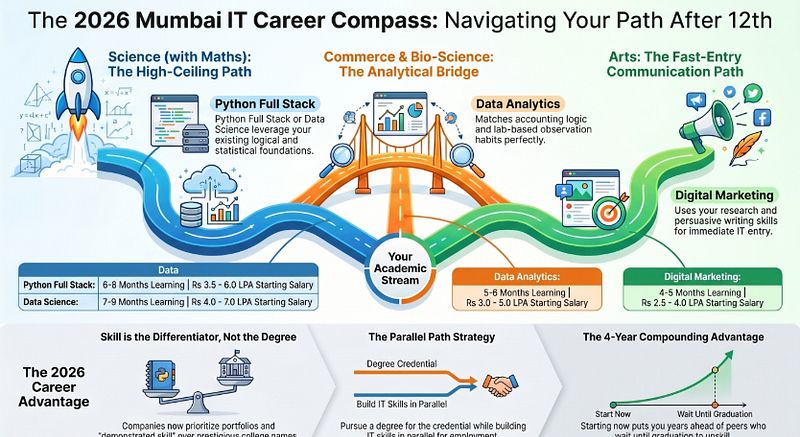
An infographic or conceptual visual making the case that the IT skill decision made after 12th in 2026 carries more career weight than the college admission decision — showing a comparison between two paths: Path A (wait for graduation → start IT skills → enter job market) and Path B (start IT skills after 12th → enter job market 3 to 4 years earlier → compound experience, salary, and increments over time). The visual uses a timeline or trajectory diagram to show the compounding employment advantage of an early start, with salary markers at key career stages.
Most 12th students think the most important decision they will make this year is which college to apply to. In 2026’s job market, that framing is outdated. The college you attend will appear on your resume. The skills you build will determine whether anyone reads the rest of it.
India’s IT industry does not primarily sort candidates by college name at the entry level for most roles outside of elite campus placements at Infosys, TCS, or Wipro. It sorts them by demonstrated skill. According to NASSCOM’s talent development reports, the skills gap in India’s IT market persists not because companies cannot find educated graduates, but because they cannot find graduates who can actually do the work from day one. The degree certificate has become a minimum floor, not a differentiator. What sits above that floor, and what companies actively evaluate in technical rounds, is skill specifically, the ability to write working code, analyse real data, or build an effective digital marketing campaign.
This means a 12th student in Mumbai who chooses the right IT skill in the next 60 days, pursues it with disciplined structured training, and builds a portfolio of real work, enters the job market 3 to 4 years ahead of their peers who are still completing a degree. The compounding advantage of those early years of employment, experience, and salary increments is significant and permanent.
The decision is not whether to do a degree or an IT course. Both can coexist. The decision is what skill to start building now, in parallel with or instead of your degree, that gives you the first employment advantage before your peers have graduated.
The 12th-to-IT Skill Compass Your Stream-Specific Starting Point
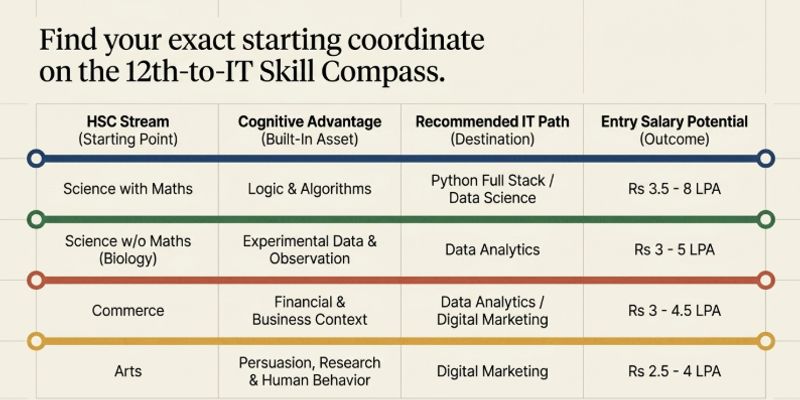
A four-quadrant or four-row compass or mapping table showing the 12th-to-IT Skill Compass — each row representing an HSC stream (Science + Maths/CS, Science without Maths/Biology, Commerce, Arts) mapped to its recommended IT career path, the specific IT skill recommended, the approximate training duration, and the expected entry salary range in Mumbai for 2026. The visual is designed to be scannable in under 30 seconds — a student should be able to find their stream and see their recommended path without reading the surrounding text.
(See the visual framework above)
The 12th-to-IT Skill Compass maps your HSC stream to the IT skill path where your existing academic exposure gives you the most productive head start. This is not about what sounds most impressive. It is about which path gets you to employment fastest with the highest probability of success given where you are starting from.
For HSC Science Students with Mathematics or Computer Science
If you studied Mathematics, Physics, and either Computer Science or Chemistry in your HSC, you are the most technically positioned of the four groups for the highest-ceiling IT careers. Your maths foundation means you can comfortably engage with programming logic, algorithm thinking, and basic statistical reasoning without the conceptual friction that non-maths students experience in the first few weeks of learning.
Python Full Stack Development is the most direct entry point for Science-with-Maths students who want to build software applications. The logical thinking you developed in HSC Maths is the same thinking Python programming requires. The structured approach you used in Physics problem-solving maps directly to how experienced developers approach debugging and system design. A 6 to 8 month Python Full Stack programme covering Python, Django, React, SQL, REST APIs, Git, and deployment takes your existing thinking style and adds the industry-specific toolset that converts it into employment.
Data Science with AI is the second strong option for this group, particularly for students who found Statistics and Mathematics genuinely interesting rather than just manageable. The Data Science track builds on mathematical reasoning and adds Python, machine learning, statistical modelling, data visualisation, and in 2026, Generative AI and Agentic AI integration. This is the higher-ceiling path slower to employment by one to two months but with a starting salary ceiling of Rs 5 to Rs 8 LPA for skilled freshers, compared to Rs 3.5 to Rs 6 LPA for Full Stack developers.
For HSC Science Students Without Mathematics (Biology/Biotech Stream)
If your HSC Science stream was Biology-based without formal Mathematics, the common assumption is that IT careers are largely inaccessible. This assumption is wrong, but the path recommendation is different from the maths stream.
Data Analytics is the most accessible and fastest IT entry path for Biology and Biotech stream students. Your science education has developed a specific cognitive habit: you are comfortable with structured observation, data collection from experiments, comparing results against expected values, and drawing conclusions from evidence. These are analytical thinking habits, and they transfer directly into Data Analytics work. The tools required are SQL, Excel, Power BI, Tableau, and Python basics — none of which require a mathematics foundation beyond what is embedded in your science curriculum. A structured 5 to 6 month Data Analytics programme builds all of these from fundamentals, and biology students consistently find the early SQL and Excel modules intuitive because of their data-handling experience in labs.
Digital Marketing is the second strong option for Biology stream students who are more interested in the communication and business side of technology than the data analysis side. It requires no mathematical foundation whatsoever and leverages the written communication and research skills that any HSC student has developed.
For HSC Commerce Students
Commerce students are the group most consistently underrated in IT career conversations, and the most consistently well-matched to Data Analytics specifically. Your HSC Commerce curriculum has already introduced you to accounts, financial statements, business studies, and basic economics. You have spent two years working with numbers in business context, which is exactly the environment Data Analysts work in.
Data Analytics for Commerce students is not a stretch. It is a natural continuation. SQL feels similar to database-style thinking in accounts. Power BI dashboards are the professional-grade version of the Excel spreadsheets you have worked with in accounts practicals. Business Studies gives you the framework to understand why a metric matters to a company, which is the most underrated skill in analytics and the one that technical graduates often lack. A 5 to 6 month Data Analytics programme for a Commerce student is building on an existing foundation, not starting from zero.
Digital Marketing is the second strong option, particularly for Commerce students from the Business Studies and Economics combination who understand market dynamics, consumer behaviour, and commercial communication. The crossover between commerce thinking and digital marketing strategy is natural and productive.
At Itdaksh Education, a meaningful portion of placed Data Analytics alumni come from Commerce backgrounds. Students who studied BCom or HSC Commerce and completed the Data Analytics programme with disciplined adherence to the Skill Mastery Framework have been placed in analytics and business intelligence roles at companies across Thane and Mumbai’s MMR at salaries ranging from Rs 3 to Rs 4.5 LPA at entry level.
Arts students are the group that most feels excluded from IT careers, and the group where the exclusion is most often a self-imposed belief rather than a market reality. Digital Marketing is the IT career where arts skills are not just acceptable but actively advantageous, and it is the fastest path to IT employment for an arts graduate at any stage.
Your HSC Arts subjects whether English, History, Psychology, Sociology, Economics, or any combination have developed three things that every Digital Marketing professional needs: the ability to write clearly and persuasively, the ability to research and analyse information, and the ability to understand human motivations and behaviour. These are not soft skills that supplement Digital Marketing work. They are core competencies of the role.
The additional technical skills required are learnable without a mathematical or programming background: SEO principles, Google Ads and Meta Ads campaign management, Google Analytics interpretation, Content Marketing strategy, Email Marketing, and AI-assisted content creation. A structured 4 to 5 month Digital Marketing programme covers all of these comprehensively, and arts students who complete it carry a genuine communication advantage over technical candidates who approach marketing from a numbers-only perspective.
The Degree vs IT Skill Course Debate An Honest Answer
(See the comparison framework above)
This is the question that most students and most parents actually want answered, and most career guides are too diplomatic to answer directly. So here is the direct version.
A traditional degree whether B.E., BCA, BCom, or BSc is not worthless. The theoretical foundation of a three or four year programme has real value, and for specific career paths including government IT roles, academic research, and campus placement at tier-1 companies, a degree remains the appropriate path.
For most private sector IT employment in Mumbai’s market in 2026, the employment outcome you get from a structured 6 to 9 month IT skill course is faster, less expensive, and equally respected as the outcome from a three or four year degree without additional skilling. This is not speculation. It is observable in the hiring patterns of mid-market IT companies in Thane, Navi Mumbai, and Mumbai, where the first question in a technical interview is “can you show me your code?” or “can you walk me through your project?” not “where did you get your degree?”
The most practical approach for most 12th students in Mumbai is to do both: pursue a degree for the institutional credential and the four-year foundation, while simultaneously building a specific IT skill through a structured part-time or weekend programme that produces a portfolio and an employment advantage before the degree completes. Itdaksh Education’s programmes are offered in morning, evening, and weekend batches specifically because many students pursue them alongside their undergraduate education. A student who completes their first year of BCom while simultaneously completing a 6-month Data Analytics programme at Itdaksh Education enters their second year of college with a verified skill, a portfolio project, and potentially a part-time or junior analyst role already in hand. This parallel path is the most efficient use of the 18 to 24 months immediately following 12th.
The Three IT Skills with the Best Entry-Level Job Market in Mumbai Right Now
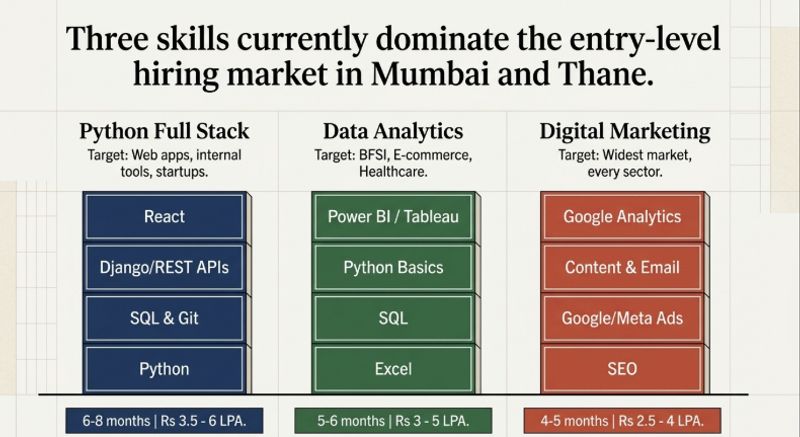
A three-skill comparison card visual showing Python Full Stack Development, Data Analytics, and Digital Marketing side by side — each with the HSC stream best suited to it, the training duration, entry salary range in Mumbai, the primary employment sectors (startup/product for Python, BFSI/e-commerce for Analytics, every sector for Digital Marketing), and a brief statement of the long-term career ceiling. The visual is designed for a student to compare all three and quickly identify the best fit for their background and goals.
If you have read the stream guidance above and still need help prioritising, here are the three specific IT skills with the strongest fresher hiring market in Mumbai and Thane in 2026, with the reasoning for each.
Python Full Stack Development
has the highest job volume among technical fresher roles in Mumbai’s mid-market and startup ecosystem. Companies building web applications, internal tools, and API-driven products need Python developers, and the skill is learnable from zero within 6 to 8 months of structured training. The entry salary range is Rs 3.5 to Rs 6 LPA, and the role provides a direct path to senior developer, technical lead, and eventually system architect positions.
Data Analytics
has the widest accessibility across student backgrounds and consistently strong demand from BFSI, e-commerce, healthcare, and IT services sectors in Mumbai. The tool stack of SQL, Excel, Power BI, and Python basics is learnable from any educational background in 5 to 6 months, and the business-facing nature of the role means strong communicators from non-technical backgrounds perform as well or better than technical graduates who lack business context. Entry salary range is Rs 3 to Rs 5 LPA.
Digital Marketing
has the fastest learning curve among the three and the widest employment market in Mumbai every company, regardless of sector, needs digital marketing capability. The entry salary range is Rs 2.5 to Rs 4 LPA, with strong mid-level growth for specialists in SEO, paid performance marketing, and data-driven campaign management. It is the most accessible IT career for students from any stream, including those with no prior technical exposure whatsoever.
The Contrarian Truth Every 12th Student in Mumbai Should Hear
Here is the uncomfortable insight that most educational counsellors, coaching class owners, and even some parents will not tell you because it contradicts twenty years of conventional advice: the traditional degree-first-career-later sequence is becoming an increasingly expensive and slow way to enter the IT job market in India.
The common assumption is that you must complete your education fully before you can meaningfully participate in the job market. This assumption made sense when skills were primarily learned in educational institutions and when companies hired based on degree credentials. In 2026, skills are learned in structured training programmes that take months, not years, and companies evaluate candidates on demonstrated output code, dashboards, campaigns not on degree certificates.
A 17 or 18 year old in Mumbai who completes HSC and immediately begins a structured 6-month IT skill programme is 18 months ahead of the peer who spends the first year of college figuring out what they want to do and starts upskilling only after graduation. Those 18 months compound into a first year of employment, first annual increment, first project ownership, and first professional reference that the peer simply does not have. By the time the peer graduates, the first student may be 18 months into a real IT career, earning Rs 3.5 to Rs 5 LPA, with a year and a half of domain experience that no college curriculum provides.
This is not an argument against college. It is an argument that the decision about what IT skill to learn, and when to start learning it, does not need to wait for graduation. It needs to happen now.
Tactical Section: Your 45-Day Post-12th IT Skill Plan in Mumbai
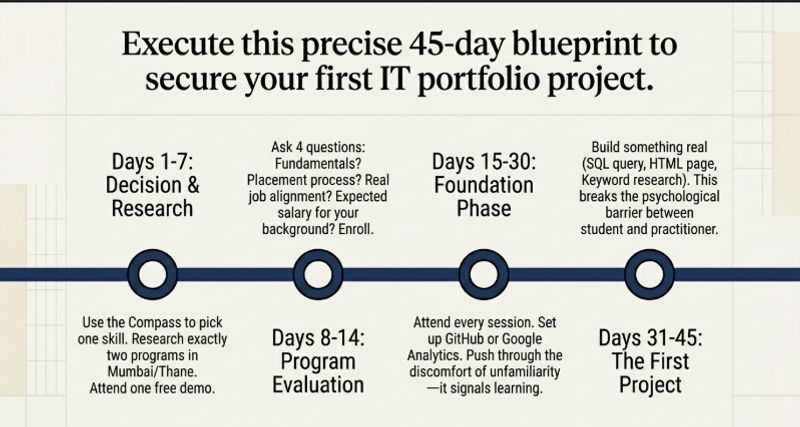
A day-range structured action plan visual showing the 45-day post-HSC IT skill plan — Days 1–7 (stream identification and programme research using the 12th-to-IT Skill Compass, attend free demo), Days 8–14 (programme evaluation with four specific questions, enroll), Days 15–30 (foundation phase start — attend every session, complete every assignment, set up GitHub or Google Analytics account), and Days 31–45 (first project start — working SQL query, functional webpage, or keyword research document). Each phase has a colour-coded label, daily activity description, and a milestone output.
If you have just received your HSC results or are waiting for them, this is your exact 45-day plan. No confusion. Clear daily actions.
Days 1 to 7 Decision and research. Use the 12th-to-IT Skill Compass above to identify your recommended skill path based on your HSC stream. Research two or three structured programmes in Mumbai or Thane for that specific skill. Do not research ten skills and five programme types. Research one skill, two programmes. Attend a free demo session at one of them.
Days 8 to 14 Programme evaluation. At the demo or during a counselling call, ask four specific questions: Does the programme start from absolute fundamentals? What is the exact placement process? Can I see the curriculum against a real job description? What is the typical entry salary of your placed graduates from my background? Evaluate the answers against what you read in this guide. Enroll in the programme that answers all four questions clearly.
Days 15 to 30 Foundation phase start. Begin the programme. Attend every session. Complete every assignment the day it is given. Set up a GitHub account (for developer or data tracks) or a Google Analytics account (for marketing tracks). These will hold your portfolio evidence. The first two weeks of any IT skill programme feel unfamiliar. This is normal. The discomfort of unfamiliarity is not a signal to stop. It is a signal that learning is happening.
Days 31 to 45 First project start. By this point in a structured programme, you will have enough foundation to begin a small first project. Start it. It does not need to be sophisticated. It needs to be real: a working SQL query on a real dataset, a functional HTML/CSS webpage, or a documented keyword research project for a real local business. The first project is the most important one, not because of its quality, but because it breaks the psychological barrier between student and practitioner.
By day 45 you are 45 days into a structured IT skill programme, have a foundational portfolio piece in progress, and are ahead of every peer who is still deciding what to do next. Start today, not after results, not after admission, not after summer break ends.
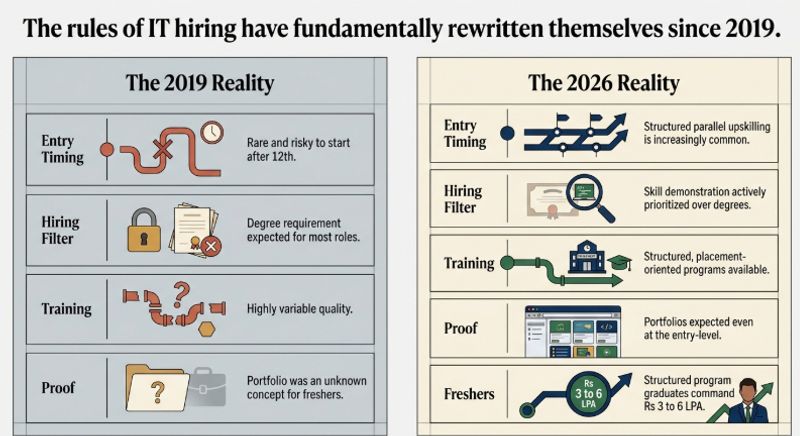
After 12th IT Career: What Changed Between 2019 and 2026
A before-and-after comparison table showing how the IT career landscape for 12th students in Mumbai has shifted between 2019 and 2026 — covering factors such as degree necessity for private sector IT roles (higher vs decreasing for skill-demonstrating candidates), IT course quality (limited vs structured with placement support), non-Maths stream accessibility (narrow vs broad across analytics and marketing), part-time IT course availability alongside college (rare vs standard with multiple batches), portfolio requirement (optional vs near-mandatory), starting salary for skilled freshers (lower vs ₹2.5–6 LPA), and employer evaluation method (degree credential vs demonstrated skill). The table uses a clean two-column 2019 vs 2026 layout
FAQs
Q1: What is the best IT skill to learn after 12th in Mumbai in 2026?
For Science students with Maths, Python Full Stack Development or Data Science offers the strongest long-term trajectory. For Science students without Maths, Commerce students, and Arts students, Data Analytics and Digital Marketing offer the fastest and most accessible paths into IT employment in Mumbai. The best skill for you specifically depends on your HSC stream, your interest, and your employment timeline use the 12th-to-IT Skill Compass in this article to identify your specific recommendation.
Q2: Can I do an IT course after 12th without a degree in Mumbai?
Yes. Multiple IT roles in Mumbai’s private sector IT market including Junior Data Analyst, Digital Marketing Executive, and Junior Web Developer are filled by candidates who have completed structured skill programmes without formal degrees. A degree is beneficial but not mandatory for these roles, particularly in the mid-market company segment in Thane and Navi Mumbai. Employers in this segment evaluate skill demonstration through portfolio projects and technical interview performance, not degree certificates.
Q3: How much can I earn with an IT skill after 12th in Mumbai?
Entry salaries for students who complete structured IT skill programmes after 12th in Mumbai in 2026 range from Rs 2.5 to Rs 3.5 LPA for Digital Marketing roles to Rs 3.5 to Rs 6 LPA for Python Full Stack Development and Data Science roles. The salary is determined by the skill depth, the portfolio quality, and the interview performance, not by the 12th score or the HSC stream.
Q4: Should I do a degree or an IT course after 12th in Mumbai?
The most efficient approach for most students is both simultaneously. Pursue your undergraduate degree for the institutional credential and four-year academic foundation, while completing a structured 5 to 8 month IT skill programme in parallel mornings, evenings, or weekends. This produces both the degree credential and the employment-ready skill without sacrificing either. Itdaksh Education runs multiple batch timings specifically for students who are simultaneously pursuing their undergraduate education.
Q5: What is the first coding skill a 12th student should learn to start an IT career in Mumbai?
Python is the recommended first coding language for any 12th student starting from zero programming experience. Its syntax is the most readable and beginner-friendly of all major programming languages, its ecosystem covers Data Science, Full Stack web development, and AI, and it is the most frequently tested language in IT fresher interviews in Mumbai’s market. A student who becomes genuinely proficient in Python opens doors to multiple IT career tracks without committing to a single path immediately.
Q6: Does Itdaksh Education accept students who have just completed 12th?
Yes. Itdaksh Education’s programmes in Python Full Stack Development, Data Analytics, Data Science with AI, Java Full Stack Development, Digital Marketing, and Agentic AI accept students who have just completed HSC. All programmes start from absolute fundamentals and do not require prior programming or IT knowledge. Multiple batch timings are available to allow students to pursue the programme alongside their first year of undergraduate college. Every student receives a free career counselling session to identify the right programme based on their HSC stream, interest, and employment goal.
The best IT skill to learn after 12th in Mumbai depends on your HSC stream. Science with Maths: Python Full Stack or Data Science. Science without Maths: Data Analytics. Commerce: Data Analytics or Digital Marketing. Arts: Digital Marketing.
The 12th-to-IT Skill Compass provides stream-specific recommendations with timeline and salary outcomes for each path in Mumbai’s 2026 market.
A traditional degree and an IT skill programme are not mutually exclusive. The most efficient approach is to pursue both simultaneously degree for the credential, skill programme for the employment advantage.
The three IT skills with the strongest fresher hiring market in Mumbai in 2026 are Python Full Stack Development, Data Analytics, and Digital Marketing.
Starting an IT skill programme immediately after 12th, rather than waiting for graduation, creates a 3 to 4 year compounding employment advantage over peers who delay.
The first coding language for any 12th student starting from zero is Python. It is the most accessible, most versatile, and most in-demand language across IT’s fastest-growing fields in India.
Portfolio projects replace the experience you do not yet have. Building one real project during the programme is the single highest-impact action for getting shortlisted in IT interviews.
The 45-day post-12th plan in this article turns an overwhelming decision into a concrete sequence of daily actions. The best time to start was the day results came out. The second best time is now.
Free Resources:
Download the Free After-12th IT Career Guide for Mumbai Students the same stream-specific roadmap used by Itdaksh Education’s counsellors to help 12th students choose the right IT skill, the right programme, and the right starting timeline for their background and goal in 2026.
Itdaksh Education 201 Ganesh Tower, Opposite Thane Railway Station, Thane West. ISO 9001:2015 and MSME Certified. Python Full Stack, Data Analytics, Data Science with AI, Digital Marketing, Agentic AI. Morning, Evening, and Weekend Batches Available. Rated 4.9/5 on Google.

 Chat to Support